

Stationary Points of the Nutrients. Algae. and Herbivores Model
247
ji -(u+ V)
Z=
c·
I'
(A6.10)
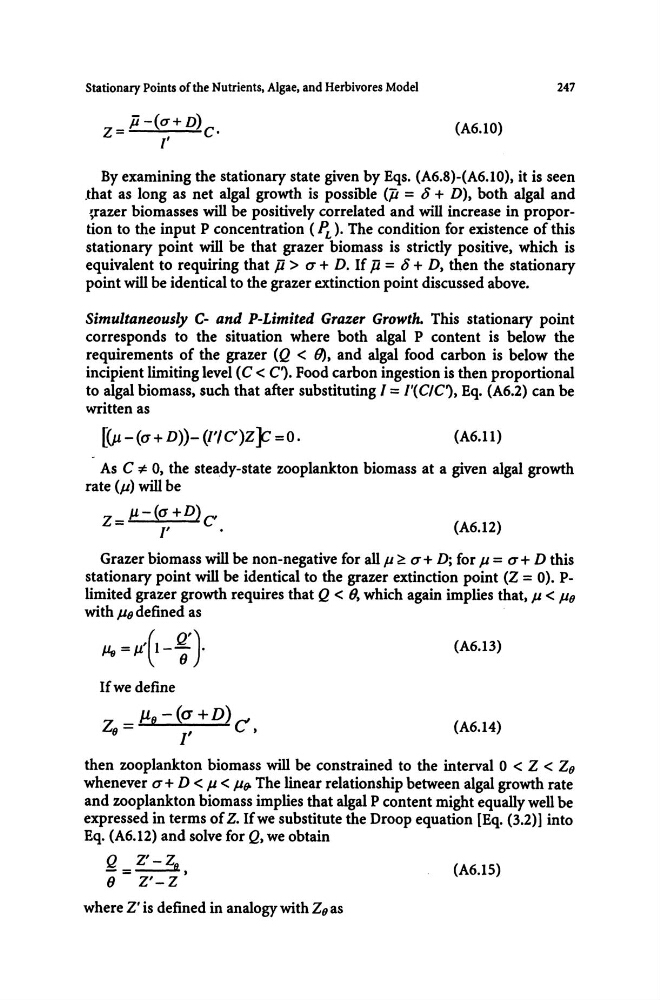
By examining the stationary state given by Eqs. (A6.8)-{A6.10), it is seen
.that as long as net algal growth is possible (p = 8 + D), both algal and
~razer biomasses will be positively correlated and will increase in proportion to the input P concentration (~). The condition for existence of this
stationary point will be that grazer biomass is strictly positive, which is
equivalent to requiring that j1 > u + D. If j1 = 8 + D, then the stationary
point will be identical to the grazer extinction point discussed above.
Simultaneously c- and P-Limited Grazer Growth. This stationary point
corresponds to the situation where both algal P content is below the
requirements of the grazer (Q < 0), and algal food carbon is below the
incipient limiting level {C < C~. Food carbon ingestion is then proportional
to algal biomass, such that after substituting I = 1'(CIC~, Eq. (A6.2) can be
written as
[(.u - (0" + D»)- (I'I C)Z]c = o.
(A6.11)
As C * 0, the steady-state zooplankton biomass at a given algal growth
rate (p) will be
Z= JL-(O" +D) C
I'
(A6.12)
Grazer biomass will be non-negative for all p ~ u+ D; for p = u+ D this
stationary point will be identical to the grazer extinction point (Z = 0). Plimited grazer growth requires that Q < 0, which again implies that, p < Po
with Po defined as
J4 = JL' (I- ~'}
(A6.13)
Ifwe define
(A6.14)
then zooplankton biomass will be constrained to the interval 0 < Z < Zo
whenever u + D < P < P(Jo The linear relationship between algal growth rate
and zooplankton biomass implies that algal P content might equally well be
expressed in terms of Z. Ifwe substitute the Droop equation [Eq. (3.2)] into
Eq. (A6.12) and solve for Q, we obtain
Q Z'-Z
_ = =---:Ji. ,
()
Z' - Z
(A6.15)
where Z' is defined in analogy with Ze as
247
ji -(u+ V)
Z=
c·
I'
(A6.10)
By examining the stationary state given by Eqs. (A6.8)-{A6.10), it is seen
.that as long as net algal growth is possible (p = 8 + D), both algal and
~razer biomasses will be positively correlated and will increase in proportion to the input P concentration (~). The condition for existence of this
stationary point will be that grazer biomass is strictly positive, which is
equivalent to requiring that j1 > u + D. If j1 = 8 + D, then the stationary
point will be identical to the grazer extinction point discussed above.
Simultaneously c- and P-Limited Grazer Growth. This stationary point
corresponds to the situation where both algal P content is below the
requirements of the grazer (Q < 0), and algal food carbon is below the
incipient limiting level {C < C~. Food carbon ingestion is then proportional
to algal biomass, such that after substituting I = 1'(CIC~, Eq. (A6.2) can be
written as
[(.u - (0" + D»)- (I'I C)Z]c = o.
(A6.11)
As C * 0, the steady-state zooplankton biomass at a given algal growth
rate (p) will be
Z= JL-(O" +D) C
I'
(A6.12)
Grazer biomass will be non-negative for all p ~ u+ D; for p = u+ D this
stationary point will be identical to the grazer extinction point (Z = 0). Plimited grazer growth requires that Q < 0, which again implies that, p < Po
with Po defined as
J4 = JL' (I- ~'}
(A6.13)
Ifwe define
(A6.14)
then zooplankton biomass will be constrained to the interval 0 < Z < Zo
whenever u + D < P < P(Jo The linear relationship between algal growth rate
and zooplankton biomass implies that algal P content might equally well be
expressed in terms of Z. Ifwe substitute the Droop equation [Eq. (3.2)] into
Eq. (A6.12) and solve for Q, we obtain
Q Z'-Z
_ = =---:Ji. ,
()
Z' - Z
(A6.15)
where Z' is defined in analogy with Ze as