

The Fate of Zooplankton Egesta: Carbon Cycling and Chaos
201
4~----------------------------------~
~
cU
....
.- - u
b.()
E
I.-J
3
'-" 2
CI)
~
8 o
:D
c:
o
.D
~
U
/
I
i
/
i
I
/
/
i
0~~~~~==~F=====~-----+----~
0.0
0.1
0.2
0.3
0.4
0.5
P loading rate ([Ilg P] liter-) do))
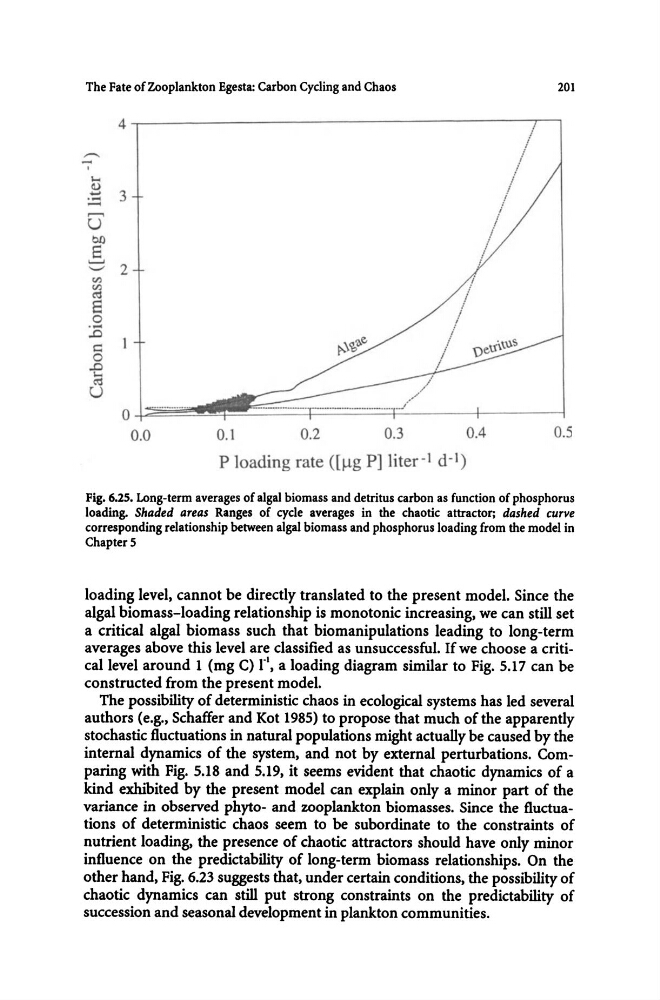
Fig. 6.25. Long-term averages of algal biomass and detritus carbon as function of phosphorus
loading. Shaded areas Ranges of cycle averages in the chaotic attractor; dashed curve
corresponding relationship between algal biomass and phosphorus loading from the model in
Chapter 5
loading level, cannot be directly translated to the present model. Since the
algal biomass-loading relationship is monotonic increasing, we can still set
a critical algal biomass such that biomanipulations leading to long-term
averages above this level are classified as unsuccessful. If we choose a critical level around 1 (mg C) r', a loading diagram similar to Fig. 5.17 can be
constructed from the present model.
The possibility of deterministic chaos in ecological systems has led several
authors (e.g., Schaffer and Kot 1985) to propose that much of the apparently
stochastic fluctuations in natural populations might actually be caused by the
internal dynamics of the system, and not by external perturbations. Comparing with Fig. 5.18 and 5.19, it seems evident that chaotic dynamics of a
kind exhibited by the present model can explain only a minor part of the
variance in observed phyto- and zooplankton biomasses. Since the fluctuations of deterministic chaos seem to be subordinate to the constraints of
nutrient loading, the presence of chaotic attractors should have only minor
influence on the predictability of long-term biomass relationships. On the
other hand, Fig. 6.23 suggests that, under certain conditions, the possibility of
chaotic dynamics can still put strong constraints on the predictability of
succession and seasonal development in plankton communities.
201
4~----------------------------------~
~
cU
....
.- - u
b.()
E
I.-J
3
'-" 2
CI)
~
8 o
:D
c:
o
.D
~
U
/
I
i
/
i
I
/
/
i
0~~~~~==~F=====~-----+----~
0.0
0.1
0.2
0.3
0.4
0.5
P loading rate ([Ilg P] liter-) do))
Fig. 6.25. Long-term averages of algal biomass and detritus carbon as function of phosphorus
loading. Shaded areas Ranges of cycle averages in the chaotic attractor; dashed curve
corresponding relationship between algal biomass and phosphorus loading from the model in
Chapter 5
loading level, cannot be directly translated to the present model. Since the
algal biomass-loading relationship is monotonic increasing, we can still set
a critical algal biomass such that biomanipulations leading to long-term
averages above this level are classified as unsuccessful. If we choose a critical level around 1 (mg C) r', a loading diagram similar to Fig. 5.17 can be
constructed from the present model.
The possibility of deterministic chaos in ecological systems has led several
authors (e.g., Schaffer and Kot 1985) to propose that much of the apparently
stochastic fluctuations in natural populations might actually be caused by the
internal dynamics of the system, and not by external perturbations. Comparing with Fig. 5.18 and 5.19, it seems evident that chaotic dynamics of a
kind exhibited by the present model can explain only a minor part of the
variance in observed phyto- and zooplankton biomasses. Since the fluctuations of deterministic chaos seem to be subordinate to the constraints of
nutrient loading, the presence of chaotic attractors should have only minor
influence on the predictability of long-term biomass relationships. On the
other hand, Fig. 6.23 suggests that, under certain conditions, the possibility of
chaotic dynamics can still put strong constraints on the predictability of
succession and seasonal development in plankton communities.