

188
Approaching Planktonic Food Webs: Competition, Coexistence, and Chaos
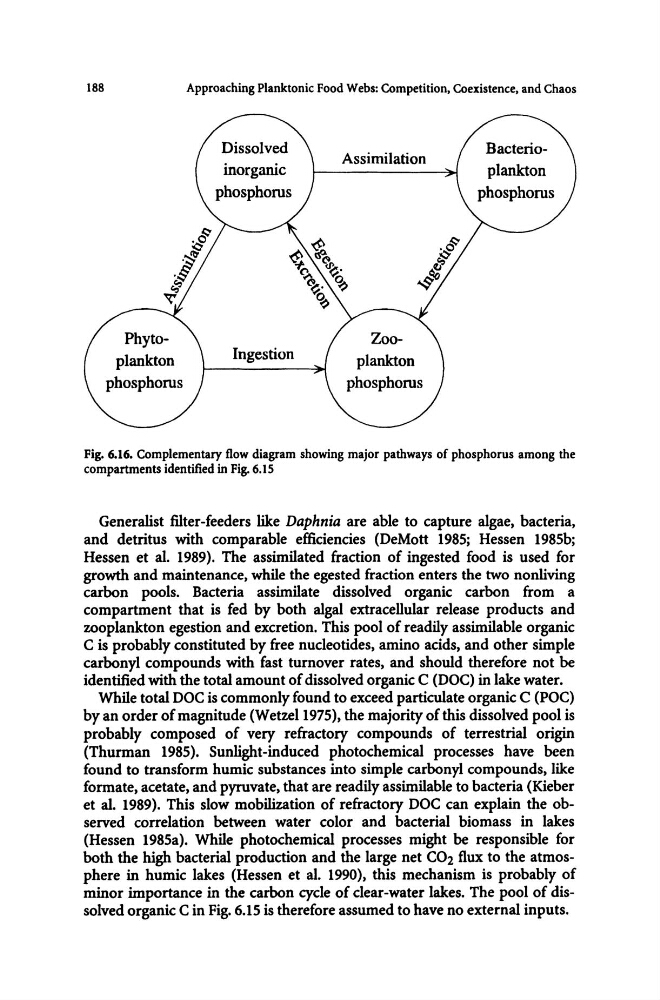
Assimilation
Ingestion
Fig. 6.16. Complementary flow diagram showing major pathways of phosphorus among the
compartments identified in Fig. 6.15
Generalist filter-feeders like Daphnia are able to capture algae, bacteria,
and detritus with comparable efficiencies (DeMott 1985; Hessen 1985b;
Hessen et al. 1989). The assimilated fraction of ingested food is used for
growth and maintenance, while the egested fraction enters the two nonliving
carbon pools. Bacteria assimilate dissolved organic carbon from a
compartment that is fed by both algal extracellular release products and
zooplankton egestion and excretion. This pool of readily assimilable organic
C is probably constituted by free nucleotides, amino acids, and other simple
carbonyl compounds with fast turnover rates, and should therefore not be
identified with the total amount of dissolved organic C (DOC) in lake water.
While total DOC is commonly found to exceed particulate organic C (POC)
by an order of magnitude (Wetzel 1975), the majority of this dissolved pool is
probably composed of very refractory compounds of terrestrial origin
(Thurman 1985). Sunlight-induced photochemical processes have been
found to transform humic substances into simple carbonyl compounds, like
formate, acetate, and pyruvate, that are readily assimilable to bacteria (Kieber
et aI. 1989). This slow mobilization of refractory DOC can explain the observed correlation between water color and bacterial biomass in lakes
(Hessen 1985a). While photochemical processes might be responsible for
both the high bacterial production and the large net C02 flux to the atmosphere in humic lakes (Hessen et al. 1990), this mechanism is probably of
minor importance in the carbon cycle of clear-water lakes. The pool of dissolved organic C in Fig. 6.15 is therefore assumed to have no external inputs.
Approaching Planktonic Food Webs: Competition, Coexistence, and Chaos
Assimilation
Ingestion
Fig. 6.16. Complementary flow diagram showing major pathways of phosphorus among the
compartments identified in Fig. 6.15
Generalist filter-feeders like Daphnia are able to capture algae, bacteria,
and detritus with comparable efficiencies (DeMott 1985; Hessen 1985b;
Hessen et al. 1989). The assimilated fraction of ingested food is used for
growth and maintenance, while the egested fraction enters the two nonliving
carbon pools. Bacteria assimilate dissolved organic carbon from a
compartment that is fed by both algal extracellular release products and
zooplankton egestion and excretion. This pool of readily assimilable organic
C is probably constituted by free nucleotides, amino acids, and other simple
carbonyl compounds with fast turnover rates, and should therefore not be
identified with the total amount of dissolved organic C (DOC) in lake water.
While total DOC is commonly found to exceed particulate organic C (POC)
by an order of magnitude (Wetzel 1975), the majority of this dissolved pool is
probably composed of very refractory compounds of terrestrial origin
(Thurman 1985). Sunlight-induced photochemical processes have been
found to transform humic substances into simple carbonyl compounds, like
formate, acetate, and pyruvate, that are readily assimilable to bacteria (Kieber
et aI. 1989). This slow mobilization of refractory DOC can explain the observed correlation between water color and bacterial biomass in lakes
(Hessen 1985a). While photochemical processes might be responsible for
both the high bacterial production and the large net C02 flux to the atmosphere in humic lakes (Hessen et al. 1990), this mechanism is probably of
minor importance in the carbon cycle of clear-water lakes. The pool of dissolved organic C in Fig. 6.15 is therefore assumed to have no external inputs.