

The Fate of Zooplankton Egesta: Carbon Cycling and Chaos
187
therefore seems likely that a major fraction of bacterial growth must be
supported by other carbon sources, like release of dissolved organic matter
from the consumer levels of the pelagic food web (Azam et al. 1983).
Bacteria have traditionally been assigned the role as decomposers in the
pelagic food web (e.g., Wetzel 1975), although the past decade has seen the
emergence of an alternative view, where the role of bacteria as nutrient
competitors also is emphasized (Azam et a1. 1983; Thingstad 1987). This
view is supported by the observation that bacteria have very high requirements for phosphorus compared to common plankton algae (Vadstein et
a1. 1988), and that bacteria have uptake affinities for P that are at least an
order of magnitude higher than is found in their algal competitors (Currie
and Kalff 1984; Vadstein and Olsen 1989). As pointed out by Bratbak and
Thingstad (1985), this makes the relationship between planktonic algae and
bacteria an ecologically interesting case of competition and commensalism;
bacteria compete with algae for mineral nutrients, but are at the same time
at least partly dependent on their competitors to supply them with organic
carbon skeletons in the form of extracellular release products.
Similar to the minimal representation of the internal phosphorus cycle in
the lower parts of pelagic food webs, presented in Fig. 2.6, we can propose a
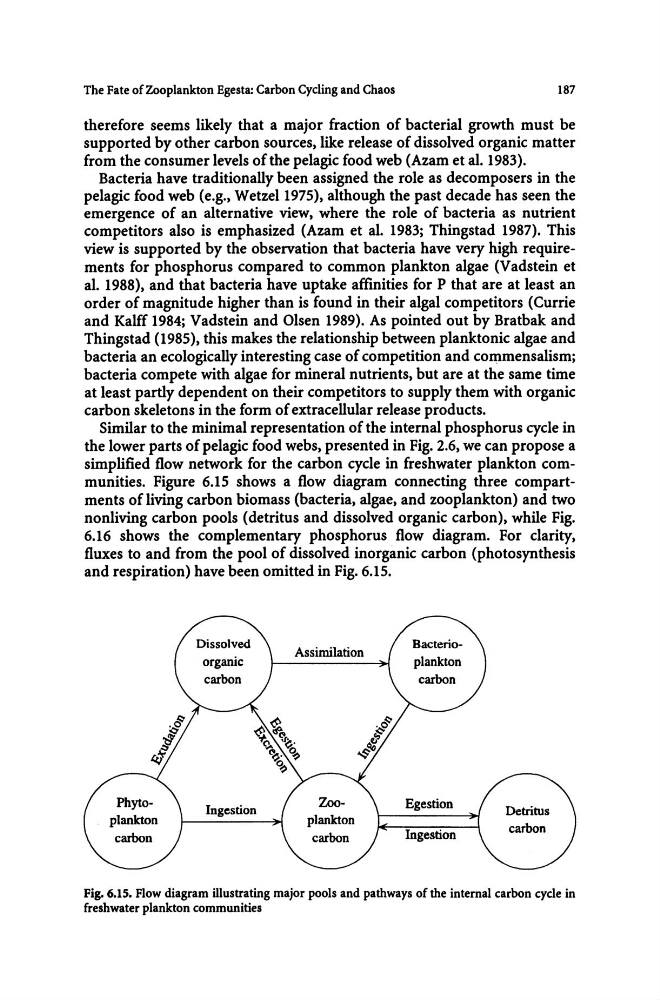
simplified flow network for the carbon cycle in freshwater plankton communities. Figure 6.15 shows a flow diagram connecting three compartments of living carbon biomass (bacteria, algae, and zooplankton) and two
nonliving carbon pools (detritus and dissolved organic carbon), while Fig.
6.16 shows the complementary phosphorus flow diagram. For clarity,
fluxes to and from the pool of dissolved inorganic carbon (photosynthesis
and respiration) have been omitted in Fig. 6.15.
Assimilation
Ingestion
Egestion
Ingestion
Fig. 6.15. Flow diagram illustrating major pools and pathways of the internal carbon cycle in
freshwater plankton communities
187
therefore seems likely that a major fraction of bacterial growth must be
supported by other carbon sources, like release of dissolved organic matter
from the consumer levels of the pelagic food web (Azam et al. 1983).
Bacteria have traditionally been assigned the role as decomposers in the
pelagic food web (e.g., Wetzel 1975), although the past decade has seen the
emergence of an alternative view, where the role of bacteria as nutrient
competitors also is emphasized (Azam et a1. 1983; Thingstad 1987). This
view is supported by the observation that bacteria have very high requirements for phosphorus compared to common plankton algae (Vadstein et
a1. 1988), and that bacteria have uptake affinities for P that are at least an
order of magnitude higher than is found in their algal competitors (Currie
and Kalff 1984; Vadstein and Olsen 1989). As pointed out by Bratbak and
Thingstad (1985), this makes the relationship between planktonic algae and
bacteria an ecologically interesting case of competition and commensalism;
bacteria compete with algae for mineral nutrients, but are at the same time
at least partly dependent on their competitors to supply them with organic
carbon skeletons in the form of extracellular release products.
Similar to the minimal representation of the internal phosphorus cycle in
the lower parts of pelagic food webs, presented in Fig. 2.6, we can propose a
simplified flow network for the carbon cycle in freshwater plankton communities. Figure 6.15 shows a flow diagram connecting three compartments of living carbon biomass (bacteria, algae, and zooplankton) and two
nonliving carbon pools (detritus and dissolved organic carbon), while Fig.
6.16 shows the complementary phosphorus flow diagram. For clarity,
fluxes to and from the pool of dissolved inorganic carbon (photosynthesis
and respiration) have been omitted in Fig. 6.15.
Assimilation
Ingestion
Egestion
Ingestion
Fig. 6.15. Flow diagram illustrating major pools and pathways of the internal carbon cycle in
freshwater plankton communities