

Differential Loss Rates and Invadability of Equilibria
179
thus violating the competitive exclusion principle in the strictest sense. If,
instead, zooplankton grazing leads to N:P supply ratios that diverge from
those of the external supply, as suggested by Sterner (1990), the presence of
grazers would tend to destabilize pairs of phytoplankton species that would
otherwise coexist for certain N:P supply ratios in the absence of grazing. In
order to investigate these two possible outcomes of competition for Nand
P in the presence of grazers, we will need to describe Nand P utilization by
zooplankton at some more detailed levels.
Differential Nand P Recycling. We will assume that grazers maintain an
internal homeostasis leading to constant C:N:P ratios of grazer biomass, as
indicated by the data of Andersen and Hessen (1991). In Section 4.5 it was
shown that observed P release rates would be consistent with the maintenance of a constant animal P:C ratio if grazer growth rate was described by
a piecewise linear function offood P:C ratio [Eq. (4.19)]. Since this growth
model is equivalent to a Liebig-type minimum law, a threshold model
seems to be appropriate for describing grazer growth on a food source that
can be both N- and P-deficient. If, in analogy with Eq. (4.25), we define the
grazer growth rate on N- and P-sufficient food as g' (day"\ then grazer
growth rate (g; day"l) as function of food N - and P-content can be written as
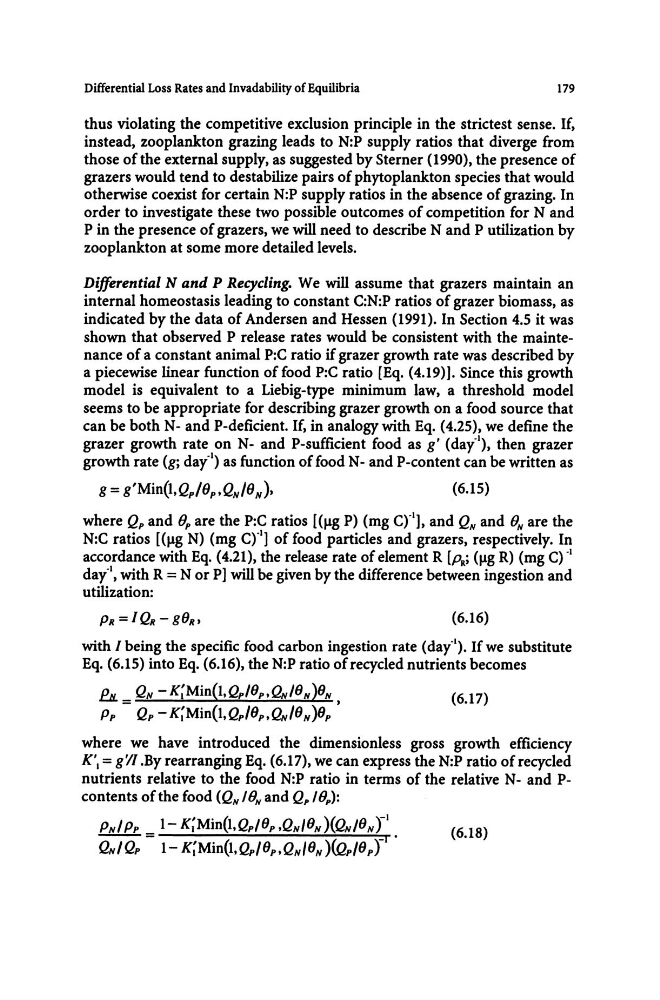
g = g'Min(I,Qp/8p,QN/8N)'
(6.15)
where Qp and Op are the P:C ratios [(~g P) (mg C)"I], and QN and ON are the
N:C ratios [(~g N) (mg Cn of food particles and grazers, respectively. In
accordance with Eq. (4.21), the release rate of element R [A; (~g R) (mg C)"I
day"I, with R = N or P] will be given by the difference between ingestion and
utilization:
(6.16)
with I being the specific food carbon ingestion rate (day"I). If we substitute
Eq. (6.15) into Eq. (6.16), the N:P ratio of recycled nutrients becomes
& = QN -K;Min(1,Qp/8p,QN/ 8 N)8N,
(6.17)
Pp Qp - K;Min(I,Qp/8p,QN/8N)8p
where we have introduced the dimensionless gross growth efficiency
K'I = g'lI.By rearranging Eq. (6.17), we can express the N:P ratio of recycled
nutrients relative to the food N:P ratio in terms of the relative N- and Pcontents of the food (QN ION and QI' 101'):
PN/PP 1- K;Min(1,Qp/8p ,QNI8N )(QN/8Nt
~/Qp = 1- K;Min(1,Qp/8p,QNI8 N )(Qp/8S 1 •
(6.18)
179
thus violating the competitive exclusion principle in the strictest sense. If,
instead, zooplankton grazing leads to N:P supply ratios that diverge from
those of the external supply, as suggested by Sterner (1990), the presence of
grazers would tend to destabilize pairs of phytoplankton species that would
otherwise coexist for certain N:P supply ratios in the absence of grazing. In
order to investigate these two possible outcomes of competition for Nand
P in the presence of grazers, we will need to describe Nand P utilization by
zooplankton at some more detailed levels.
Differential Nand P Recycling. We will assume that grazers maintain an
internal homeostasis leading to constant C:N:P ratios of grazer biomass, as
indicated by the data of Andersen and Hessen (1991). In Section 4.5 it was
shown that observed P release rates would be consistent with the maintenance of a constant animal P:C ratio if grazer growth rate was described by
a piecewise linear function offood P:C ratio [Eq. (4.19)]. Since this growth
model is equivalent to a Liebig-type minimum law, a threshold model
seems to be appropriate for describing grazer growth on a food source that
can be both N- and P-deficient. If, in analogy with Eq. (4.25), we define the
grazer growth rate on N- and P-sufficient food as g' (day"\ then grazer
growth rate (g; day"l) as function of food N - and P-content can be written as
g = g'Min(I,Qp/8p,QN/8N)'
(6.15)
where Qp and Op are the P:C ratios [(~g P) (mg C)"I], and QN and ON are the
N:C ratios [(~g N) (mg Cn of food particles and grazers, respectively. In
accordance with Eq. (4.21), the release rate of element R [A; (~g R) (mg C)"I
day"I, with R = N or P] will be given by the difference between ingestion and
utilization:
(6.16)
with I being the specific food carbon ingestion rate (day"I). If we substitute
Eq. (6.15) into Eq. (6.16), the N:P ratio of recycled nutrients becomes
& = QN -K;Min(1,Qp/8p,QN/ 8 N)8N,
(6.17)
Pp Qp - K;Min(I,Qp/8p,QN/8N)8p
where we have introduced the dimensionless gross growth efficiency
K'I = g'lI.By rearranging Eq. (6.17), we can express the N:P ratio of recycled
nutrients relative to the food N:P ratio in terms of the relative N- and Pcontents of the food (QN ION and QI' 101'):
PN/PP 1- K;Min(1,Qp/8p ,QNI8N )(QN/8Nt
~/Qp = 1- K;Min(1,Qp/8p,QNI8 N )(Qp/8S 1 •
(6.18)