

168
Approaching Planktonic Food Webs: Competition, Coexistence, and Chaos
easily seen that constant" is equivalent to F2 = "F I , or, if we drop the indices,
that FI = F and F2 = " F. The corresponding ingestion rate (/; day"l) on a
mixture of the two species will then be given by
1= .FiC, +F;~ =F(C, +t/>C 2 ).
(6.8)
Vanderploeg et al. (1984) introduced the concept of effective food concentration [C; (mg C) rl], which is the virtual food concentration that controls
the functional response in a grazer feeding selectively on a mixed phytoplankton community. If we require that the effective food concentration (C)
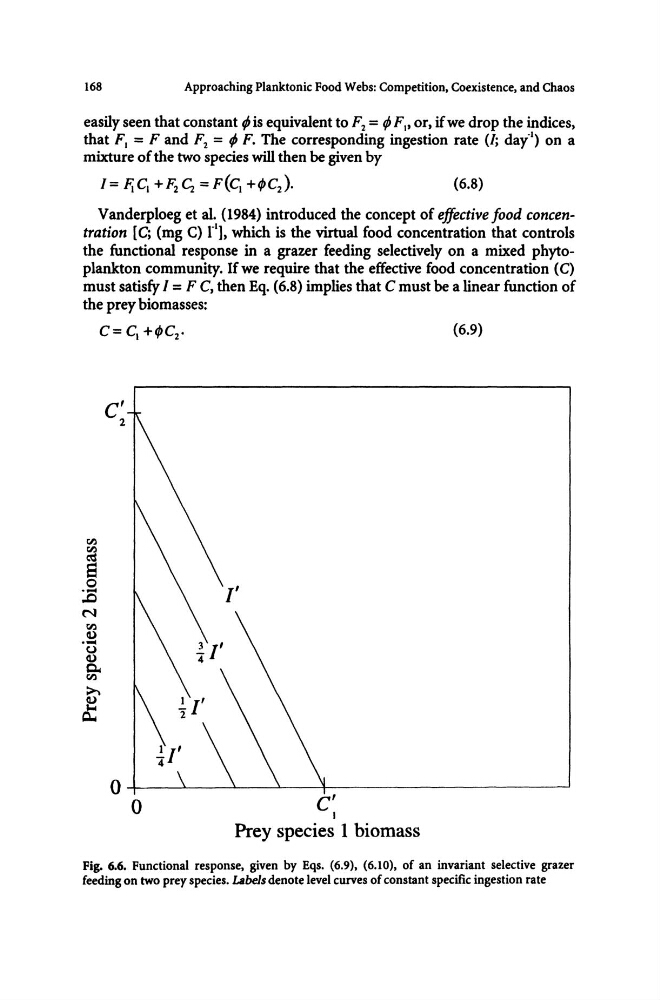
must satisfy 1= F C, then Eq. (6.8) implies that C must be a linear function of
the prey biomasses:
C= C, +t/>C 2 •
(6.9)
c' 2
I'
04---~--~--~--4-------------------~
C'
I
o
Prey species 1 biomass
Fig. 6.6. Functional response, given by Eqs. (6.9), (6.10), of an invariant selective grazer
feeding on two prey species. Label, denote level curves of constant specific ingestion rate
Approaching Planktonic Food Webs: Competition, Coexistence, and Chaos
easily seen that constant" is equivalent to F2 = "F I , or, if we drop the indices,
that FI = F and F2 = " F. The corresponding ingestion rate (/; day"l) on a
mixture of the two species will then be given by
1= .FiC, +F;~ =F(C, +t/>C 2 ).
(6.8)
Vanderploeg et al. (1984) introduced the concept of effective food concentration [C; (mg C) rl], which is the virtual food concentration that controls
the functional response in a grazer feeding selectively on a mixed phytoplankton community. If we require that the effective food concentration (C)
must satisfy 1= F C, then Eq. (6.8) implies that C must be a linear function of
the prey biomasses:
C= C, +t/>C 2 •
(6.9)
c' 2
I'
04---~--~--~--4-------------------~
C'
I
o
Prey species 1 biomass
Fig. 6.6. Functional response, given by Eqs. (6.9), (6.10), of an invariant selective grazer
feeding on two prey species. Label, denote level curves of constant specific ingestion rate