

Differential Loss Rates and Invadability of Equilibria
167
Water quality improvement from food chain manipulations depends on
zooplankton-induced mortality rates being sufficient to match the growth
rates of all species in the phytoplankton community (Gliwicz 1990). Invasion or persistence of grazing-resistant phytoplankton species has been
identified with the failure of several biomanipulation experiments to
produce the anticipated reduction in algal biomass and increase in water
transparency (Lynch 1980b; Benndorf et al. 1984; Jeppesen et. al. 1990).
Since the group of grazing-resistant algae contains several nuisance-bloom
species like colonial cyanobacteria, one can easily imagine situations where
a failed biomanipulation actually would lead to further deterioration of
water quality. One would therefore expect the long-term stability of biomanipulated lake communities to be crucially dependent on the persistence
of a short, efficient food chain structure with high resistance to invasion by
inedible phytoplankton species.
The Mathematics of Selective Feeding. According to the definition of Jacobs
(1974), selective feeding is said to take place when a predator consumes
cooccurring prey species at different rates. In the absence of growth and
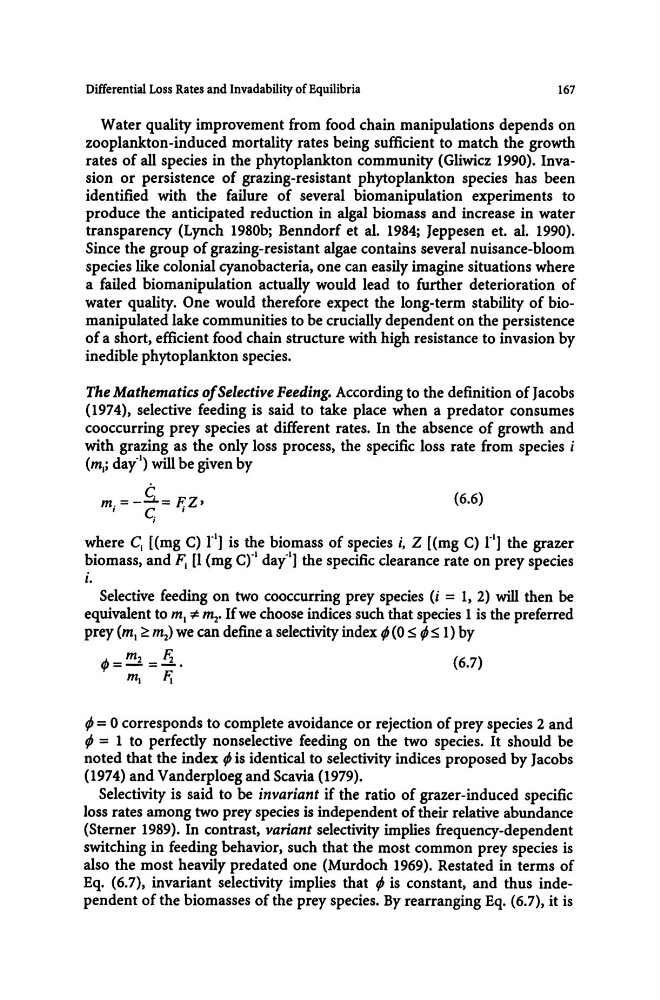
with grazing as the only loss process, the specific loss rate from species i
(m l ; dayl) will be given by
C
m. = _-L.= FZ,
,
C
'
,
(6.6)
where C 1 [(mg C) rl] is the biomass of species i, Z [(mg C) rl] the grazer
biomass, and FI [l (mg ct dayl] the specific clearance rate on prey species
i.
Selective feeding on two cooccurring prey species (i = 1, 2) will then be
equivalent to m. *" m 2 • If we choose indices such that species 1 is the preferred
prey (m. ~ m 2 ) we can define a selectivity index ¢ (0 ::s; ¢::s; 1) by
(6.7)
t/J = 0 corresponds to complete avoidance or rejection of prey species 2 and
¢ = 1 to perfectly nonselective feeding on the two species. It should be
noted that the index ¢ is identical to selectivity indices proposed by Jacobs
(1974) and Vanderploeg and Scavia (1979).
Selectivity is said to be invariant if the ratio of grazer-induced specific
loss rates among two prey species is independent of their relative abundance
(Sterner 1989). In contrast, variant selectivity implies frequency-dependent
switching in feeding behavior, such that the most common prey species is
also the most heavily predated one (Murdoch 1969). Restated in terms of
Eq. (6.7), invariant selectivity implies that ¢ is constant, and thus independent of the biomasses of the prey species. By rearranging Eq. (6.7), it is
167
Water quality improvement from food chain manipulations depends on
zooplankton-induced mortality rates being sufficient to match the growth
rates of all species in the phytoplankton community (Gliwicz 1990). Invasion or persistence of grazing-resistant phytoplankton species has been
identified with the failure of several biomanipulation experiments to
produce the anticipated reduction in algal biomass and increase in water
transparency (Lynch 1980b; Benndorf et al. 1984; Jeppesen et. al. 1990).
Since the group of grazing-resistant algae contains several nuisance-bloom
species like colonial cyanobacteria, one can easily imagine situations where
a failed biomanipulation actually would lead to further deterioration of
water quality. One would therefore expect the long-term stability of biomanipulated lake communities to be crucially dependent on the persistence
of a short, efficient food chain structure with high resistance to invasion by
inedible phytoplankton species.
The Mathematics of Selective Feeding. According to the definition of Jacobs
(1974), selective feeding is said to take place when a predator consumes
cooccurring prey species at different rates. In the absence of growth and
with grazing as the only loss process, the specific loss rate from species i
(m l ; dayl) will be given by
C
m. = _-L.= FZ,
,
C
'
,
(6.6)
where C 1 [(mg C) rl] is the biomass of species i, Z [(mg C) rl] the grazer
biomass, and FI [l (mg ct dayl] the specific clearance rate on prey species
i.
Selective feeding on two cooccurring prey species (i = 1, 2) will then be
equivalent to m. *" m 2 • If we choose indices such that species 1 is the preferred
prey (m. ~ m 2 ) we can define a selectivity index ¢ (0 ::s; ¢::s; 1) by
(6.7)
t/J = 0 corresponds to complete avoidance or rejection of prey species 2 and
¢ = 1 to perfectly nonselective feeding on the two species. It should be
noted that the index ¢ is identical to selectivity indices proposed by Jacobs
(1974) and Vanderploeg and Scavia (1979).
Selectivity is said to be invariant if the ratio of grazer-induced specific
loss rates among two prey species is independent of their relative abundance
(Sterner 1989). In contrast, variant selectivity implies frequency-dependent
switching in feeding behavior, such that the most common prey species is
also the most heavily predated one (Murdoch 1969). Restated in terms of
Eq. (6.7), invariant selectivity implies that ¢ is constant, and thus independent of the biomasses of the prey species. By rearranging Eq. (6.7), it is