

152
....
I
1-0
o
.......
.- - u
OJ)
8
'--'
' - '
Vl
Vl
~
0.1
E o 0.01
:.0
c
o
~
Q. 0.001
o
o
N
Nutrients, Algae and Herbivores - the Paradox of Enrichment Revisited
o
o 0
o
o
I
I I I ,
1- -,--,--,'
1
10
100
Particulate phosphorus ([J.lg P] liter-I)
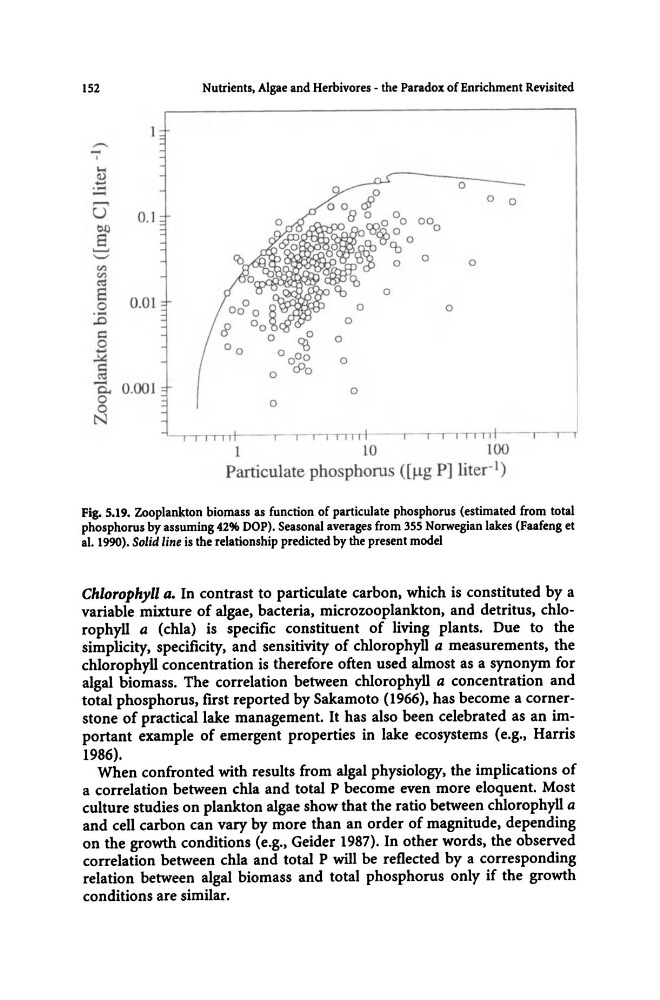
Fig. 5.19. Zooplankton biomass as function of particulate phosphorus (estimated from total
phosphorus by assuming 42% DOP). Seasonal averages from 355 Norwegian lakes (Faafeng et
al. 1990). Solid line is the relationship predicted by the present model
Chlorophyll a. In contrast to particulate carbon, which is constituted by a
variable mixture of algae, bacteria, micro zooplankton, and detritus, chlorophyll a (chla) is specific constituent of living plants. Due to the
simplicity, specificity, and sensitivity of chlorophyll a measurements, the
chlorophyll concentration is therefore often used almost as a synonym for
algal biomass. The correlation between chlorophyll a concentration and
total phosphorus, first reported by Sakamoto (1966), has become a cornerstone of practical lake management. It has also been celebrated as an important example of emergent properties in lake ecosystems (e.g., Harris
1986).
When confronted with results from algal physiology, the implications of
a correlation between chla and total P become even more eloquent. Most
culture studies on plankton algae show that the ratio between chlorophyll a
and cell carbon can vary by more than an order of magnitude, depending
on the growth conditions (e.g., Geider 1987). In other words, the observed
correlation between chla and total P will be reflected by a corresponding
relation between algal biomass and total phosphorus only if the growth
conditions are similar.
....
I
1-0
o
.......
.- - u
OJ)
8
'--'
' - '
Vl
Vl
~
0.1
E o 0.01
:.0
c
o
~
Q. 0.001
o
o
N
Nutrients, Algae and Herbivores - the Paradox of Enrichment Revisited
o
o 0
o
o
I
I I I ,
1- -,--,--,'
1
10
100
Particulate phosphorus ([J.lg P] liter-I)
Fig. 5.19. Zooplankton biomass as function of particulate phosphorus (estimated from total
phosphorus by assuming 42% DOP). Seasonal averages from 355 Norwegian lakes (Faafeng et
al. 1990). Solid line is the relationship predicted by the present model
Chlorophyll a. In contrast to particulate carbon, which is constituted by a
variable mixture of algae, bacteria, micro zooplankton, and detritus, chlorophyll a (chla) is specific constituent of living plants. Due to the
simplicity, specificity, and sensitivity of chlorophyll a measurements, the
chlorophyll concentration is therefore often used almost as a synonym for
algal biomass. The correlation between chlorophyll a concentration and
total phosphorus, first reported by Sakamoto (1966), has become a cornerstone of practical lake management. It has also been celebrated as an important example of emergent properties in lake ecosystems (e.g., Harris
1986).
When confronted with results from algal physiology, the implications of
a correlation between chla and total P become even more eloquent. Most
culture studies on plankton algae show that the ratio between chlorophyll a
and cell carbon can vary by more than an order of magnitude, depending
on the growth conditions (e.g., Geider 1987). In other words, the observed
correlation between chla and total P will be reflected by a corresponding
relation between algal biomass and total phosphorus only if the growth
conditions are similar.