

A Loading Criterion for the Feasibility of Biomanipulation
145
Sensitivity Analysis. While there appears to be no simple analytical expression for the bifurcation level P'L as function of the model parameters, it can
still be determined to arbitrary precision by the numerical procedure outlined in Appendix A9. This means that we also can compute numerical
approximations to the parameter sensitivities of the bifurcation level for a
local region centered at the nominal parameter values (Table 5.1). As the
model parameters differ in both units and in magnitude, it is also here reasonable to work with relative parameter sensitivities, or parameter elasticities (i.e., a relative sensitivity of 1 means that a 1 % increase in a parameter
value increases p' L by 1 %, while a relative sensitivity of -1 means that a 1 %
parameter increase gives a 1% decrease in P·L).
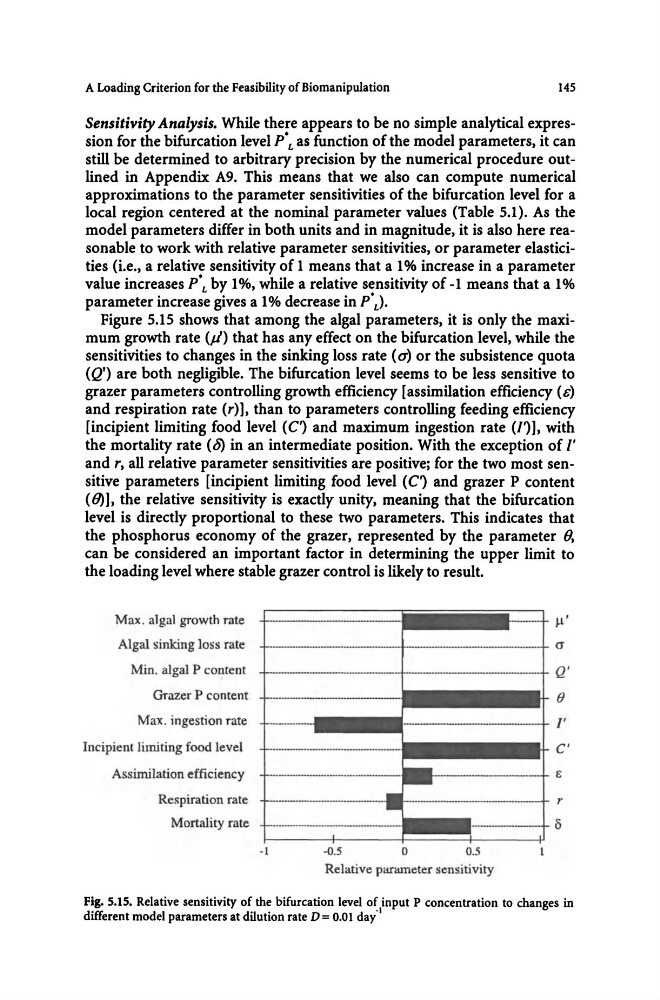
Figure 5.15 shows that among the algal parameters, it is only the maximum growth rate (Ji) that has any effect on the bifurcation level, while the
sensitivities to changes in the sinking loss rate (u) or the subsistence quota
(Q') are both negligible. The bifurcation level seems to be less sensitive to
grazer parameters controlling growth efficiency [assimilation efficiency (&)
and respiration rate (r)), than to parameters controlling feeding efficiency
[incipient limiting food level (C1 and maximum ingestion rate (11), with
the mortality rate (0) in an intermediate position. With the exception of I'
and r, all relative parameter sensitivities are positive; for the two most sensitive parameters [incipient limiting food level (C1 and grazer P content
(8)), the relative sensitivity is exactly unity, meaning that the bifurcation
level is directly proportional to these two parameters. This indicates that
the phosphorus economy of the grazer, represented by the parameter 0,
can be considered an important factor in determining the upper limit to
the loading level where stable grazer control is likely to result.
Max. algal growth rate
Algal sinking loss rate
Min. algal P content
Grazer P content
Max. ingestion rate
Incipient limiting food level
Assimilation efficiency
Respiration rate
Mortality rate
+ --.. ----.---------.--------+------------------------.+ cr
+--------------------------.+-._---_._----------------+ Q'
B
t ------··----- • • • • ---- ---------· · ------t l'
.-r c '
- ---._-----.----------- -.-+ E
+------------.------~.---------------------_r r
- 1
-0.5
o
0.5
Relative parameter sensitivity
Fig. S.lS. Relative sensitivity of the bifurcation level of input P concentration to changes in
different model parameters at dilution rate D = 0.01 day-I
145
Sensitivity Analysis. While there appears to be no simple analytical expression for the bifurcation level P'L as function of the model parameters, it can
still be determined to arbitrary precision by the numerical procedure outlined in Appendix A9. This means that we also can compute numerical
approximations to the parameter sensitivities of the bifurcation level for a
local region centered at the nominal parameter values (Table 5.1). As the
model parameters differ in both units and in magnitude, it is also here reasonable to work with relative parameter sensitivities, or parameter elasticities (i.e., a relative sensitivity of 1 means that a 1 % increase in a parameter
value increases p' L by 1 %, while a relative sensitivity of -1 means that a 1 %
parameter increase gives a 1% decrease in P·L).
Figure 5.15 shows that among the algal parameters, it is only the maximum growth rate (Ji) that has any effect on the bifurcation level, while the
sensitivities to changes in the sinking loss rate (u) or the subsistence quota
(Q') are both negligible. The bifurcation level seems to be less sensitive to
grazer parameters controlling growth efficiency [assimilation efficiency (&)
and respiration rate (r)), than to parameters controlling feeding efficiency
[incipient limiting food level (C1 and maximum ingestion rate (11), with
the mortality rate (0) in an intermediate position. With the exception of I'
and r, all relative parameter sensitivities are positive; for the two most sensitive parameters [incipient limiting food level (C1 and grazer P content
(8)), the relative sensitivity is exactly unity, meaning that the bifurcation
level is directly proportional to these two parameters. This indicates that
the phosphorus economy of the grazer, represented by the parameter 0,
can be considered an important factor in determining the upper limit to
the loading level where stable grazer control is likely to result.
Max. algal growth rate
Algal sinking loss rate
Min. algal P content
Grazer P content
Max. ingestion rate
Incipient limiting food level
Assimilation efficiency
Respiration rate
Mortality rate
+ --.. ----.---------.--------+------------------------.+ cr
+--------------------------.+-._---_._----------------+ Q'
B
t ------··----- • • • • ---- ---------· · ------t l'
.-r c '
- ---._-----.----------- -.-+ E
+------------.------~.---------------------_r r
- 1
-0.5
o
0.5
Relative parameter sensitivity
Fig. S.lS. Relative sensitivity of the bifurcation level of input P concentration to changes in
different model parameters at dilution rate D = 0.01 day-I