

144
1.0
0.8
r::
0
'J:!
r:: 0.6
11)
....
11)
' "'
..r::
c::l..
s: 0.2
0.0
0
Nutrients, Algae and Herbivores - the Paradox of Enrichment Revisited
p*
L
1'---... ..
: ,-"",---------=:
I
- .
I
I
I
I
cr
_ ... __ ._----_._+-----_._--_._--+
I
l~cr
20
40
60
Input P concentration PL ([J.lg P] liter-I)
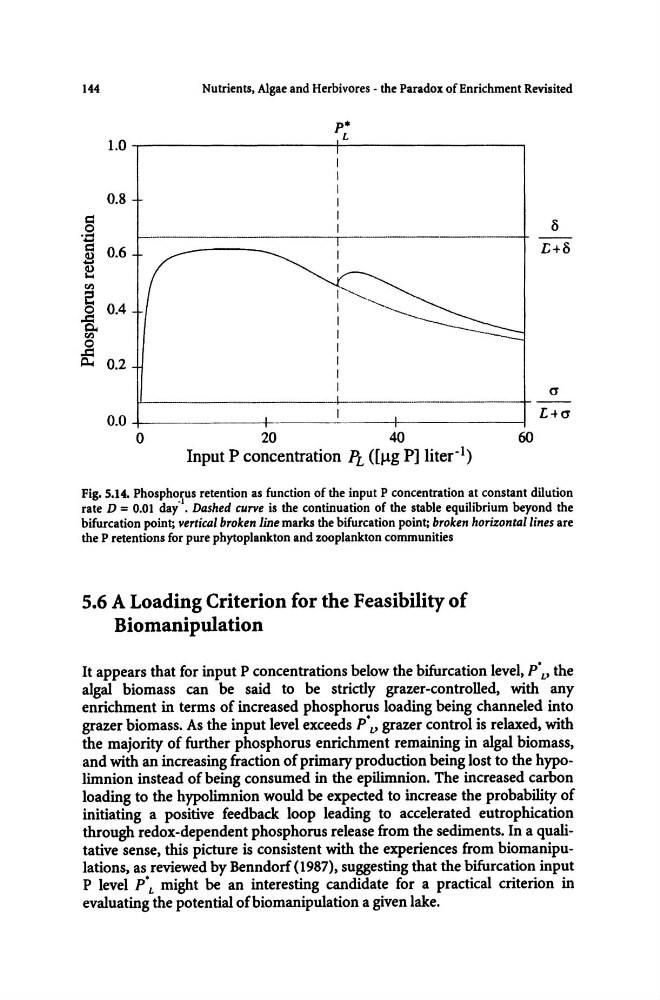
Fig. 5.14. Phosphorus retention as function of the input P concentration at constant dilution
rate D = 0.01 day-I. Dashed curve is the continuation of the stable equilibrium beyond the
bifurcation point; vertical broken line maries the bifurcation point; broken horizontal lines are
the P retentions for pure phytoplankton and zooplankton communities
5.6 A Loading Criterion for the Feasibility of
Biomanipulation
It appears that for input P concentrations below the bifurcation level, pOL' the
algal biomass can be said to be strictly grazer-controlled, with any
enrichment in terms of increased phosphorus loading being channeled into
grazer biomass. As the input level exceeds pOL' grazer control is relaxed, with
the majority of further phosphorus enrichment remaining in algal biomass,
and with an increasing fraction of primary production being lost to the hypolimnion instead of being consumed in the epilimnion. The increased carbon
loading to the hypolimnion would be expected to increase the probability of
initiating a positive feedback loop leading to accelerated eutrophication
through redox-dependent phosphorus release from the sediments. In a qualitative sense, this picture is consistent with the experiences from biomanipulations, as reviewed by Benndorf (1987), suggesting that the bifurcation input
P level pOL might be an interesting candidate for a practical criterion in
evaluating the potential ofbiomanipulation a given lake.
1.0
0.8
r::
0
'J:!
r:: 0.6
11)
....
11)
' "'
..r::
c::l..
s: 0.2
0.0
0
Nutrients, Algae and Herbivores - the Paradox of Enrichment Revisited
p*
L
1'---... ..
: ,-"",---------=:
I
- .
I
I
I
I
cr
_ ... __ ._----_._+-----_._--_._--+
I
l~cr
20
40
60
Input P concentration PL ([J.lg P] liter-I)
Fig. 5.14. Phosphorus retention as function of the input P concentration at constant dilution
rate D = 0.01 day-I. Dashed curve is the continuation of the stable equilibrium beyond the
bifurcation point; vertical broken line maries the bifurcation point; broken horizontal lines are
the P retentions for pure phytoplankton and zooplankton communities
5.6 A Loading Criterion for the Feasibility of
Biomanipulation
It appears that for input P concentrations below the bifurcation level, pOL' the
algal biomass can be said to be strictly grazer-controlled, with any
enrichment in terms of increased phosphorus loading being channeled into
grazer biomass. As the input level exceeds pOL' grazer control is relaxed, with
the majority of further phosphorus enrichment remaining in algal biomass,
and with an increasing fraction of primary production being lost to the hypolimnion instead of being consumed in the epilimnion. The increased carbon
loading to the hypolimnion would be expected to increase the probability of
initiating a positive feedback loop leading to accelerated eutrophication
through redox-dependent phosphorus release from the sediments. In a qualitative sense, this picture is consistent with the experiences from biomanipulations, as reviewed by Benndorf (1987), suggesting that the bifurcation input
P level pOL might be an interesting candidate for a practical criterion in
evaluating the potential ofbiomanipulation a given lake.