

142
Nutrients, Algae and Herbivores - the Paradox of Enrichment Revisited
decreases with increasing P loading when P L < pOL (ef. Fig. 5.11), this effect
on primary production ()lC) is masked by the increase in growth rate, such
that primary production becomes a monotonously increasing function of P
loading (Fig. 5.12). At the internal focus, the equilibrium condition g = 0 + D
means that secondary production (gZ) becomes directly proportional to
steady-state grazer biomass, which is again proportional to algal growth
rate [ef. Eq. (A6.16)].
This common dependency on the algal growth rate explains why both
primary and secondary production follow the same pattern in Fig. 5.12,
indicating that any increase in primary production caused by an increase in
P loading is efficiently channeled into secondary production when PL < pOL.
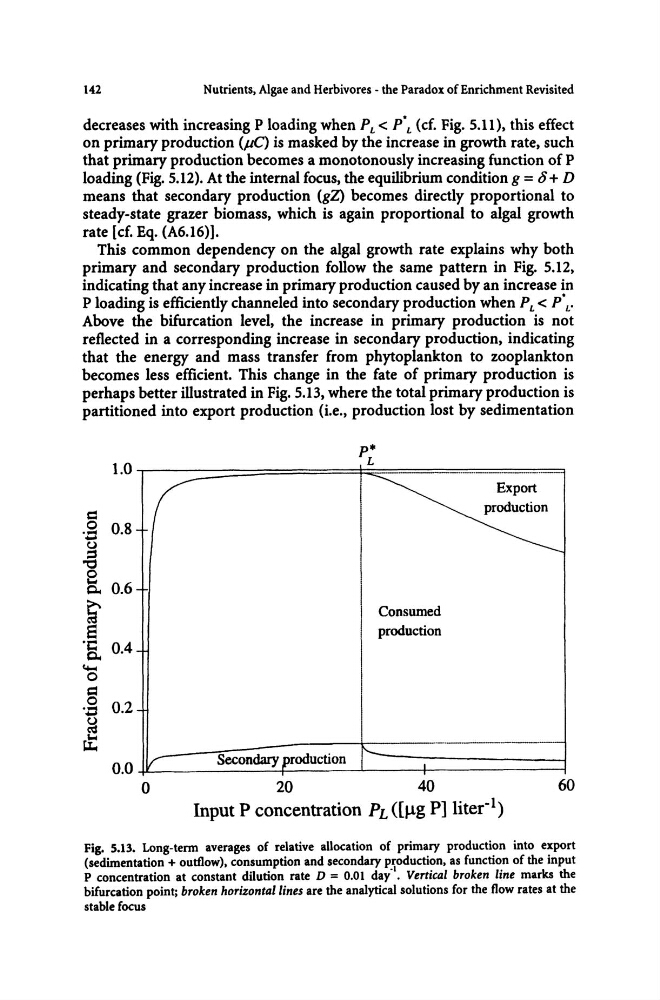
Above the bifurcation level, the increase in primary production is not
reflected in a corresponding increase in secondary production, indicating
that the energy and mass transfer from phytoplankton to zooplankton
becomes less efficient. This change in the fate of primary production is
perhaps better illustrated in Fig. 5.13, where the total primary production is
partitioned into export production (i.e., production lost by sedimentation
1.0
c:
.9 0.8
...
~
0.. 0.6
~
.s. 0.4
'+-<
o
c:
o
.::: 0.2
~
~
0.0
/'
o
p*
L
production
~
Consumed
production
I
I
I
----------_ .. _Secondary production
I'--.
20
40
60
Input P concentration PL ([J.1g P] liter-I)
Fig. 5.13. Long-term averages of relative allocation of primary production into export
(sedimentation + outflow), consumption and secondary production, as function of the input
P concentration at constant dilution rate D = 0.01 day·l. Vertical broken line marks the
bifurcation point; broken horizontal lines are the analytical solutions for the flow rates at the
stable focus
Nutrients, Algae and Herbivores - the Paradox of Enrichment Revisited
decreases with increasing P loading when P L < pOL (ef. Fig. 5.11), this effect
on primary production ()lC) is masked by the increase in growth rate, such
that primary production becomes a monotonously increasing function of P
loading (Fig. 5.12). At the internal focus, the equilibrium condition g = 0 + D
means that secondary production (gZ) becomes directly proportional to
steady-state grazer biomass, which is again proportional to algal growth
rate [ef. Eq. (A6.16)].
This common dependency on the algal growth rate explains why both
primary and secondary production follow the same pattern in Fig. 5.12,
indicating that any increase in primary production caused by an increase in
P loading is efficiently channeled into secondary production when PL < pOL.
Above the bifurcation level, the increase in primary production is not
reflected in a corresponding increase in secondary production, indicating
that the energy and mass transfer from phytoplankton to zooplankton
becomes less efficient. This change in the fate of primary production is
perhaps better illustrated in Fig. 5.13, where the total primary production is
partitioned into export production (i.e., production lost by sedimentation
1.0
c:
.9 0.8
...
~
0.. 0.6
~
.s. 0.4
'+-<
o
c:
o
.::: 0.2
~
~
0.0
/'
o
p*
L
production
~
Consumed
production
I
I
I
----------_ .. _Secondary production
I'--.
20
40
60
Input P concentration PL ([J.1g P] liter-I)
Fig. 5.13. Long-term averages of relative allocation of primary production into export
(sedimentation + outflow), consumption and secondary production, as function of the input
P concentration at constant dilution rate D = 0.01 day·l. Vertical broken line marks the
bifurcation point; broken horizontal lines are the analytical solutions for the flow rates at the
stable focus