

Isoclines and Global Stability
131
involuntary group defence against predation. As increasing yield per unit
nutrient with decreasing growth rate, and other phenotypic adaptations to
nutrient limitation, appear to be common to all phytoplankton algae,
group defence among plankton algae is probably not a result of coevolution. This means that the presence of group defence-like mechanisms in
plankton algae is not dependent on any arguments relying on group selection, and thus not affected by the problem of "cheaters" which is otherwise
likely to turn up in the context of group defence and prey-predator coevolution (e.g., Roughgarden 1979).
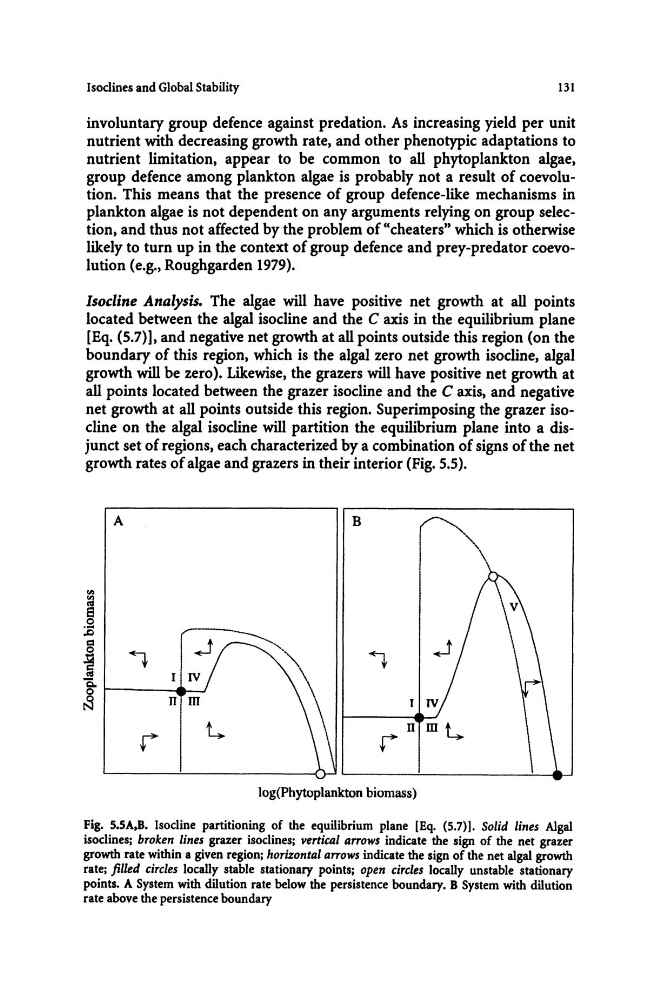
Isocline Analysis. The algae will have positive net growth at all points
located between the algal isocline and the C axis in the equilibrium plane
[Eq. (5.7)], and negative net growth at all points outside this region (on the
boundary of this region, which is the algal zero net growth isocline, algal
growth will be zero). Likewise, the grazers will have positive net growth at
all points located between the grazer isocline and the C axis, and negative
net growth at all points outside this region. Superimposing the grazer isocline on the algal isocline will partition the equilibrium plane into a disjunct set of regions, each characterized by a combination of signs of the net
growth rates of algae and grazers in their interior (Fig. 5.5).
A
B
'" '" ..s
8
0
:E
CI
0
t
~
Q.
I IV
0
~
II m
r
L
log(Phytoplankton biomass)
Fig. 5.5A,B. Isocline partitioning of the equilibrium plane [Eq. (5.7)). Solid lines Algal
isoclines; broken lines grazer isoclines; vertical arrows indicate the sign of the net grazer
growth rate within a given region; horizontal arrows indicate the sign of the net algal growth
rate; filled circles locally stable stationary points; open circles locally unstable stationary
points. A System with dilution rate below the persistence boundary. B System with dilution
rate above the persistence boundary
131
involuntary group defence against predation. As increasing yield per unit
nutrient with decreasing growth rate, and other phenotypic adaptations to
nutrient limitation, appear to be common to all phytoplankton algae,
group defence among plankton algae is probably not a result of coevolution. This means that the presence of group defence-like mechanisms in
plankton algae is not dependent on any arguments relying on group selection, and thus not affected by the problem of "cheaters" which is otherwise
likely to turn up in the context of group defence and prey-predator coevolution (e.g., Roughgarden 1979).
Isocline Analysis. The algae will have positive net growth at all points
located between the algal isocline and the C axis in the equilibrium plane
[Eq. (5.7)], and negative net growth at all points outside this region (on the
boundary of this region, which is the algal zero net growth isocline, algal
growth will be zero). Likewise, the grazers will have positive net growth at
all points located between the grazer isocline and the C axis, and negative
net growth at all points outside this region. Superimposing the grazer isocline on the algal isocline will partition the equilibrium plane into a disjunct set of regions, each characterized by a combination of signs of the net
growth rates of algae and grazers in their interior (Fig. 5.5).
A
B
'" '" ..s
8
0
:E
CI
0
t
~
Q.
I IV
0
~
II m
r
L
log(Phytoplankton biomass)
Fig. 5.5A,B. Isocline partitioning of the equilibrium plane [Eq. (5.7)). Solid lines Algal
isoclines; broken lines grazer isoclines; vertical arrows indicate the sign of the net grazer
growth rate within a given region; horizontal arrows indicate the sign of the net algal growth
rate; filled circles locally stable stationary points; open circles locally unstable stationary
points. A System with dilution rate below the persistence boundary. B System with dilution
rate above the persistence boundary