

130
Nutrients, Algae and Herbivores - the Paradox of Enrichment Revisited
50
rIl
40
~
• ...c
~
30
_
11 Z·~----, ~_-_-_~~_-_-~_--_-_-_-_-_---------~~----~--~-----I
20
!
10
o~----+---~------------------~--~--~~~
c"
C'
log(Phytoplankton biomass)
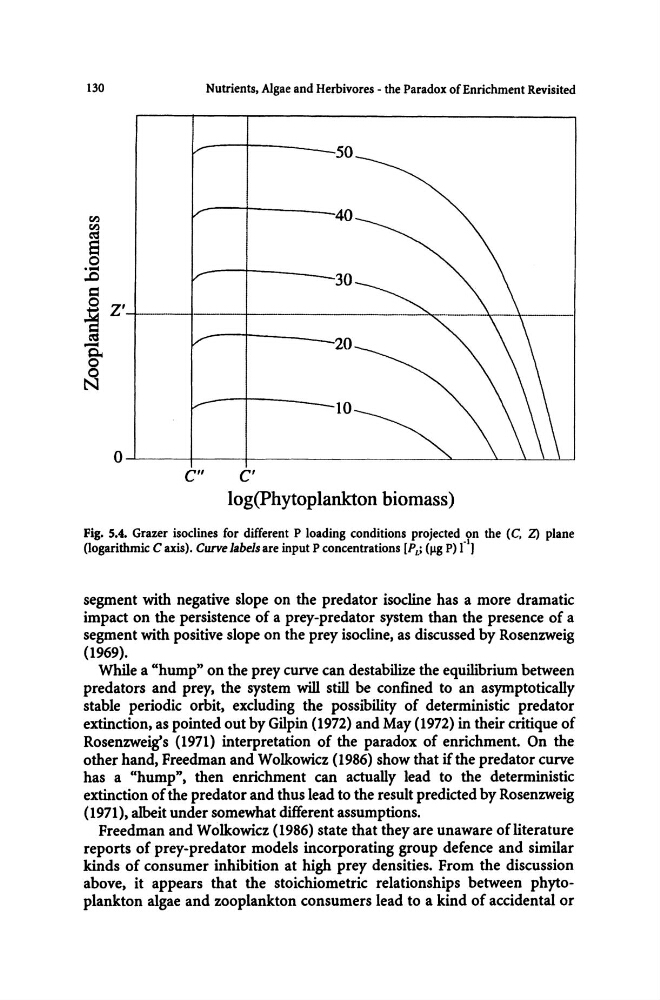
Fig. 5.4. Grazer isoclines for different P loading conditions projected on the (C, Z) plane
(logarithmic C axis). Curve labels are input P concentrations [P,; (1'8 P) rlJ
segment with negative slope on the predator isocline has a more dramatic
impact on the persistence of a prey-predator system than the presence of a
segment with positive slope on the prey isocline, as discussed by Rosenzweig
(1969).
While a "hump" on the prey curve can destabilize the equilibrium between
predators and prey, the system will still be confined to an asymptotically
stable periodic orbit, excluding the possibility of deterministic predator
extinction, as pointed out by Gilpin (1972) and May (1972) in their critique of
Rosenzweig's (1971) interpretation of the paradox of enrichment. On the
other hand, Freedman and Wolkowicz (1986) show that if the predator curve
has a "hump", then enrichment can actually lead to the deterministic
extinction of the predator and thus lead to the result predicted by Rosenzweig
(1971), albeit under somewhat different assumptions.
Freedman and Wolkowicz (1986) state that they are unaware of literature
reports of prey-predator models incorporating group defence and similar
kinds of consumer inhibition at high prey densities. From the discussion
above, it appears that the stoichiometric relationships between phytoplankton algae and zooplankton consumers lead to a kind of accidental or
Nutrients, Algae and Herbivores - the Paradox of Enrichment Revisited
50
rIl
40
~
• ...c
~
30
_
11 Z·~----, ~_-_-_~~_-_-~_--_-_-_-_-_---------~~----~--~-----I
20
!
10
o~----+---~------------------~--~--~~~
c"
C'
log(Phytoplankton biomass)
Fig. 5.4. Grazer isoclines for different P loading conditions projected on the (C, Z) plane
(logarithmic C axis). Curve labels are input P concentrations [P,; (1'8 P) rlJ
segment with negative slope on the predator isocline has a more dramatic
impact on the persistence of a prey-predator system than the presence of a
segment with positive slope on the prey isocline, as discussed by Rosenzweig
(1969).
While a "hump" on the prey curve can destabilize the equilibrium between
predators and prey, the system will still be confined to an asymptotically
stable periodic orbit, excluding the possibility of deterministic predator
extinction, as pointed out by Gilpin (1972) and May (1972) in their critique of
Rosenzweig's (1971) interpretation of the paradox of enrichment. On the
other hand, Freedman and Wolkowicz (1986) show that if the predator curve
has a "hump", then enrichment can actually lead to the deterministic
extinction of the predator and thus lead to the result predicted by Rosenzweig
(1971), albeit under somewhat different assumptions.
Freedman and Wolkowicz (1986) state that they are unaware of literature
reports of prey-predator models incorporating group defence and similar
kinds of consumer inhibition at high prey densities. From the discussion
above, it appears that the stoichiometric relationships between phytoplankton algae and zooplankton consumers lead to a kind of accidental or