

98
Herbivores and Algae: Food Utilization, Growth and Reproduction ...
mortality rate from the lack of some maternally supplied, essential material. If the fraction of aberrant eggs is denoted by a, the composite survival
function lex) of these two subpopulations can be written as
i(x)= a l'(x) + (l-a)l(x),
(4.29)
with rex) and I(x) being the survival functions of individuals developing
from aberrant and normal eggs, respectively. If we assume that individuals
developing from aberrant eggs have a constant mortality rate TJ' (day"\
while the rest of the cohort have the survival function [Eq. (4.28)], then Eq.
(4.29) can be written as
i(x)= a exp{-l7' x)+(I-a)exp(-1110 x' (1- (1-xlx'Y) (4.30)
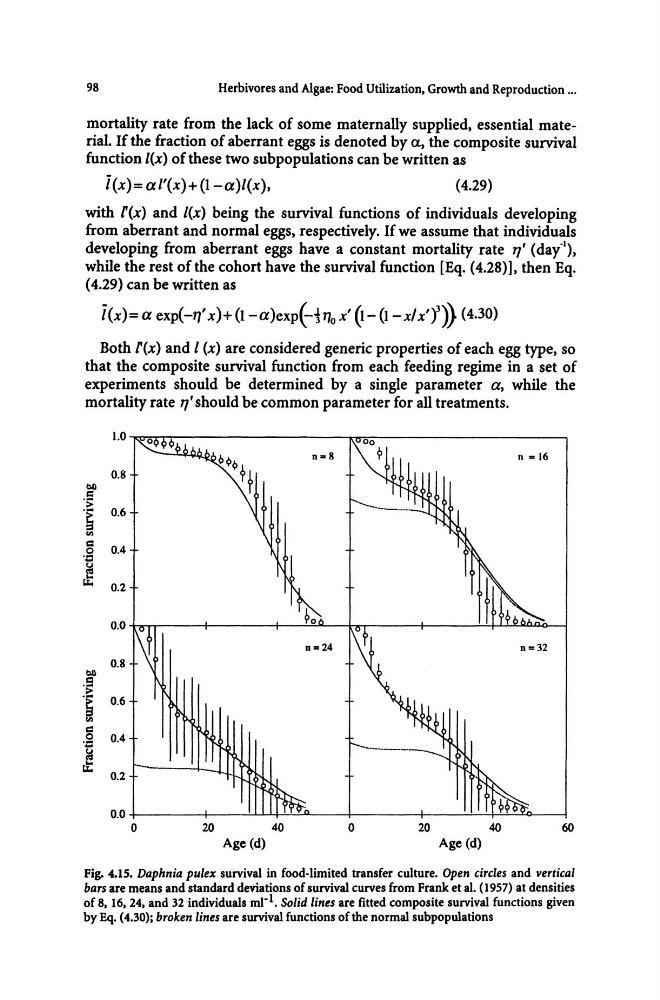
Both rex) and I (x) are considered generic properties of each egg type, so
that the composite survival function from each feeding regime in a set of
experiments should be determined by a single parameter a, while the
mortality rate TJ' should be common parameter for all treatments.
1.0
n=8
n = 16
0.8
1>0
=
.s;:
.~ 0.6
U)
= 0.4
0
.~
...
£ 0.2
0.0
n=32
0.8
1>0
=
.s;:
.~
U)
0.6
= 0 0.4
.~
~
It 0.2
0.0
0
20
40
o
20
40
60
Age (d)
Age (d)
Fig. 4.15. Daphnia pulex survival in food-limited transfer culture. Open circles and vertical
bars are means and standard deviations of survival curves from Frank et al. (1957) at densities
of 8, 16, 24, and 32 individuals mrl. Solid lines are fitted composite survival functions given
by Eq. (4.30); broken lines are survival functions of the normal subpopulations
Herbivores and Algae: Food Utilization, Growth and Reproduction ...
mortality rate from the lack of some maternally supplied, essential material. If the fraction of aberrant eggs is denoted by a, the composite survival
function lex) of these two subpopulations can be written as
i(x)= a l'(x) + (l-a)l(x),
(4.29)
with rex) and I(x) being the survival functions of individuals developing
from aberrant and normal eggs, respectively. If we assume that individuals
developing from aberrant eggs have a constant mortality rate TJ' (day"\
while the rest of the cohort have the survival function [Eq. (4.28)], then Eq.
(4.29) can be written as
i(x)= a exp{-l7' x)+(I-a)exp(-1110 x' (1- (1-xlx'Y) (4.30)
Both rex) and I (x) are considered generic properties of each egg type, so
that the composite survival function from each feeding regime in a set of
experiments should be determined by a single parameter a, while the
mortality rate TJ' should be common parameter for all treatments.
1.0
n=8
n = 16
0.8
1>0
=
.s;:
.~ 0.6
U)
= 0.4
0
.~
...
£ 0.2
0.0
n=32
0.8
1>0
=
.s;:
.~
U)
0.6
= 0 0.4
.~
~
It 0.2
0.0
0
20
40
o
20
40
60
Age (d)
Age (d)
Fig. 4.15. Daphnia pulex survival in food-limited transfer culture. Open circles and vertical
bars are means and standard deviations of survival curves from Frank et al. (1957) at densities
of 8, 16, 24, and 32 individuals mrl. Solid lines are fitted composite survival functions given
by Eq. (4.30); broken lines are survival functions of the normal subpopulations