

The Economy of Essential Elements
91
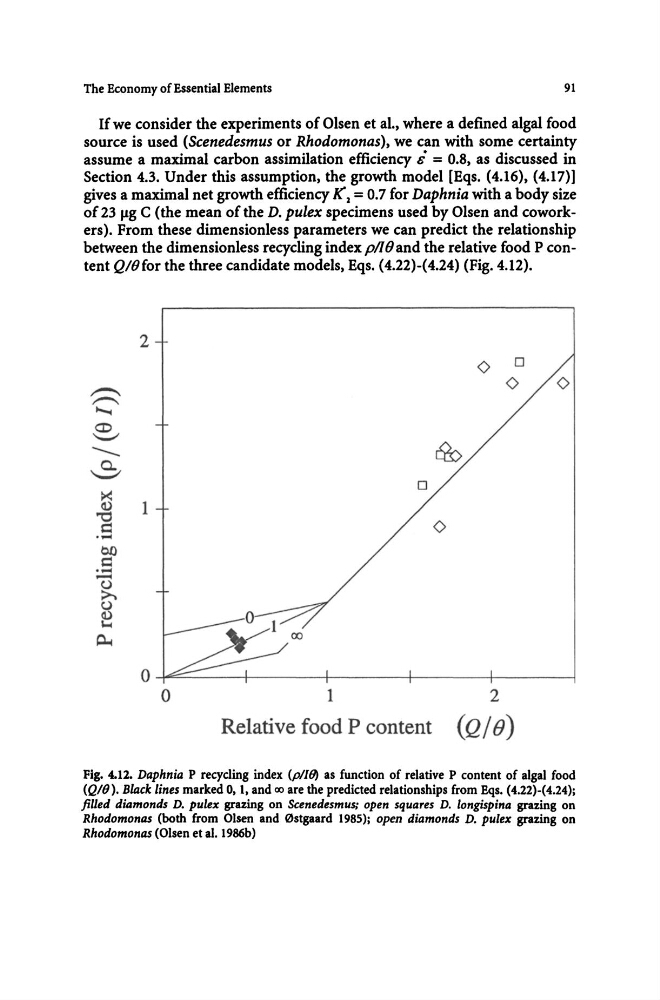
If we consider the experiments of Olsen et al., where a defmed algal food
source is used (Scenedesmus or Rhodomonas), we can with some certainty
assume a maximal carbon assimilation efficiency s· = 0.8, as discussed in
Section 4.3. Under this assumption, the growth model [Eqs. (4.16), (4.17)]
gives a maximal net growth efficiency /(J = 0.7 for Daphnia with a body size
of 23 Ilg C (the mean of the D. pulex specimens used by Olsen and coworkers). From these dimensionless parameters we can predict the relationship
between the dimensionless recycling index pH 8 and the relative food P content QI8for the three candidate models, Eqs. (4.22)-(4.24) (Fig. 4.12).
2
--.. ,-..
~
e
--~
~
Q)
1
"0
C
....
CO
C
~
u
>.
u
Q)
~
~
0
0
o
1
2
o
o
Relative food P content (Q/ B)
o
Fig. 4.12. Daphnia P recycling index (plIO) as function of relative P content of algal food
(QIO). Black lines marked 0, I, and 00 are the predicted relationships from Eqs. (4.22)-(4.24);
filled diamonds D. pulex grazing on Scenedesmus; open squares D. longispina grazing on
Rhodomonas (both from Olsen and 0stgaard 1985); open diamonds D. pulex grazing on
Rhodomonas (Olsen et al. 1986b)
91
If we consider the experiments of Olsen et al., where a defmed algal food
source is used (Scenedesmus or Rhodomonas), we can with some certainty
assume a maximal carbon assimilation efficiency s· = 0.8, as discussed in
Section 4.3. Under this assumption, the growth model [Eqs. (4.16), (4.17)]
gives a maximal net growth efficiency /(J = 0.7 for Daphnia with a body size
of 23 Ilg C (the mean of the D. pulex specimens used by Olsen and coworkers). From these dimensionless parameters we can predict the relationship
between the dimensionless recycling index pH 8 and the relative food P content QI8for the three candidate models, Eqs. (4.22)-(4.24) (Fig. 4.12).
2
--.. ,-..
~
e
--~
~
Q)
1
"0
C
....
CO
C
~
u
>.
u
Q)
~
~
0
0
o
1
2
o
o
Relative food P content (Q/ B)
o
Fig. 4.12. Daphnia P recycling index (plIO) as function of relative P content of algal food
(QIO). Black lines marked 0, I, and 00 are the predicted relationships from Eqs. (4.22)-(4.24);
filled diamonds D. pulex grazing on Scenedesmus; open squares D. longispina grazing on
Rhodomonas (both from Olsen and 0stgaard 1985); open diamonds D. pulex grazing on
Rhodomonas (Olsen et al. 1986b)