

m
-2 , being highest on the farthest site from the coast. They argued that the lower
densities were probably the result of the high sedimentation, producing a negative
effect on the diversity of echinoderms and on the development of coral reefs
(Alvarado and Fernández 2005; Alvarado et al. 2009).
In Cocos Island, Costa Rica, Alvarado and Chiriboga (2008) reported the presence of 28 species of echinoderms (seven species of asteroids, six species of
ophiuroids, nine species of echinoids and six species of holothuroids) located
between 3 and 18 m deep at 18 sites around the Island. The sea urchin D. mexicanum
was the only echinoderm present at all sites and depths studied, and provided a
density between 0.05 and 6.53 ind m
-2 .
For the Pacific side of Nicaragua, on the Rivas Department, Alvarado et al.
(2011) reported the presence of 11 species of echinoderms (one species of asteroid,
six species of echinoids, and four species of holothuroids). The sea urchin
D. mexicanum was present in nine of the ten study sites, with a density between
0.04 and 1.10 ind m
-2 , while Echinometra vanbrunti had the highest density (4.09
ind m
-2 ) of all echinoderms studied.
Carballo-Bolaños and Pocasangre-Orellana (2007) describe the echinoderm
intertidal fauna to a depth of 2 m in the Los Cobanos rocky reefs system, a natural
protected area in El Salvador. They reported the presence of 13 echinoderms
species (five species of ophiuroids, two species of echinoids and six species of
holothuroids). The ophiuroids were the most abundant group with 1,771 individuals at the study sites, and followed by the sea cucumbers with 877 individuals,
while there were only 22 individuals of Echinometra vanbrunti and Astropyga
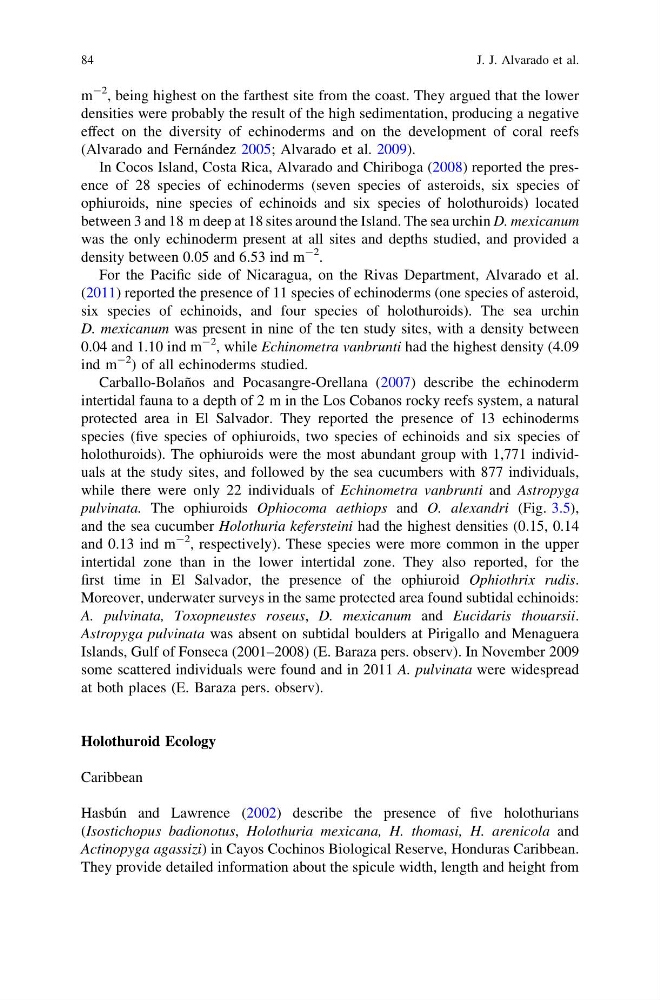
pulvinata. The ophiuroids Ophiocoma aethiops and O. alexandri (Fig. 3.5),
and the sea cucumber Holothuria kefersteini had the highest densities (0.15, 0.14
and 0.13 ind m
-2 , respectively). These species were more common in the upper
intertidal zone than in the lower intertidal zone. They also reported, for the
first time in El Salvador, the presence of the ophiuroid Ophiothrix rudis.
Moreover, underwater surveys in the same protected area found subtidal echinoids:
A. pulvinata, Toxopneustes roseus, D. mexicanum and Eucidaris thouarsii.
Astropyga pulvinata was absent on subtidal boulders at Pirigallo and Menaguera
Islands, Gulf of Fonseca (2001–2008) (E. Baraza pers. observ). In November 2009
some scattered individuals were found and in 2011 A. pulvinata were widespread
at both places (E. Baraza pers. observ).
Holothuroid Ecology
Caribbean
Hasbún and Lawrence (2002) describe the presence of five holothurians
(Isostichopus badionotus, Holothuria mexicana, H. thomasi, H. arenicola and
Actinopyga agassizi) in Cayos Cochinos Biological Reserve, Honduras Caribbean.
They provide detailed information about the spicule width, length and height from
84
J. J. Alvarado et al.
-2 , being highest on the farthest site from the coast. They argued that the lower
densities were probably the result of the high sedimentation, producing a negative
effect on the diversity of echinoderms and on the development of coral reefs
(Alvarado and Fernández 2005; Alvarado et al. 2009).
In Cocos Island, Costa Rica, Alvarado and Chiriboga (2008) reported the presence of 28 species of echinoderms (seven species of asteroids, six species of
ophiuroids, nine species of echinoids and six species of holothuroids) located
between 3 and 18 m deep at 18 sites around the Island. The sea urchin D. mexicanum
was the only echinoderm present at all sites and depths studied, and provided a
density between 0.05 and 6.53 ind m
-2 .
For the Pacific side of Nicaragua, on the Rivas Department, Alvarado et al.
(2011) reported the presence of 11 species of echinoderms (one species of asteroid,
six species of echinoids, and four species of holothuroids). The sea urchin
D. mexicanum was present in nine of the ten study sites, with a density between
0.04 and 1.10 ind m
-2 , while Echinometra vanbrunti had the highest density (4.09
ind m
-2 ) of all echinoderms studied.
Carballo-Bolaños and Pocasangre-Orellana (2007) describe the echinoderm
intertidal fauna to a depth of 2 m in the Los Cobanos rocky reefs system, a natural
protected area in El Salvador. They reported the presence of 13 echinoderms
species (five species of ophiuroids, two species of echinoids and six species of
holothuroids). The ophiuroids were the most abundant group with 1,771 individuals at the study sites, and followed by the sea cucumbers with 877 individuals,
while there were only 22 individuals of Echinometra vanbrunti and Astropyga
pulvinata. The ophiuroids Ophiocoma aethiops and O. alexandri (Fig. 3.5),
and the sea cucumber Holothuria kefersteini had the highest densities (0.15, 0.14
and 0.13 ind m
-2 , respectively). These species were more common in the upper
intertidal zone than in the lower intertidal zone. They also reported, for the
first time in El Salvador, the presence of the ophiuroid Ophiothrix rudis.
Moreover, underwater surveys in the same protected area found subtidal echinoids:
A. pulvinata, Toxopneustes roseus, D. mexicanum and Eucidaris thouarsii.
Astropyga pulvinata was absent on subtidal boulders at Pirigallo and Menaguera
Islands, Gulf of Fonseca (2001–2008) (E. Baraza pers. observ). In November 2009
some scattered individuals were found and in 2011 A. pulvinata were widespread
at both places (E. Baraza pers. observ).
Holothuroid Ecology
Caribbean
Hasbún and Lawrence (2002) describe the presence of five holothurians
(Isostichopus badionotus, Holothuria mexicana, H. thomasi, H. arenicola and
Actinopyga agassizi) in Cayos Cochinos Biological Reserve, Honduras Caribbean.
They provide detailed information about the spicule width, length and height from
84
J. J. Alvarado et al.