

Pacific
On the Pacific side, Alvarado (2008) studied the seasonal occurrence of Astropyga
pulvinata in Bahía Culebra, located on the north Pacific side of Costa Rica. During
upwelling months (December to April), this sea urchin forms aggregations as a
protection mechanism from predators while feeding. During the rainy season when
non-upwelling occurs, the populations of A. pulvinata were reduced in the bay, and
probably migrating into deeper waters. Alvarado (2008) calculated an average of
679 ind month
-1 for the upwelling season and 159 ind month
-1 for the nonupwelling season. The average number of aggregations per month was 21.6, with
an average of 27 ind per aggregation. Most individuals have a test diameter
between 70 and 120 mm. These aggregations act as refuges for other animals like
fish juveniles and crustaceans, thus having an important conservation value. This
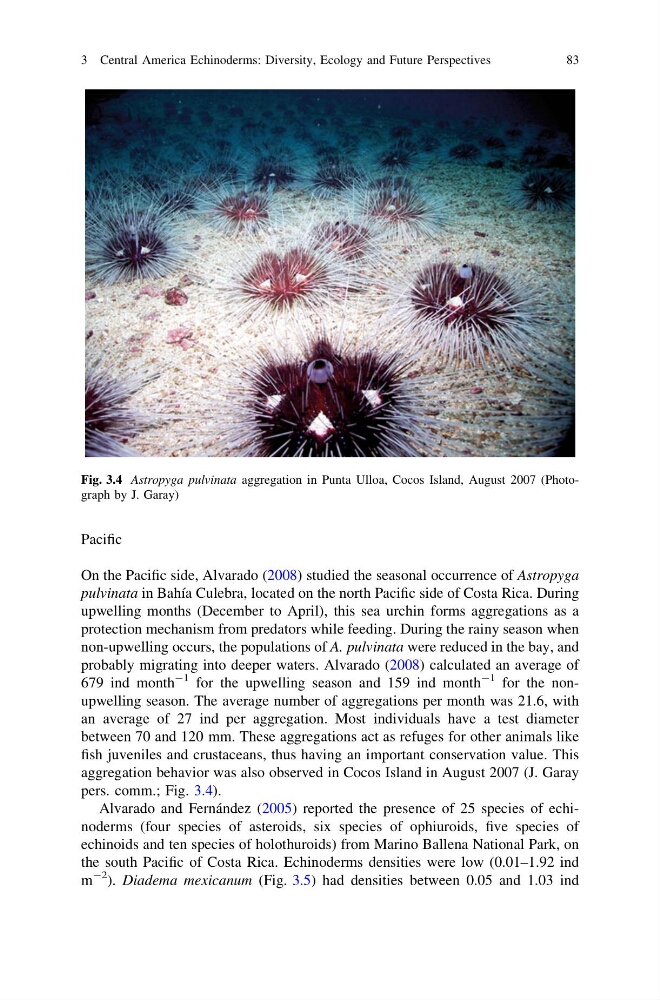
aggregation behavior was also observed in Cocos Island in August 2007 (J. Garay
pers. comm.; Fig. 3.4).
Alvarado and Fernández (2005) reported the presence of 25 species of echinoderms (four species of asteroids, six species of ophiuroids, five species of
echinoids and ten species of holothuroids) from Marino Ballena National Park, on
the south Pacific of Costa Rica. Echinoderms densities were low (0.01–1.92 ind
m
-2 ). Diadema mexicanum (Fig. 3.5) had densities between 0.05 and 1.03 ind
Fig. 3.4 Astropyga pulvinata aggregation in Punta Ulloa, Cocos Island, August 2007 (Photograph by J. Garay)
3 Central America Echinoderms: Diversity, Ecology and Future Perspectives
83
On the Pacific side, Alvarado (2008) studied the seasonal occurrence of Astropyga
pulvinata in Bahía Culebra, located on the north Pacific side of Costa Rica. During
upwelling months (December to April), this sea urchin forms aggregations as a
protection mechanism from predators while feeding. During the rainy season when
non-upwelling occurs, the populations of A. pulvinata were reduced in the bay, and
probably migrating into deeper waters. Alvarado (2008) calculated an average of
679 ind month
-1 for the upwelling season and 159 ind month
-1 for the nonupwelling season. The average number of aggregations per month was 21.6, with
an average of 27 ind per aggregation. Most individuals have a test diameter
between 70 and 120 mm. These aggregations act as refuges for other animals like
fish juveniles and crustaceans, thus having an important conservation value. This
aggregation behavior was also observed in Cocos Island in August 2007 (J. Garay
pers. comm.; Fig. 3.4).
Alvarado and Fernández (2005) reported the presence of 25 species of echinoderms (four species of asteroids, six species of ophiuroids, five species of
echinoids and ten species of holothuroids) from Marino Ballena National Park, on
the south Pacific of Costa Rica. Echinoderms densities were low (0.01–1.92 ind
m
-2 ). Diadema mexicanum (Fig. 3.5) had densities between 0.05 and 1.03 ind
Fig. 3.4 Astropyga pulvinata aggregation in Punta Ulloa, Cocos Island, August 2007 (Photograph by J. Garay)
3 Central America Echinoderms: Diversity, Ecology and Future Perspectives
83