

Puig (1986) found three unidentified holothuroid species and three species of
Ophiuroidea in the stomach content of the fish Micropogonias opercularis.
Fossil material has been more intensively studied (Martínez 1984, 1994;
Martínez and Durham 1988; Mooi et al. 2000; Martínez and Mooi 2005). It is
relatively well known but is restricted almost exclusively to Cenozoic echinoids
because of their best preservation potential and of the characteristics of the sedimentary units of Uruguay.
10.3 Diversity and Distribution
10.3.1 Extant Echinoderm Fauna
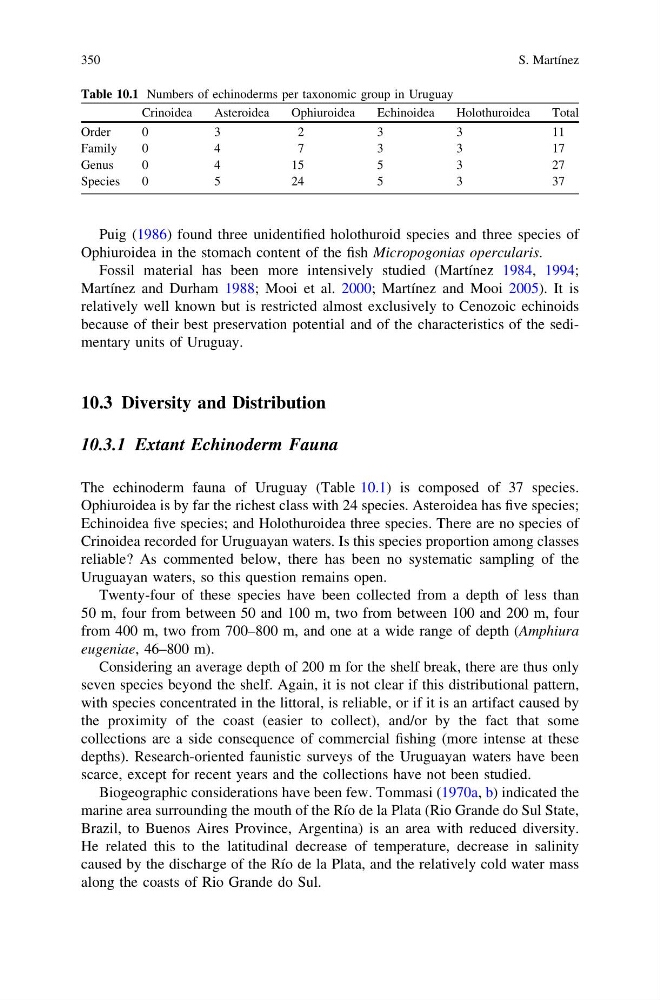
The echinoderm fauna of Uruguay (Table 10.1) is composed of 37 species.
Ophiuroidea is by far the richest class with 24 species. Asteroidea has five species;
Echinoidea five species; and Holothuroidea three species. There are no species of
Crinoidea recorded for Uruguayan waters. Is this species proportion among classes
reliable? As commented below, there has been no systematic sampling of the
Uruguayan waters, so this question remains open.
Twenty-four of these species have been collected from a depth of less than
50 m, four from between 50 and 100 m, two from between 100 and 200 m, four
from 400 m, two from 700–800 m, and one at a wide range of depth (Amphiura
eugeniae, 46–800 m).
Considering an average depth of 200 m for the shelf break, there are thus only
seven species beyond the shelf. Again, it is not clear if this distributional pattern,
with species concentrated in the littoral, is reliable, or if it is an artifact caused by
the proximity of the coast (easier to collect), and/or by the fact that some
collections are a side consequence of commercial fishing (more intense at these
depths). Research-oriented faunistic surveys of the Uruguayan waters have been
scarce, except for recent years and the collections have not been studied.
Biogeographic considerations have been few. Tommasi (1970a, b) indicated the
marine area surrounding the mouth of the Río de la Plata (Rio Grande do Sul State,
Brazil, to Buenos Aires Province, Argentina) is an area with reduced diversity.
He related this to the latitudinal decrease of temperature, decrease in salinity
caused by the discharge of the Río de la Plata, and the relatively cold water mass
along the coasts of Rio Grande do Sul.
Table 10.1 Numbers of echinoderms per taxonomic group in Uruguay
Crinoidea
Asteroidea
Ophiuroidea
Echinoidea
Holothuroidea
Total
Order
0
3
2
3
3
11
Family
0
4
7
3
3
17
Genus
0
4
15
5
3
27
Species
0
5
24
5
3
37
350
S. Martínez
Ophiuroidea in the stomach content of the fish Micropogonias opercularis.
Fossil material has been more intensively studied (Martínez 1984, 1994;
Martínez and Durham 1988; Mooi et al. 2000; Martínez and Mooi 2005). It is
relatively well known but is restricted almost exclusively to Cenozoic echinoids
because of their best preservation potential and of the characteristics of the sedimentary units of Uruguay.
10.3 Diversity and Distribution
10.3.1 Extant Echinoderm Fauna
The echinoderm fauna of Uruguay (Table 10.1) is composed of 37 species.
Ophiuroidea is by far the richest class with 24 species. Asteroidea has five species;
Echinoidea five species; and Holothuroidea three species. There are no species of
Crinoidea recorded for Uruguayan waters. Is this species proportion among classes
reliable? As commented below, there has been no systematic sampling of the
Uruguayan waters, so this question remains open.
Twenty-four of these species have been collected from a depth of less than
50 m, four from between 50 and 100 m, two from between 100 and 200 m, four
from 400 m, two from 700–800 m, and one at a wide range of depth (Amphiura
eugeniae, 46–800 m).
Considering an average depth of 200 m for the shelf break, there are thus only
seven species beyond the shelf. Again, it is not clear if this distributional pattern,
with species concentrated in the littoral, is reliable, or if it is an artifact caused by
the proximity of the coast (easier to collect), and/or by the fact that some
collections are a side consequence of commercial fishing (more intense at these
depths). Research-oriented faunistic surveys of the Uruguayan waters have been
scarce, except for recent years and the collections have not been studied.
Biogeographic considerations have been few. Tommasi (1970a, b) indicated the
marine area surrounding the mouth of the Río de la Plata (Rio Grande do Sul State,
Brazil, to Buenos Aires Province, Argentina) is an area with reduced diversity.
He related this to the latitudinal decrease of temperature, decrease in salinity
caused by the discharge of the Río de la Plata, and the relatively cold water mass
along the coasts of Rio Grande do Sul.
Table 10.1 Numbers of echinoderms per taxonomic group in Uruguay
Crinoidea
Asteroidea
Ophiuroidea
Echinoidea
Holothuroidea
Total
Order
0
3
2
3
3
11
Family
0
4
7
3
3
17
Genus
0
4
15
5
3
27
Species
0
5
24
5
3
37
350
S. Martínez