

Lucchi (1985) identified 17 species of ophiuroids in samples obtained between
10 and 800 m. (continental shelf and slope), being five of them reported for the
first time for Uruguay. He and Martínez (2008, with an updated database and
including asteroids) made some biogeographical considerations about ophiuroids
(see below).
Martínez and Mooi (2005) published a bibliographical review about the fossil
and recent sand dollars of Uruguay, recognizing three recent species, two
Quaternary, and four Miocene ones. They stressed the importance of the extinct
Miocene family Monophorasteridae in the phylogeny of Mellitidae and included
some biogeographical observations (see Sect. 3.1).
Scarabino (2006) presents an updated list of the Uruguayan echinoderms
reported to a depth of 50 m. He provided a brief account of the characteristics of
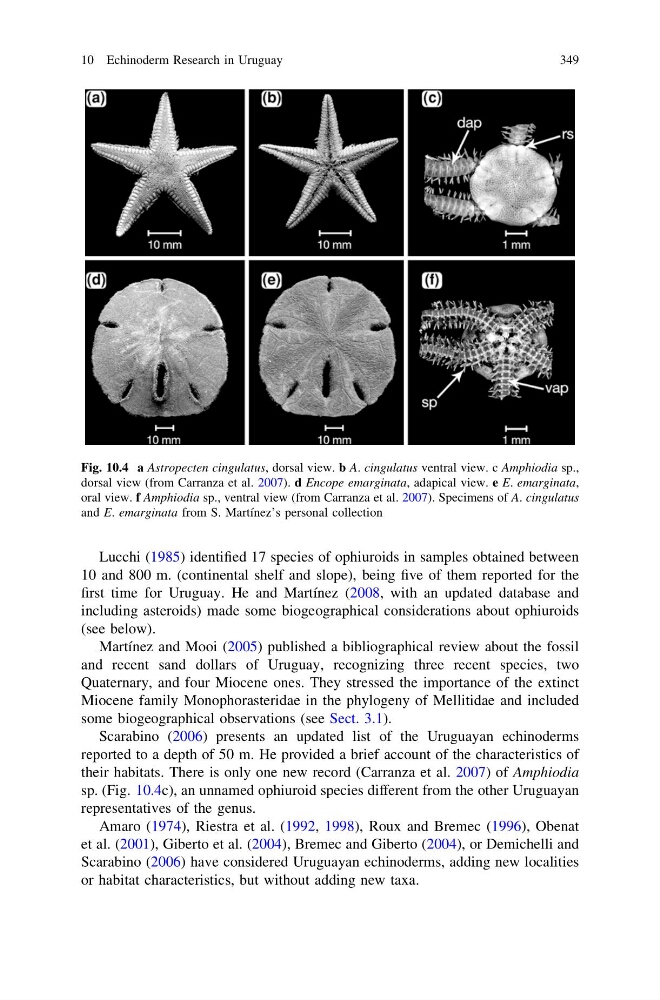
their habitats. There is only one new record (Carranza et al. 2007) of Amphiodia
sp. (Fig. 10.4c), an unnamed ophiuroid species different from the other Uruguayan
representatives of the genus.
Amaro (1974), Riestra et al. (1992, 1998), Roux and Bremec (1996), Obenat
et al. (2001), Giberto et al. (2004), Bremec and Giberto (2004), or Demichelli and
Scarabino (2006) have considered Uruguayan echinoderms, adding new localities
or habitat characteristics, but without adding new taxa.
Fig. 10.4 a Astropecten cingulatus, dorsal view. b A. cingulatus ventral view. c Amphiodia sp.,
dorsal view (from Carranza et al. 2007). d Encope emarginata, adapical view. e E. emarginata,
oral view. f Amphiodia sp., ventral view (from Carranza et al. 2007). Specimens of A. cingulatus
and E. emarginata from S. Martínez’s personal collection
10 Echinoderm Research in Uruguay
349
10 and 800 m. (continental shelf and slope), being five of them reported for the
first time for Uruguay. He and Martínez (2008, with an updated database and
including asteroids) made some biogeographical considerations about ophiuroids
(see below).
Martínez and Mooi (2005) published a bibliographical review about the fossil
and recent sand dollars of Uruguay, recognizing three recent species, two
Quaternary, and four Miocene ones. They stressed the importance of the extinct
Miocene family Monophorasteridae in the phylogeny of Mellitidae and included
some biogeographical observations (see Sect. 3.1).
Scarabino (2006) presents an updated list of the Uruguayan echinoderms
reported to a depth of 50 m. He provided a brief account of the characteristics of
their habitats. There is only one new record (Carranza et al. 2007) of Amphiodia
sp. (Fig. 10.4c), an unnamed ophiuroid species different from the other Uruguayan
representatives of the genus.
Amaro (1974), Riestra et al. (1992, 1998), Roux and Bremec (1996), Obenat
et al. (2001), Giberto et al. (2004), Bremec and Giberto (2004), or Demichelli and
Scarabino (2006) have considered Uruguayan echinoderms, adding new localities
or habitat characteristics, but without adding new taxa.
Fig. 10.4 a Astropecten cingulatus, dorsal view. b A. cingulatus ventral view. c Amphiodia sp.,
dorsal view (from Carranza et al. 2007). d Encope emarginata, adapical view. e E. emarginata,
oral view. f Amphiodia sp., ventral view (from Carranza et al. 2007). Specimens of A. cingulatus
and E. emarginata from S. Martínez’s personal collection
10 Echinoderm Research in Uruguay
349