

Another kind of commerce for the Peruvian echinoderms that is usually not
taken into account which affects seriously populations of some species is the
souvenir market (Fig. 8.7c). Commerce of dry specimens of S. striatus and
H. helianthus in some tourist places of central and southern Peru is common.
These species are also used to make handcrafts. Some species are also sold dry on
the tropical north beaches, mainly Mancora. The list includes N. armata,
P. cumingi, P. pyramidatus, P. unifascialis, C. europacificus and E. micropora.
The first two species have become close to extinction because they were never
abundant and the reefs where they live are not common. C. europacificus is
accidentally caught by artisanal trawling boats. The effect of this on its populations
is unknown.
Sueiro (2009) mentions a trade exportation of 5 tons of S. striatus in the year
2001, but the objective of this commerce is unknown. The populations of this
seastar have been reduced due to its multiple usages given (ornaments, souvenirs,
mystic rituals, etc.). More recently most local universities and schools use them for
their teaching laboratories because they are easily collected in the intertidal.
No special effort has been made to develop echinoderm aquaculture techniques
in Peru. Nevertheless, the IMARPE’s Ilo Aquaculture Laboratory has been
working successfully on reproduction of L. albus. It is possible that in a short time
the aquaculture of this sea urchin will be developed for both market and scientific
interests.
8.5 Echinoderm Threats
There is no national strategy for the conservation and management of echinoderms
except for the sea urchin L. albus. Because new Marine Protected Areas (MPA) in
Peru were created, in 2010 and 2011, the country is now faces new challenges. The
Servicio Nacional de Areas Naturales Protegidas del Peru currently preparing Red
List files of threatened species in Peruvian MPAs. It is expected that several
echinoderm species will be included. The following list shows some of the proposed species and their status following the criteria of the International Union for
Conservation of Nature (IUCN).
1. Nidorellia armata: Critically endangered.
2. Pharia pyramidatus: Endangered.
3. Phataria unifascialis: Almost threatened.
4. Stichaster striatus: Vulnerable.
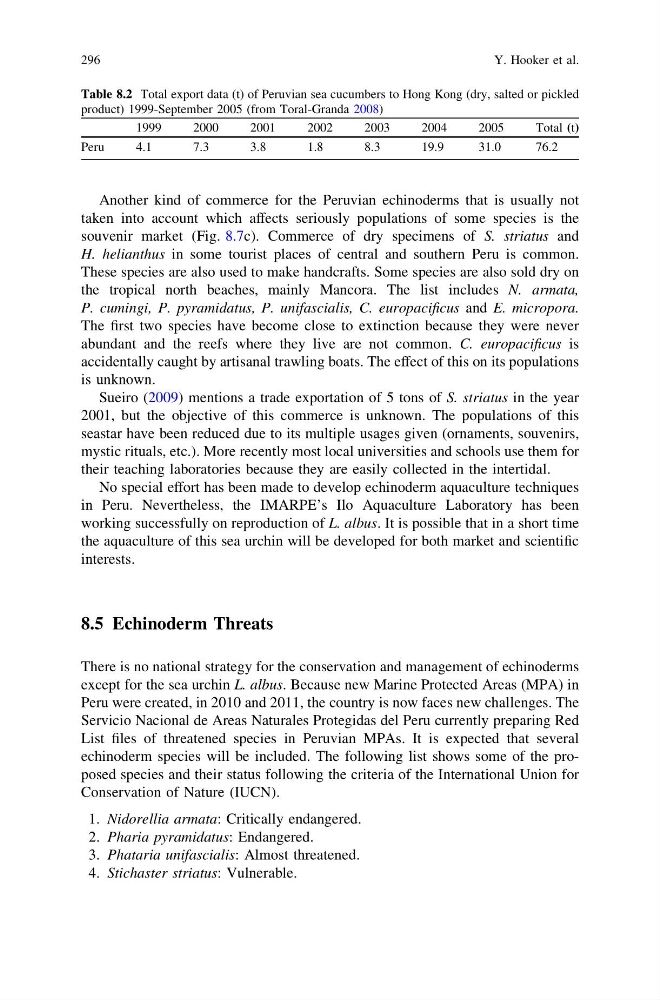
Table 8.2 Total export data (t) of Peruvian sea cucumbers to Hong Kong (dry, salted or pickled
product) 1999-September 2005 (from Toral-Granda 2008)
1999
2000
2001
2002
2003
2004
2005
Total (t)
Peru
4.1
7.3
3.8
1.8
8.3
19.9
31.0
76.2
296
Y. Hooker et al.
taken into account which affects seriously populations of some species is the
souvenir market (Fig. 8.7c). Commerce of dry specimens of S. striatus and
H. helianthus in some tourist places of central and southern Peru is common.
These species are also used to make handcrafts. Some species are also sold dry on
the tropical north beaches, mainly Mancora. The list includes N. armata,
P. cumingi, P. pyramidatus, P. unifascialis, C. europacificus and E. micropora.
The first two species have become close to extinction because they were never
abundant and the reefs where they live are not common. C. europacificus is
accidentally caught by artisanal trawling boats. The effect of this on its populations
is unknown.
Sueiro (2009) mentions a trade exportation of 5 tons of S. striatus in the year
2001, but the objective of this commerce is unknown. The populations of this
seastar have been reduced due to its multiple usages given (ornaments, souvenirs,
mystic rituals, etc.). More recently most local universities and schools use them for
their teaching laboratories because they are easily collected in the intertidal.
No special effort has been made to develop echinoderm aquaculture techniques
in Peru. Nevertheless, the IMARPE’s Ilo Aquaculture Laboratory has been
working successfully on reproduction of L. albus. It is possible that in a short time
the aquaculture of this sea urchin will be developed for both market and scientific
interests.
8.5 Echinoderm Threats
There is no national strategy for the conservation and management of echinoderms
except for the sea urchin L. albus. Because new Marine Protected Areas (MPA) in
Peru were created, in 2010 and 2011, the country is now faces new challenges. The
Servicio Nacional de Areas Naturales Protegidas del Peru currently preparing Red
List files of threatened species in Peruvian MPAs. It is expected that several
echinoderm species will be included. The following list shows some of the proposed species and their status following the criteria of the International Union for
Conservation of Nature (IUCN).
1. Nidorellia armata: Critically endangered.
2. Pharia pyramidatus: Endangered.
3. Phataria unifascialis: Almost threatened.
4. Stichaster striatus: Vulnerable.
Table 8.2 Total export data (t) of Peruvian sea cucumbers to Hong Kong (dry, salted or pickled
product) 1999-September 2005 (from Toral-Granda 2008)
1999
2000
2001
2002
2003
2004
2005
Total (t)
Peru
4.1
7.3
3.8
1.8
8.3
19.9
31.0
76.2
296
Y. Hooker et al.