

Dry specimens of Stichaster striatus and Heliaster helianthus are used in these
rites. Both species are still sold as souvenirs (Fig. 8.7c) or in herb and mystic
objects (chamaneria) markets.
Exploitation of echinoderms in Peru is not older than 20 years. It began with
exportation of the red sea urchin Lytechinus albus gonads and later with some
species of sea cucumbers to Japan. The first sea cucumber formally and legally
exploited was I. fuscus in 1995, possibly when the fishing of the species began to
be controlled or even sold in some areas of the Galapagos Islands. Sueiro (2009)
mentioned the problem of exploitation of I. fuscus in the Galapagos and the
regulation measures taken for its protection. Although I. fuscus is an economically
important marine product in Peru (class ‘‘A’’ product), no protection measures are
taken in its fishery. Catches are sent to Ecuador immediately with no information
on the catch provided to authorities. Local fishing divers have provided information that I. fuscus was eliminated in less than 3 years after fishing began from
areas in Peru, Lobos de Afuera and the region between Cabo Blanco and Punta
Mero, north of Punta Sal. Legal exportation of sea cucumbers began officially at
the end of the 1990s. Catches were principally composed of P. mollis and
Holothuria theeli. The last species became common after El Niño 1997–1998, with
large landings in Huacho (Elliott et al. 2005) and Chimbote. The last year this sea
cucumber was reported was 2002. Since that it has been replaced in fishing by
P. mollis captures (Fig. 8.7d–f).
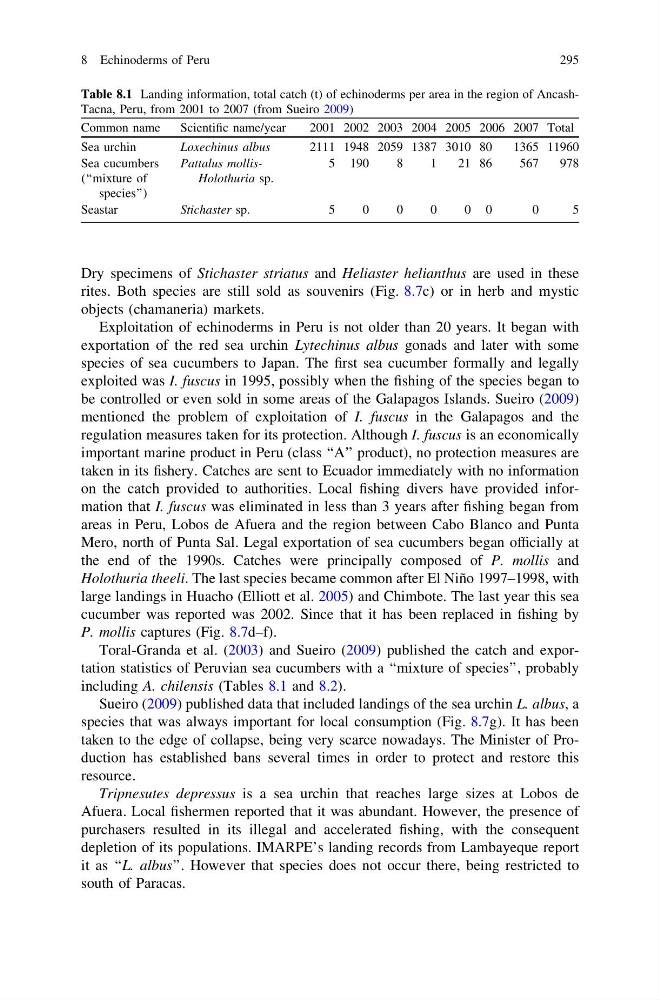
Toral-Granda et al. (2003) and Sueiro (2009) published the catch and exportation statistics of Peruvian sea cucumbers with a ‘‘mixture of species’’, probably
including A. chilensis (Tables 8.1 and 8.2).
Sueiro (2009) published data that included landings of the sea urchin L. albus, a
species that was always important for local consumption (Fig. 8.7g). It has been
taken to the edge of collapse, being very scarce nowadays. The Minister of Production has established bans several times in order to protect and restore this
resource.
Tripnesutes depressus is a sea urchin that reaches large sizes at Lobos de
Afuera. Local fishermen reported that it was abundant. However, the presence of
purchasers resulted in its illegal and accelerated fishing, with the consequent
depletion of its populations. IMARPE’s landing records from Lambayeque report
it as ‘‘L. albus’’. However that species does not occur there, being restricted to
south of Paracas.
Table 8.1 Landing information, total catch (t) of echinoderms per area in the region of AncashTacna, Peru, from 2001 to 2007 (from Sueiro 2009)
Common name
Scientific name/year
2001 2002 2003 2004 2005 2006 2007 Total
Sea urchin
Loxechinus albus
2111 1948 2059 1387 3010 80
1365 11960
Sea cucumbers
(‘‘mixture of
species’’)
Pattalus mollisHolothuria sp.
5 190
8
1
21 86
567
978
Seastar
Stichaster sp.
5
0
0
0
0 0
0
5
8 Echinoderms of Peru
295
rites. Both species are still sold as souvenirs (Fig. 8.7c) or in herb and mystic
objects (chamaneria) markets.
Exploitation of echinoderms in Peru is not older than 20 years. It began with
exportation of the red sea urchin Lytechinus albus gonads and later with some
species of sea cucumbers to Japan. The first sea cucumber formally and legally
exploited was I. fuscus in 1995, possibly when the fishing of the species began to
be controlled or even sold in some areas of the Galapagos Islands. Sueiro (2009)
mentioned the problem of exploitation of I. fuscus in the Galapagos and the
regulation measures taken for its protection. Although I. fuscus is an economically
important marine product in Peru (class ‘‘A’’ product), no protection measures are
taken in its fishery. Catches are sent to Ecuador immediately with no information
on the catch provided to authorities. Local fishing divers have provided information that I. fuscus was eliminated in less than 3 years after fishing began from
areas in Peru, Lobos de Afuera and the region between Cabo Blanco and Punta
Mero, north of Punta Sal. Legal exportation of sea cucumbers began officially at
the end of the 1990s. Catches were principally composed of P. mollis and
Holothuria theeli. The last species became common after El Niño 1997–1998, with
large landings in Huacho (Elliott et al. 2005) and Chimbote. The last year this sea
cucumber was reported was 2002. Since that it has been replaced in fishing by
P. mollis captures (Fig. 8.7d–f).
Toral-Granda et al. (2003) and Sueiro (2009) published the catch and exportation statistics of Peruvian sea cucumbers with a ‘‘mixture of species’’, probably
including A. chilensis (Tables 8.1 and 8.2).
Sueiro (2009) published data that included landings of the sea urchin L. albus, a
species that was always important for local consumption (Fig. 8.7g). It has been
taken to the edge of collapse, being very scarce nowadays. The Minister of Production has established bans several times in order to protect and restore this
resource.
Tripnesutes depressus is a sea urchin that reaches large sizes at Lobos de
Afuera. Local fishermen reported that it was abundant. However, the presence of
purchasers resulted in its illegal and accelerated fishing, with the consequent
depletion of its populations. IMARPE’s landing records from Lambayeque report
it as ‘‘L. albus’’. However that species does not occur there, being restricted to
south of Paracas.
Table 8.1 Landing information, total catch (t) of echinoderms per area in the region of AncashTacna, Peru, from 2001 to 2007 (from Sueiro 2009)
Common name
Scientific name/year
2001 2002 2003 2004 2005 2006 2007 Total
Sea urchin
Loxechinus albus
2111 1948 2059 1387 3010 80
1365 11960
Sea cucumbers
(‘‘mixture of
species’’)
Pattalus mollisHolothuria sp.
5 190
8
1
21 86
567
978
Seastar
Stichaster sp.
5
0
0
0
0 0
0
5
8 Echinoderms of Peru
295