

characteristics, emerging sedimentary deposits offer a rich register of fossils that
date to the Carboniferous. Further to the south, at the Arequipa region to near the
Chilean border, the Andes Mountains extend closer to the sea, forming edges
dominated by recent igneous rocks that form cliffs, deep coves, and islands,
interspersed by valleys with seasonal rivers. There are long sandy beaches and
coastal dunes, forming a coastline with high geomorphologic diversity. This in
turn generates great habitat diversity that favors the development of complex
biological communities. The marine sediments between 7° and 10°30
0 S are mainly
sand, which dominate the wide continental shelf. Sand also appears in patches
towards the south. Mud with high organic content covers the continental shelf and
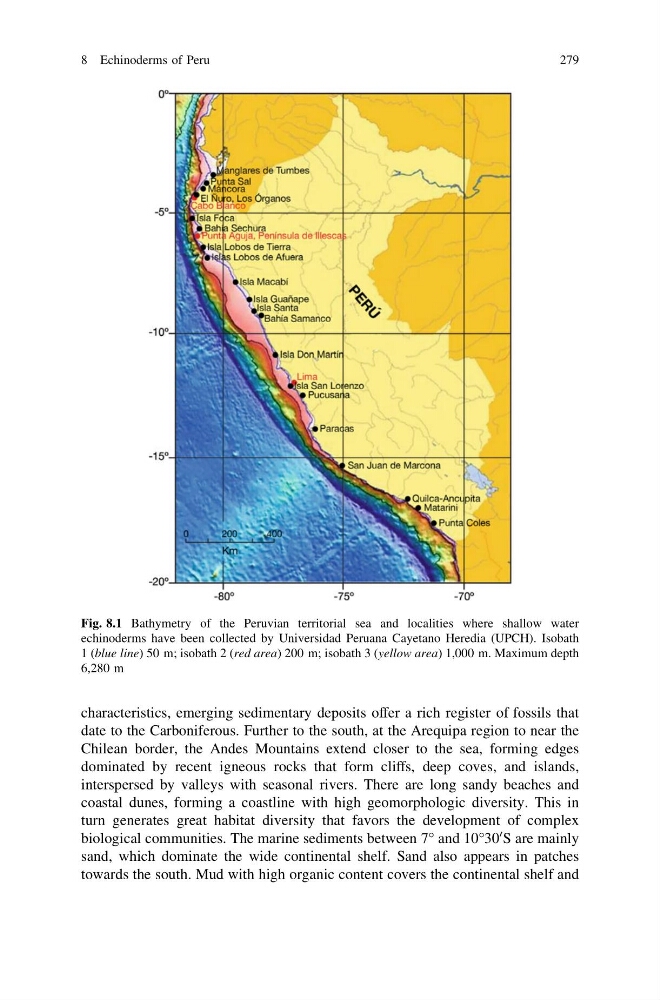
Fig. 8.1 Bathymetry of the Peruvian territorial sea and localities where shallow water
echinoderms have been collected by Universidad Peruana Cayetano Heredia (UPCH). Isobath
1 (blue line) 50 m; isobath 2 (red area) 200 m; isobath 3 (yellow area) 1,000 m. Maximum depth
6,280 m
8 Echinoderms of Peru
279
date to the Carboniferous. Further to the south, at the Arequipa region to near the
Chilean border, the Andes Mountains extend closer to the sea, forming edges
dominated by recent igneous rocks that form cliffs, deep coves, and islands,
interspersed by valleys with seasonal rivers. There are long sandy beaches and
coastal dunes, forming a coastline with high geomorphologic diversity. This in
turn generates great habitat diversity that favors the development of complex
biological communities. The marine sediments between 7° and 10°30
0 S are mainly
sand, which dominate the wide continental shelf. Sand also appears in patches
towards the south. Mud with high organic content covers the continental shelf and
Fig. 8.1 Bathymetry of the Peruvian territorial sea and localities where shallow water
echinoderms have been collected by Universidad Peruana Cayetano Heredia (UPCH). Isobath
1 (blue line) 50 m; isobath 2 (red area) 200 m; isobath 3 (yellow area) 1,000 m. Maximum depth
6,280 m
8 Echinoderms of Peru
279