

should continue to optimize the initial stages of culture, as well as for the
following growth stages. Nutritional research should be emphasized to establish
the appropriate diet for growth and the production of gonads.
Studies in Venezuela concerning culture of E. lucunter, A. punctulata and
T. ventricosus have focused on conditions affecting larval development. García
et al. (2005) studied the effect of salinity (30 and 40 %) and type of microalga on
the larval development of A. punctulata, and suggested the use of the microalgae
Isochrysis galbana, Chaetoceros gracilis and Chaetoceros calcitrans for raising
larvae. They also found that using 40 % salinity reached the greatest survival,
while in 30 % salinity the growth rate was maximized. Astudillo et al. (2005)
concluded that E. lucunter is a species with excellent characteristics for cultivation
because it has short embryonic (16 h) and larval (12 days) periods and good
survival rates when fed a monoculture of C. gracilis. This microalga also supports
larval development of T. ventricosus, which completes larval development to
metamorphosis in 24 days after fertilization at temperatures from 23 to 29°C
(Fernández 2005). Survival is greater at lower temperatures.
Studies to increase production of sea cucumbers by culture have not been done
in Venezuela despite the high product market value and the detritivorous condition
that make their culture attractive.
7.6 Threats to Echinoderms in Venezuela
The echinoderms in Venezuela are not free from threats experienced by marine
organisms nowadays, like global warming (Byrne et al. 2009), increased UV
radiation associated with a reduction in the ozone layer (Lesser and Barry 2003)
and acidification of the oceans produced by an increase in the CO 2 concentration
(Kurihara and Shirayama 2004).
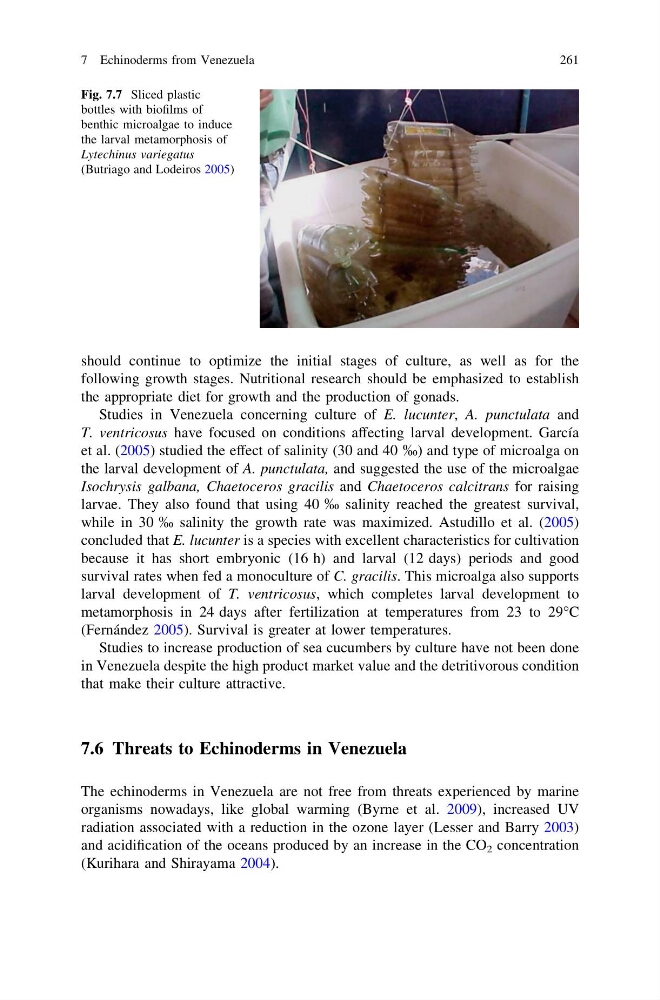
Fig. 7.7 Sliced plastic
bottles with biofilms of
benthic microalgae to induce
the larval metamorphosis of
Lytechinus variegatus
(Butriago and Lodeiros 2005)
7 Echinoderms from Venezuela
261
following growth stages. Nutritional research should be emphasized to establish
the appropriate diet for growth and the production of gonads.
Studies in Venezuela concerning culture of E. lucunter, A. punctulata and
T. ventricosus have focused on conditions affecting larval development. García
et al. (2005) studied the effect of salinity (30 and 40 %) and type of microalga on
the larval development of A. punctulata, and suggested the use of the microalgae
Isochrysis galbana, Chaetoceros gracilis and Chaetoceros calcitrans for raising
larvae. They also found that using 40 % salinity reached the greatest survival,
while in 30 % salinity the growth rate was maximized. Astudillo et al. (2005)
concluded that E. lucunter is a species with excellent characteristics for cultivation
because it has short embryonic (16 h) and larval (12 days) periods and good
survival rates when fed a monoculture of C. gracilis. This microalga also supports
larval development of T. ventricosus, which completes larval development to
metamorphosis in 24 days after fertilization at temperatures from 23 to 29°C
(Fernández 2005). Survival is greater at lower temperatures.
Studies to increase production of sea cucumbers by culture have not been done
in Venezuela despite the high product market value and the detritivorous condition
that make their culture attractive.
7.6 Threats to Echinoderms in Venezuela
The echinoderms in Venezuela are not free from threats experienced by marine
organisms nowadays, like global warming (Byrne et al. 2009), increased UV
radiation associated with a reduction in the ozone layer (Lesser and Barry 2003)
and acidification of the oceans produced by an increase in the CO 2 concentration
(Kurihara and Shirayama 2004).
Fig. 7.7 Sliced plastic
bottles with biofilms of
benthic microalgae to induce
the larval metamorphosis of
Lytechinus variegatus
(Butriago and Lodeiros 2005)
7 Echinoderms from Venezuela
261