

supported by technical evaluations in different regions of the country. The presence of a continuous illegal fishing of sea cucumbers in the Venezuelan coasts, as
revealed from sources in the coastal communities, impoundments made by
authorities and our own ‘‘in situ’’ observations, make it urgent to establish an
evaluation of these resources along the Venezuelan coast. In this regard, considering that previous studies were limited to a depth of 15 m, future studies should
cover explorations to deeper areas.
7.5.2 Aquaculture
The sea urchins (L. variegatus, E. lucunter, T. ventricosus and A. punctulata) have
been studied with the purpose of increasing production by aquaculture (Lawrence
and Balzhin 1998; García et al. 2005; Astudillo et al. 2005; Barrios and Reyes
2009). Furthermore, there is also interest in Venezuela for using the eggs and
larvae in sensitivity studies of toxic and contaminant compounds (Esclapés 1999).
This supports the importance of establishing techniques to induce spawning in
these species and production of larvae.
Most attention for aquaculture has been given to L. variegatus. Studies have
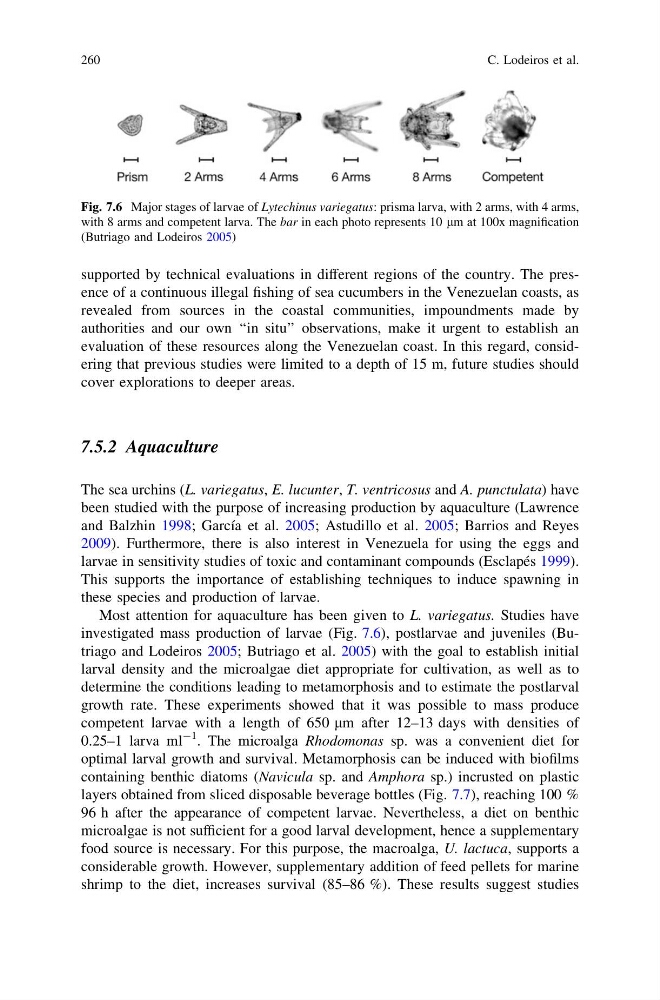
investigated mass production of larvae (Fig. 7.6), postlarvae and juveniles (Butriago and Lodeiros 2005; Butriago et al. 2005) with the goal to establish initial
larval density and the microalgae diet appropriate for cultivation, as well as to
determine the conditions leading to metamorphosis and to estimate the postlarval
growth rate. These experiments showed that it was possible to mass produce
competent larvae with a length of 650 lm after 12–13 days with densities of
0.25–1 larva ml
-1 . The microalga Rhodomonas sp. was a convenient diet for
optimal larval growth and survival. Metamorphosis can be induced with biofilms
containing benthic diatoms (Navicula sp. and Amphora sp.) incrusted on plastic
layers obtained from sliced disposable beverage bottles (Fig. 7.7), reaching 100 %
96 h after the appearance of competent larvae. Nevertheless, a diet on benthic
microalgae is not sufficient for a good larval development, hence a supplementary
food source is necessary. For this purpose, the macroalga, U. lactuca, supports a
considerable growth. However, supplementary addition of feed pellets for marine
shrimp to the diet, increases survival (85–86 %). These results suggest studies
Fig. 7.6 Major stages of larvae of Lytechinus variegatus: prisma larva, with 2 arms, with 4 arms,
with 8 arms and competent larva. The bar in each photo represents 10 lm at 100x magnification
(Butriago and Lodeiros 2005)
260
C. Lodeiros et al.
revealed from sources in the coastal communities, impoundments made by
authorities and our own ‘‘in situ’’ observations, make it urgent to establish an
evaluation of these resources along the Venezuelan coast. In this regard, considering that previous studies were limited to a depth of 15 m, future studies should
cover explorations to deeper areas.
7.5.2 Aquaculture
The sea urchins (L. variegatus, E. lucunter, T. ventricosus and A. punctulata) have
been studied with the purpose of increasing production by aquaculture (Lawrence
and Balzhin 1998; García et al. 2005; Astudillo et al. 2005; Barrios and Reyes
2009). Furthermore, there is also interest in Venezuela for using the eggs and
larvae in sensitivity studies of toxic and contaminant compounds (Esclapés 1999).
This supports the importance of establishing techniques to induce spawning in
these species and production of larvae.
Most attention for aquaculture has been given to L. variegatus. Studies have
investigated mass production of larvae (Fig. 7.6), postlarvae and juveniles (Butriago and Lodeiros 2005; Butriago et al. 2005) with the goal to establish initial
larval density and the microalgae diet appropriate for cultivation, as well as to
determine the conditions leading to metamorphosis and to estimate the postlarval
growth rate. These experiments showed that it was possible to mass produce
competent larvae with a length of 650 lm after 12–13 days with densities of
0.25–1 larva ml
-1 . The microalga Rhodomonas sp. was a convenient diet for
optimal larval growth and survival. Metamorphosis can be induced with biofilms
containing benthic diatoms (Navicula sp. and Amphora sp.) incrusted on plastic
layers obtained from sliced disposable beverage bottles (Fig. 7.7), reaching 100 %
96 h after the appearance of competent larvae. Nevertheless, a diet on benthic
microalgae is not sufficient for a good larval development, hence a supplementary
food source is necessary. For this purpose, the macroalga, U. lactuca, supports a
considerable growth. However, supplementary addition of feed pellets for marine
shrimp to the diet, increases survival (85–86 %). These results suggest studies
Fig. 7.6 Major stages of larvae of Lytechinus variegatus: prisma larva, with 2 arms, with 4 arms,
with 8 arms and competent larva. The bar in each photo represents 10 lm at 100x magnification
(Butriago and Lodeiros 2005)
260
C. Lodeiros et al.