

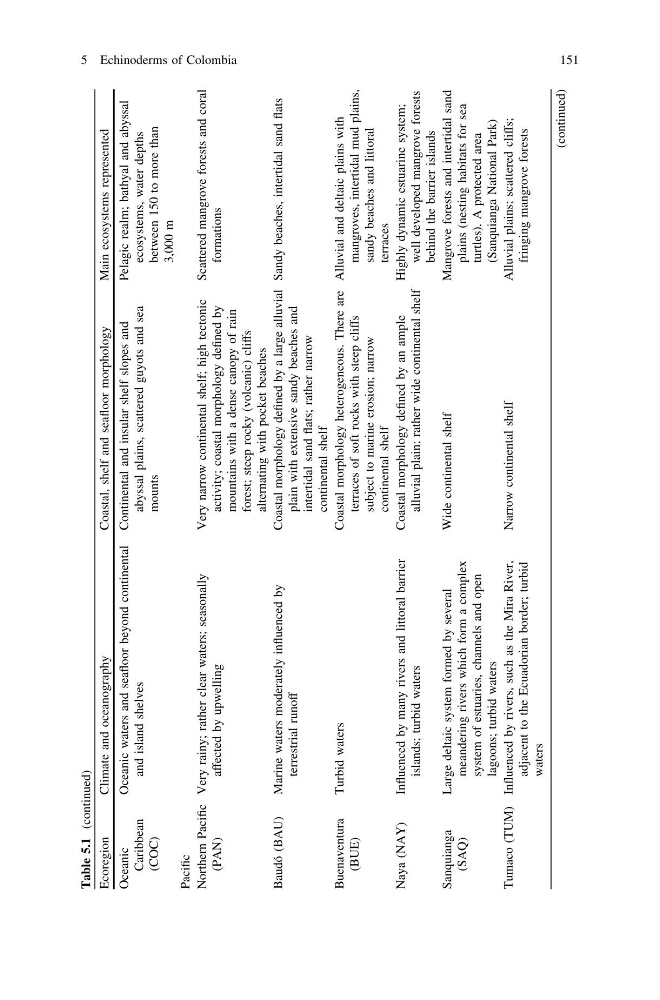
Table 5.1
(continued)
Ecoregion
Climate and oceanography
Coastal, shelf and seafloor morphology
Main ecosystems represented
Oceanic
Caribbean
(COC)
Oceanic waters and seafloor beyond continental
and island shelves
Continental and insular shelf slopes and
abyssal plains, scattered guyots and sea
mounts
Pelagic realm; bathyal and abyssal
ecosystems, water depths
between 150 to more than
3,000 m
Pacific
Northern Pacific
(PAN)
Very rainy; rather clear waters; seasonally
affected by upwelling
Very narrow continental shelf; high tectonic
activity; coastal morphology defined by
mountains with a dense canopy of rain
forest; steep rocky (volcanic) cliffs
alternating with pocket beaches
Scattered mangrove forests and coral
formations
Baudó (BAU)
Marine waters moderately influenced by
terrestrial runoff
Coastal morphology defined by a large alluvial
plain with extensive sandy beaches and
intertidal sand flats; rather narrow
continental shelf
Sandy beaches, intertidal sand flats
Buenaventura
(BUE)
Turbid waters
Coastal morphology heterogeneous. There are
terraces of soft rocks with steep cliffs
subject to marine erosion; narrow
continental shelf
Alluvial and deltaic plains with
mangroves, intertidal mud plains,
sandy beaches and littoral
terraces
Naya (NAY)
Influenced by many rivers and littoral barrier
islands; turbid waters
Coastal morphology defined by an ample
alluvial plain; rather wide continental shelf
Highly dynamic estuarine system;
well developed mangrove forests
behind the barrier islands
Sanquianga
(SAQ)
Large deltaic system formed by several
meandering rivers which form a complex
system of estuaries, channels and open
lagoons; turbid waters
Wide continental shelf
Mangrove forests and intertidal sand
plains (nesting habitats for sea
turtles). A protected area
(Sanquianga National Park)
Tumaco (TUM) Influenced by rivers, such as the Mira River,
adjacent to the Ecuadorian border; turbid
waters
Narrow continental shelf
Alluvial plains; scattered cliffs;
fringing mangrove forests
(continued)
5 Echinoderms of Colombia
151
(continued)
Ecoregion
Climate and oceanography
Coastal, shelf and seafloor morphology
Main ecosystems represented
Oceanic
Caribbean
(COC)
Oceanic waters and seafloor beyond continental
and island shelves
Continental and insular shelf slopes and
abyssal plains, scattered guyots and sea
mounts
Pelagic realm; bathyal and abyssal
ecosystems, water depths
between 150 to more than
3,000 m
Pacific
Northern Pacific
(PAN)
Very rainy; rather clear waters; seasonally
affected by upwelling
Very narrow continental shelf; high tectonic
activity; coastal morphology defined by
mountains with a dense canopy of rain
forest; steep rocky (volcanic) cliffs
alternating with pocket beaches
Scattered mangrove forests and coral
formations
Baudó (BAU)
Marine waters moderately influenced by
terrestrial runoff
Coastal morphology defined by a large alluvial
plain with extensive sandy beaches and
intertidal sand flats; rather narrow
continental shelf
Sandy beaches, intertidal sand flats
Buenaventura
(BUE)
Turbid waters
Coastal morphology heterogeneous. There are
terraces of soft rocks with steep cliffs
subject to marine erosion; narrow
continental shelf
Alluvial and deltaic plains with
mangroves, intertidal mud plains,
sandy beaches and littoral
terraces
Naya (NAY)
Influenced by many rivers and littoral barrier
islands; turbid waters
Coastal morphology defined by an ample
alluvial plain; rather wide continental shelf
Highly dynamic estuarine system;
well developed mangrove forests
behind the barrier islands
Sanquianga
(SAQ)
Large deltaic system formed by several
meandering rivers which form a complex
system of estuaries, channels and open
lagoons; turbid waters
Wide continental shelf
Mangrove forests and intertidal sand
plains (nesting habitats for sea
turtles). A protected area
(Sanquianga National Park)
Tumaco (TUM) Influenced by rivers, such as the Mira River,
adjacent to the Ecuadorian border; turbid
waters
Narrow continental shelf
Alluvial plains; scattered cliffs;
fringing mangrove forests
(continued)
5 Echinoderms of Colombia
151