

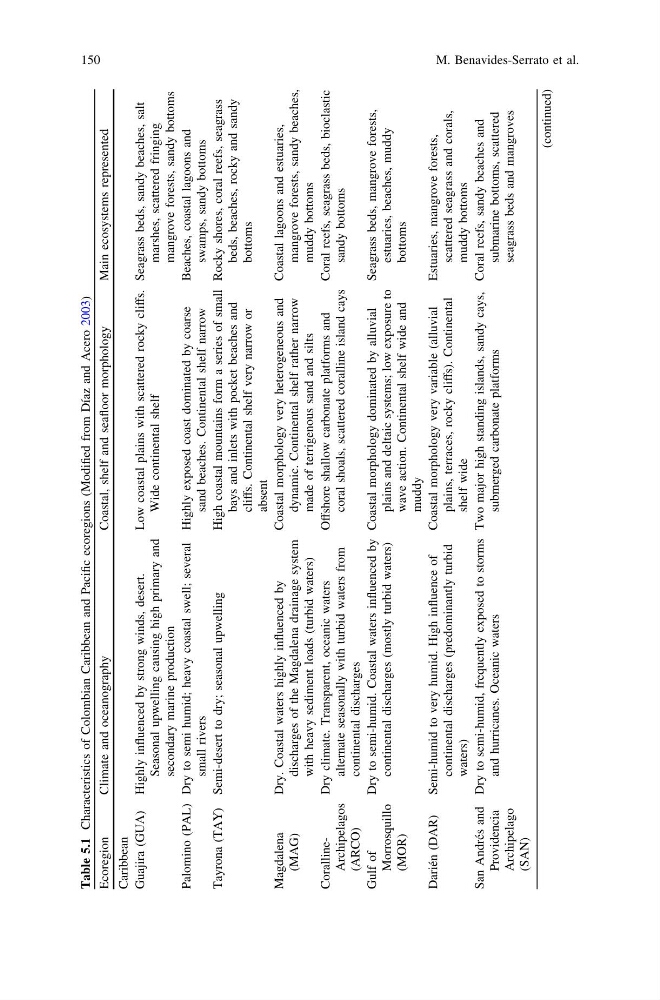
Table 5.1
Characteristics of Colombian Caribbean and Pacific ecoregions (Modified from Díaz and Acero 2003)
Ecoregion
Climate and oceanography
Coastal, shelf and seafloor morphology
Main ecosystems represented
Caribbean
Guajira (GUA) Highly influenced by strong winds, desert.
Seasonal upwelling causing high primary and
secondary marine production
Low coastal plains with scattered rocky cliffs.
Wide continental shelf
Seagrass beds, sandy beaches, salt
marshes, scattered fringing
mangrove forests, sandy bottoms
Palomino (PAL) Dry to semi humid; heavy coastal swell; several
small rivers
Highly exposed coast dominated by coarse
sand beaches. Continental shelf narrow
Beaches, coastal lagoons and
swamps, sandy bottoms
Tayrona (TAY) Semi-desert to dry; seasonal upwelling
High coastal mountains form a series of small
bays and inlets with pocket beaches and
cliffs. Continental shelf very narrow or
absent
Rocky shores, coral reefs, seagrass
beds, beaches, rocky and sandy
bottoms
Magdalena
(MAG)
Dry. Coastal waters highly influenced by
discharges of the Magdalena drainage system
with heavy sediment loads (turbid waters)
Coastal morphology very heterogeneous and
dynamic. Continental shelf rather narrow
made of terrigenous sand and silts
Coastal lagoons and estuaries,
mangrove forests, sandy beaches,
muddy bottoms
CorallineArchipelagos
(ARCO)
Dry climate. Transparent, oceanic waters
alternate seasonally with turbid waters from
continental discharges
Offshore shallow carbonate platforms and
coral shoals, scattered coralline island cays
Coral reefs, seagrass beds, bioclastic
sandy bottoms
Gulf of
Morrosquillo
(MOR)
Dry to semi-humid. Coastal waters influenced by
continental discharges (mostly turbid waters)
Coastal morphology dominated by alluvial
plains and deltaic systems; low exposure to
wave action. Continental shelf wide and
muddy
Seagrass beds, mangrove forests,
estuaries, beaches, muddy
bottoms
Darién (DAR)
Semi-humid to very humid. High influence of
continental discharges (predominantly turbid
waters)
Coastal morphology very variable (alluvial
plains, terraces, rocky cliffs). Continental
shelf wide
Estuaries, mangrove forests,
scattered seagrass and corals,
muddy bottoms
San Andrés and
Providencia
Archipelago
(SAN)
Dry to semi-humid, frequently exposed to storms
and hurricanes. Oceanic waters
Two major high standing islands, sandy cays,
submerged carbonate platforms
Coral reefs, sandy beaches and
submarine bottoms, scattered
seagrass beds and mangroves
(continued)
150
M. Benavides-Serrato et al.
Characteristics of Colombian Caribbean and Pacific ecoregions (Modified from Díaz and Acero 2003)
Ecoregion
Climate and oceanography
Coastal, shelf and seafloor morphology
Main ecosystems represented
Caribbean
Guajira (GUA) Highly influenced by strong winds, desert.
Seasonal upwelling causing high primary and
secondary marine production
Low coastal plains with scattered rocky cliffs.
Wide continental shelf
Seagrass beds, sandy beaches, salt
marshes, scattered fringing
mangrove forests, sandy bottoms
Palomino (PAL) Dry to semi humid; heavy coastal swell; several
small rivers
Highly exposed coast dominated by coarse
sand beaches. Continental shelf narrow
Beaches, coastal lagoons and
swamps, sandy bottoms
Tayrona (TAY) Semi-desert to dry; seasonal upwelling
High coastal mountains form a series of small
bays and inlets with pocket beaches and
cliffs. Continental shelf very narrow or
absent
Rocky shores, coral reefs, seagrass
beds, beaches, rocky and sandy
bottoms
Magdalena
(MAG)
Dry. Coastal waters highly influenced by
discharges of the Magdalena drainage system
with heavy sediment loads (turbid waters)
Coastal morphology very heterogeneous and
dynamic. Continental shelf rather narrow
made of terrigenous sand and silts
Coastal lagoons and estuaries,
mangrove forests, sandy beaches,
muddy bottoms
CorallineArchipelagos
(ARCO)
Dry climate. Transparent, oceanic waters
alternate seasonally with turbid waters from
continental discharges
Offshore shallow carbonate platforms and
coral shoals, scattered coralline island cays
Coral reefs, seagrass beds, bioclastic
sandy bottoms
Gulf of
Morrosquillo
(MOR)
Dry to semi-humid. Coastal waters influenced by
continental discharges (mostly turbid waters)
Coastal morphology dominated by alluvial
plains and deltaic systems; low exposure to
wave action. Continental shelf wide and
muddy
Seagrass beds, mangrove forests,
estuaries, beaches, muddy
bottoms
Darién (DAR)
Semi-humid to very humid. High influence of
continental discharges (predominantly turbid
waters)
Coastal morphology very variable (alluvial
plains, terraces, rocky cliffs). Continental
shelf wide
Estuaries, mangrove forests,
scattered seagrass and corals,
muddy bottoms
San Andrés and
Providencia
Archipelago
(SAN)
Dry to semi-humid, frequently exposed to storms
and hurricanes. Oceanic waters
Two major high standing islands, sandy cays,
submerged carbonate platforms
Coral reefs, sandy beaches and
submarine bottoms, scattered
seagrass beds and mangroves
(continued)
150
M. Benavides-Serrato et al.