

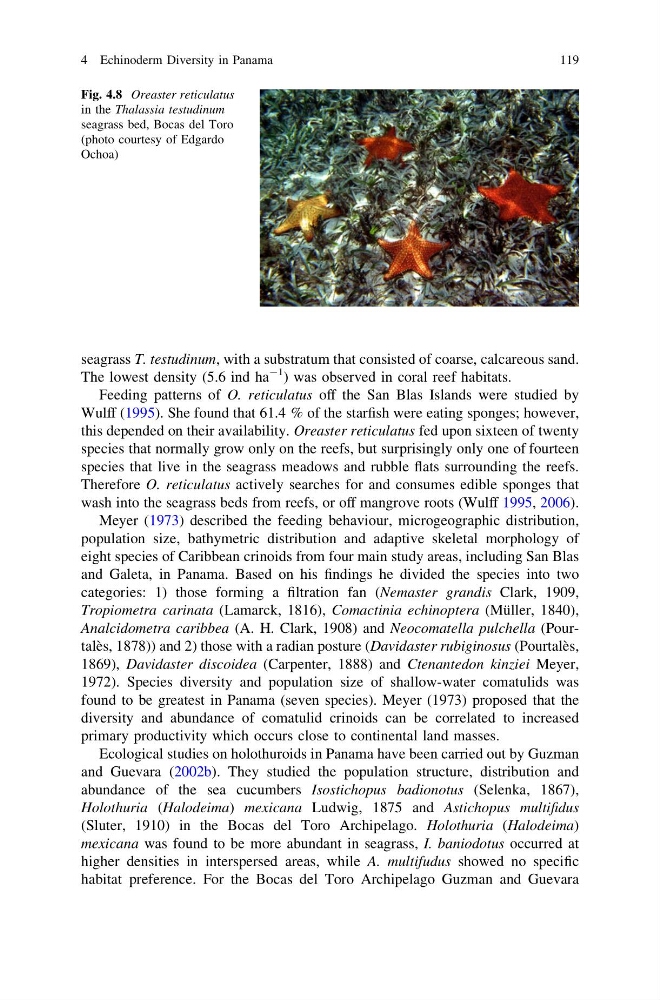
seagrass T. testudinum, with a substratum that consisted of coarse, calcareous sand.
The lowest density (5.6 ind ha
-1
) was observed in coral reef habitats.
Feeding patterns of O. reticulatus off the San Blas Islands were studied by
Wulff (1995). She found that 61.4 % of the starfish were eating sponges; however,
this depended on their availability. Oreaster reticulatus fed upon sixteen of twenty
species that normally grow only on the reefs, but surprisingly only one of fourteen
species that live in the seagrass meadows and rubble flats surrounding the reefs.
Therefore O. reticulatus actively searches for and consumes edible sponges that
wash into the seagrass beds from reefs, or off mangrove roots (Wulff 1995, 2006).
Meyer (1973) described the feeding behaviour, microgeographic distribution,
population size, bathymetric distribution and adaptive skeletal morphology of
eight species of Caribbean crinoids from four main study areas, including San Blas
and Galeta, in Panama. Based on his findings he divided the species into two
categories: 1) those forming a filtration fan (Nemaster grandis Clark, 1909,
Tropiometra carinata (Lamarck, 1816), Comactinia echinoptera (Müller, 1840),
Analcidometra caribbea (A. H. Clark, 1908) and Neocomatella pulchella (Pourtalès, 1878)) and 2) those with a radian posture (Davidaster rubiginosus (Pourtalès,
1869), Davidaster discoidea (Carpenter, 1888) and Ctenantedon kinziei Meyer,
1972). Species diversity and population size of shallow-water comatulids was
found to be greatest in Panama (seven species). Meyer (1973) proposed that the
diversity and abundance of comatulid crinoids can be correlated to increased
primary productivity which occurs close to continental land masses.
Ecological studies on holothuroids in Panama have been carried out by Guzman
and Guevara (2002b). They studied the population structure, distribution and
abundance of the sea cucumbers Isostichopus badionotus (Selenka, 1867),
Holothuria (Halodeima) mexicana Ludwig, 1875 and Astichopus multifidus
(Sluter, 1910) in the Bocas del Toro Archipelago. Holothuria (Halodeima)
mexicana was found to be more abundant in seagrass, I. baniodotus occurred at
higher densities in interspersed areas, while A. multifudus showed no specific
habitat preference. For the Bocas del Toro Archipelago Guzman and Guevara
Fig. 4.8 Oreaster reticulatus
in the Thalassia testudinum
seagrass bed, Bocas del Toro
(photo courtesy of Edgardo
Ochoa)
4 Echinoderm Diversity in Panama
119
The lowest density (5.6 ind ha
-1
) was observed in coral reef habitats.
Feeding patterns of O. reticulatus off the San Blas Islands were studied by
Wulff (1995). She found that 61.4 % of the starfish were eating sponges; however,
this depended on their availability. Oreaster reticulatus fed upon sixteen of twenty
species that normally grow only on the reefs, but surprisingly only one of fourteen
species that live in the seagrass meadows and rubble flats surrounding the reefs.
Therefore O. reticulatus actively searches for and consumes edible sponges that
wash into the seagrass beds from reefs, or off mangrove roots (Wulff 1995, 2006).
Meyer (1973) described the feeding behaviour, microgeographic distribution,
population size, bathymetric distribution and adaptive skeletal morphology of
eight species of Caribbean crinoids from four main study areas, including San Blas
and Galeta, in Panama. Based on his findings he divided the species into two
categories: 1) those forming a filtration fan (Nemaster grandis Clark, 1909,
Tropiometra carinata (Lamarck, 1816), Comactinia echinoptera (Müller, 1840),
Analcidometra caribbea (A. H. Clark, 1908) and Neocomatella pulchella (Pourtalès, 1878)) and 2) those with a radian posture (Davidaster rubiginosus (Pourtalès,
1869), Davidaster discoidea (Carpenter, 1888) and Ctenantedon kinziei Meyer,
1972). Species diversity and population size of shallow-water comatulids was
found to be greatest in Panama (seven species). Meyer (1973) proposed that the
diversity and abundance of comatulid crinoids can be correlated to increased
primary productivity which occurs close to continental land masses.
Ecological studies on holothuroids in Panama have been carried out by Guzman
and Guevara (2002b). They studied the population structure, distribution and
abundance of the sea cucumbers Isostichopus badionotus (Selenka, 1867),
Holothuria (Halodeima) mexicana Ludwig, 1875 and Astichopus multifidus
(Sluter, 1910) in the Bocas del Toro Archipelago. Holothuria (Halodeima)
mexicana was found to be more abundant in seagrass, I. baniodotus occurred at
higher densities in interspersed areas, while A. multifudus showed no specific
habitat preference. For the Bocas del Toro Archipelago Guzman and Guevara
Fig. 4.8 Oreaster reticulatus
in the Thalassia testudinum
seagrass bed, Bocas del Toro
(photo courtesy of Edgardo
Ochoa)
4 Echinoderm Diversity in Panama
119