

dispersed, surviving coral. As the reefs recovered the relative effect of predation by
A. planci intensified due to the loss of the crustacean guards (Trapezia and
Alpheus), therefore reducing local coral species diversity (Glynn 1985b).
Fong and Glynn (1998) modelled the impacts of predation by A. planci and that
of the El Niño-Southern Oscillation (ENSO) on the structure of a population of the
massive coral Gardineroseris planulata (Dana, 1846) on Uva Reef. The results of
the simulations suggested that predation was far more important than the ENSO in
controlling the size structure of the coral G. planulata in the eastern Pacific.
Although A. planci has few predators, it has been observed in Panama being
attacked by the Harlequin shrimp Hymenocera picta Dana, 1852 and by the
polychaete Pherecardia striata (Kingberg, 1857) (Glynn 1981). The shrimp
attacks the aboral surface of the starfish, eventually amputating the arms and using
its chelae to expose and feed on the internal soft parts. However, the harlequin
shrimp typically prefers other starfish species such as Phataria unifacialis (Gray,
1840), Pharia piramidatus (Gray, 1840) and Nidorellia armata (Gray, 1840)
(Glynn 1977). The wounds created by the harlequin shrimp are used also by the
polychaete P. striata to enter A. planci and feed on the internal tissues. Glynn
(1981) calculated that 5–6 % of the A. planci population is under attack by
H. picta and about half of these starfish are killed over a 3-week period.
Guzman and Guevara (2002a) studied the spatial distribution, abundance, and
size structure of Oreaster reticulatus (Linnaeus, 1758) (Fig. 4.8) in the Bocas del
Toro Archipelago. They found a mean density of 149.7 ind ha
-1 and estimated the
population size to be over seven million. Approximately 45 % of the population
was found at a density of 308.3 ± 50.9 ind ha
-1 , in areas dominated by the
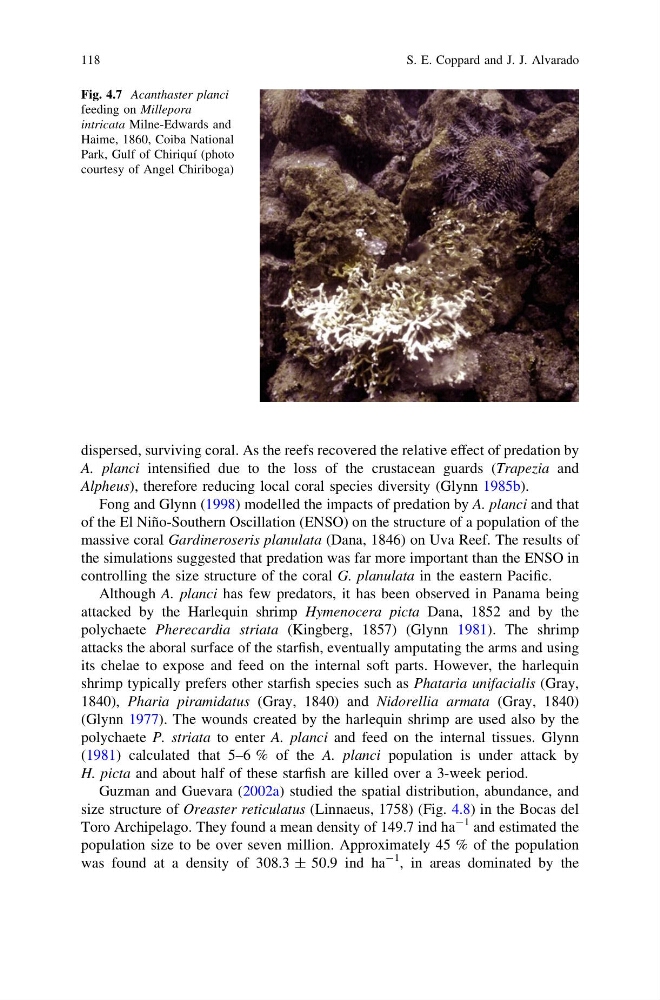
Fig. 4.7 Acanthaster planci
feeding on Millepora
intricata Milne-Edwards and
Haime, 1860, Coiba National
Park, Gulf of Chiriquí (photo
courtesy of Angel Chiriboga)
118
S. E. Coppard and J. J. Alvarado
A. planci intensified due to the loss of the crustacean guards (Trapezia and
Alpheus), therefore reducing local coral species diversity (Glynn 1985b).
Fong and Glynn (1998) modelled the impacts of predation by A. planci and that
of the El Niño-Southern Oscillation (ENSO) on the structure of a population of the
massive coral Gardineroseris planulata (Dana, 1846) on Uva Reef. The results of
the simulations suggested that predation was far more important than the ENSO in
controlling the size structure of the coral G. planulata in the eastern Pacific.
Although A. planci has few predators, it has been observed in Panama being
attacked by the Harlequin shrimp Hymenocera picta Dana, 1852 and by the
polychaete Pherecardia striata (Kingberg, 1857) (Glynn 1981). The shrimp
attacks the aboral surface of the starfish, eventually amputating the arms and using
its chelae to expose and feed on the internal soft parts. However, the harlequin
shrimp typically prefers other starfish species such as Phataria unifacialis (Gray,
1840), Pharia piramidatus (Gray, 1840) and Nidorellia armata (Gray, 1840)
(Glynn 1977). The wounds created by the harlequin shrimp are used also by the
polychaete P. striata to enter A. planci and feed on the internal tissues. Glynn
(1981) calculated that 5–6 % of the A. planci population is under attack by
H. picta and about half of these starfish are killed over a 3-week period.
Guzman and Guevara (2002a) studied the spatial distribution, abundance, and
size structure of Oreaster reticulatus (Linnaeus, 1758) (Fig. 4.8) in the Bocas del
Toro Archipelago. They found a mean density of 149.7 ind ha
-1 and estimated the
population size to be over seven million. Approximately 45 % of the population
was found at a density of 308.3 ± 50.9 ind ha
-1 , in areas dominated by the
Fig. 4.7 Acanthaster planci
feeding on Millepora
intricata Milne-Edwards and
Haime, 1860, Coiba National
Park, Gulf of Chiriquí (photo
courtesy of Angel Chiriboga)
118
S. E. Coppard and J. J. Alvarado