

less than 1 year. Recruitment of the population was reported to occur throughout
the year, but with a peak in settlement during February, in the middle of the
Panamanian dry season. This is the season of increased food availability for
planktotrophic larvae, due to the upwelling of nutrients and subsequent increase in
phytoplankton (Martin et al. 1970).
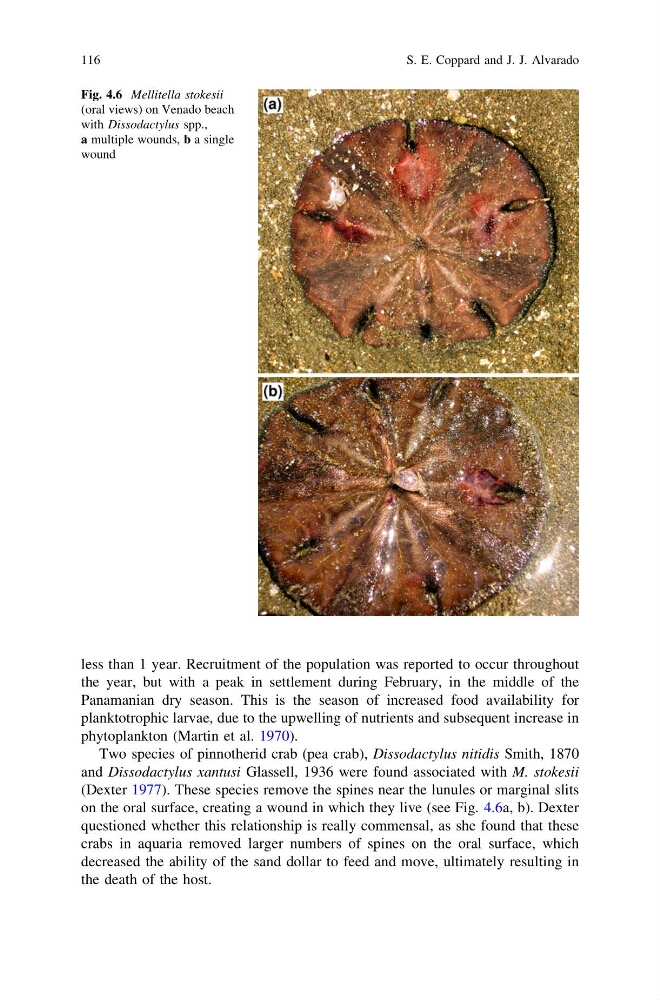
Two species of pinnotherid crab (pea crab), Dissodactylus nitidis Smith, 1870
and Dissodactylus xantusi Glassell, 1936 were found associated with M. stokesii
(Dexter 1977). These species remove the spines near the lunules or marginal slits
on the oral surface, creating a wound in which they live (see Fig. 4.6a, b). Dexter
questioned whether this relationship is really commensal, as she found that these
crabs in aquaria removed larger numbers of spines on the oral surface, which
decreased the ability of the sand dollar to feed and move, ultimately resulting in
the death of the host.
Fig. 4.6 Mellitella stokesii
(oral views) on Venado beach
with Dissodactylus spp.,
a multiple wounds, b a single
wound
116
S. E. Coppard and J. J. Alvarado
the year, but with a peak in settlement during February, in the middle of the
Panamanian dry season. This is the season of increased food availability for
planktotrophic larvae, due to the upwelling of nutrients and subsequent increase in
phytoplankton (Martin et al. 1970).
Two species of pinnotherid crab (pea crab), Dissodactylus nitidis Smith, 1870
and Dissodactylus xantusi Glassell, 1936 were found associated with M. stokesii
(Dexter 1977). These species remove the spines near the lunules or marginal slits
on the oral surface, creating a wound in which they live (see Fig. 4.6a, b). Dexter
questioned whether this relationship is really commensal, as she found that these
crabs in aquaria removed larger numbers of spines on the oral surface, which
decreased the ability of the sand dollar to feed and move, ultimately resulting in
the death of the host.
Fig. 4.6 Mellitella stokesii
(oral views) on Venado beach
with Dissodactylus spp.,
a multiple wounds, b a single
wound
116
S. E. Coppard and J. J. Alvarado