

high of 65 ind m
-2 in the dry season, with numbers concentrated in the midintertidal zone where the median sediment grain size was between 170 and
200 lm. No sand dollars were found in the muddy sand bar which had a high silt
and clay fraction. Migrations towards the substrate surface were observed at low
tide which correlated with the appearance of an organic film on the substrate,
composed of a combination of diatoms and fine detrital material. Observations by
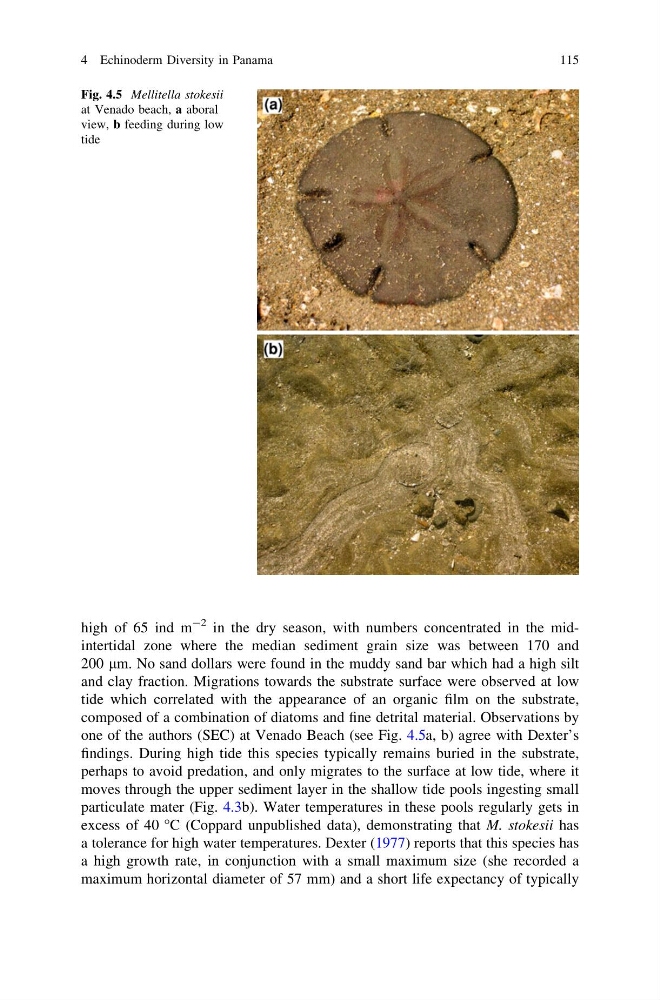
one of the authors (SEC) at Venado Beach (see Fig. 4.5a, b) agree with Dexter’s
findings. During high tide this species typically remains buried in the substrate,
perhaps to avoid predation, and only migrates to the surface at low tide, where it
moves through the upper sediment layer in the shallow tide pools ingesting small
particulate mater (Fig. 4.3b). Water temperatures in these pools regularly gets in
excess of 40 °C (Coppard unpublished data), demonstrating that M. stokesii has
a tolerance for high water temperatures. Dexter (1977) reports that this species has
a high growth rate, in conjunction with a small maximum size (she recorded a
maximum horizontal diameter of 57 mm) and a short life expectancy of typically
Fig. 4.5 Mellitella stokesii
at Venado beach, a aboral
view, b feeding during low
tide
4 Echinoderm Diversity in Panama
115
-2 in the dry season, with numbers concentrated in the midintertidal zone where the median sediment grain size was between 170 and
200 lm. No sand dollars were found in the muddy sand bar which had a high silt
and clay fraction. Migrations towards the substrate surface were observed at low
tide which correlated with the appearance of an organic film on the substrate,
composed of a combination of diatoms and fine detrital material. Observations by
one of the authors (SEC) at Venado Beach (see Fig. 4.5a, b) agree with Dexter’s
findings. During high tide this species typically remains buried in the substrate,
perhaps to avoid predation, and only migrates to the surface at low tide, where it
moves through the upper sediment layer in the shallow tide pools ingesting small
particulate mater (Fig. 4.3b). Water temperatures in these pools regularly gets in
excess of 40 °C (Coppard unpublished data), demonstrating that M. stokesii has
a tolerance for high water temperatures. Dexter (1977) reports that this species has
a high growth rate, in conjunction with a small maximum size (she recorded a
maximum horizontal diameter of 57 mm) and a short life expectancy of typically
Fig. 4.5 Mellitella stokesii
at Venado beach, a aboral
view, b feeding during low
tide
4 Echinoderm Diversity in Panama
115