

3.3. TWO-DIMENSIONAL MORPHOLOGICAL ANALYSI S OF RANGES OF GROWTH FORMS
fications of its branch structure and branch spacing, M. mirabilis can function
efficiently as a passive suspension feeder over a wide range of different degrees
of exposure to water movement.
3.3.1 Sampling Growth Forms Along a Gradient
of Increasing Water Movement
For the measurements a series of sponge samples (Haliclona oculata) was
used; these samples were collected at different sites in the Oosterschelde, the
Netherlands. For each site the exposure to water movement was estimated
quantitatively by relating the exposure to water movement to the erosion
of gypsum blocks. The erosion value (g h-1) is expressed as the weight loss
of the gypsum blocks during a lunar day (24 h 45 min) (see de Kluijver
1989, Kaandorp 1991). The series of samples of the hydrozoan Millepora
alcicornis was collected at different depths in the Caribbean area (see de
Weerdt 1981). The exact exposure to water movement was not known for
these samples, but it was assumed that exposure decreases uniformly with
depth. For the scleractinian coral Pocillopora damicornis measurements were
based on photographs published in Veron and Pichon (1976) and shown in
Fig. 1.1. In their book Veron and Pichon arranged samples in 11 classes of
growth forms originating from sites with different values of exposure to water
77
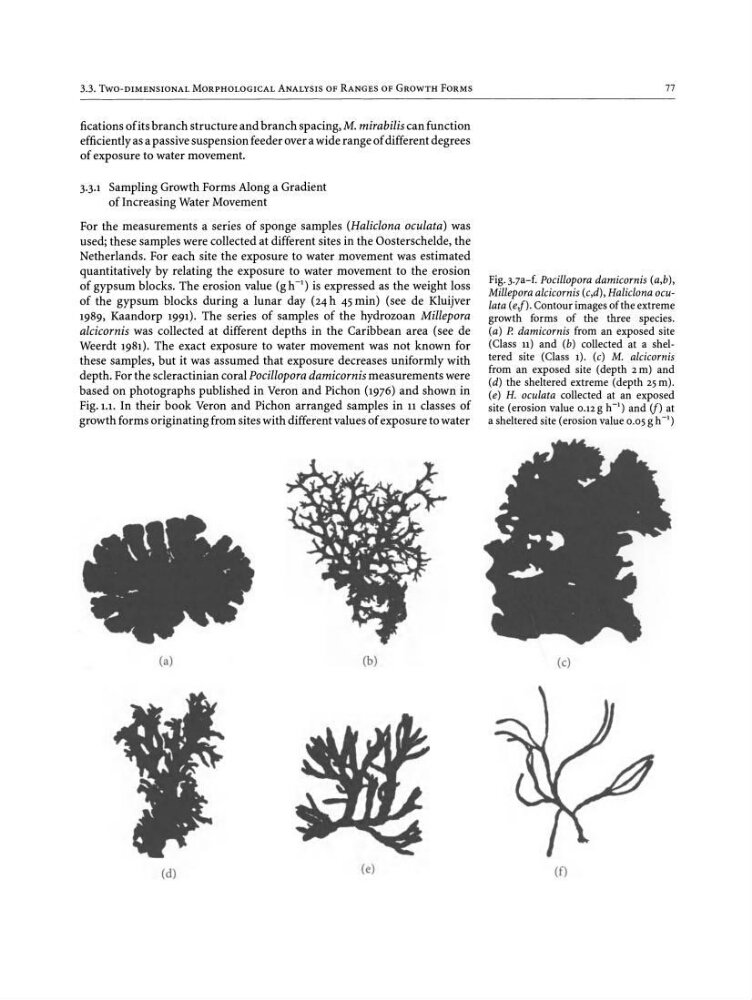
Fig. pa-f. Pocillopora damicornis (a,b),
Milleporaalcicornis (c,d), Haliclona oculata(e,f) .Contour images of the extreme
growth forms of the three species.
(a) P. damicornis from an exposed site
(Class 11) and (b) collected at a sheltered site (Class I). (c) M. alcicornis
from an exposed site (depth 2 m) and
(d) the sheltered extreme (depth 25m) .
(e) H. oculata collected at an exposed
site (erosion value 0.I2g h1
) and if) at
a sheltered site (erosion value 0.05 g h -1)
(a)
(d)
(b)
(e)
(c)
(f)
fications of its branch structure and branch spacing, M. mirabilis can function
efficiently as a passive suspension feeder over a wide range of different degrees
of exposure to water movement.
3.3.1 Sampling Growth Forms Along a Gradient
of Increasing Water Movement
For the measurements a series of sponge samples (Haliclona oculata) was
used; these samples were collected at different sites in the Oosterschelde, the
Netherlands. For each site the exposure to water movement was estimated
quantitatively by relating the exposure to water movement to the erosion
of gypsum blocks. The erosion value (g h-1) is expressed as the weight loss
of the gypsum blocks during a lunar day (24 h 45 min) (see de Kluijver
1989, Kaandorp 1991). The series of samples of the hydrozoan Millepora
alcicornis was collected at different depths in the Caribbean area (see de
Weerdt 1981). The exact exposure to water movement was not known for
these samples, but it was assumed that exposure decreases uniformly with
depth. For the scleractinian coral Pocillopora damicornis measurements were
based on photographs published in Veron and Pichon (1976) and shown in
Fig. 1.1. In their book Veron and Pichon arranged samples in 11 classes of
growth forms originating from sites with different values of exposure to water
77
Fig. pa-f. Pocillopora damicornis (a,b),
Milleporaalcicornis (c,d), Haliclona oculata(e,f) .Contour images of the extreme
growth forms of the three species.
(a) P. damicornis from an exposed site
(Class 11) and (b) collected at a sheltered site (Class I). (c) M. alcicornis
from an exposed site (depth 2 m) and
(d) the sheltered extreme (depth 25m) .
(e) H. oculata collected at an exposed
site (erosion value 0.I2g h1
) and if) at
a sheltered site (erosion value 0.05 g h -1)
(a)
(d)
(b)
(e)
(c)
(f)