

58
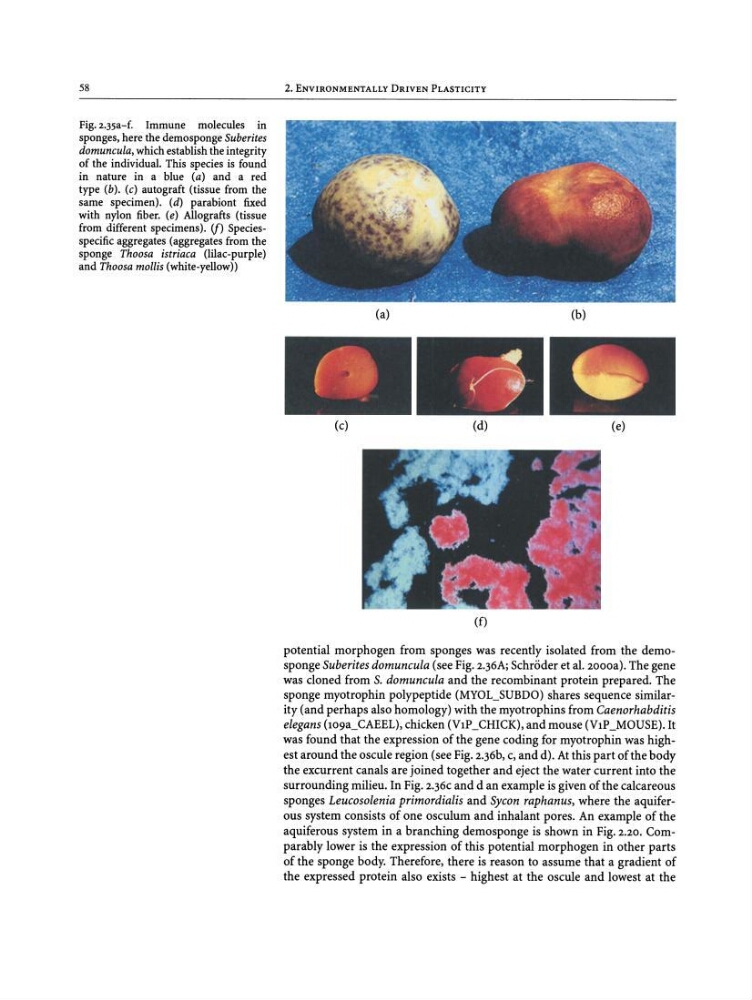
Pig.z.jsa-f. Immune molecules in
sponges, here the demosponge Suberites
domuncula, which establish the integrity
of the individual. This species is found
in nature in a blue (a) and a red
type (b) . (c) autograft (tissue from the
same specimen). (d) parabiont fixed
with nylon fiber. (e) Allografts (tissue
from different specimens). if) Speciesspecific aggregates (aggregates from the
sponge Thoosa istriaca (lilac-purple)
and Thoosa mol/is (white-yellow»
2. ENVIRONMENTALLY DRIVEN PLASTICITY
(a)
(b)
(c)
(d)
(f)
(e)
potential morphogen from sponges was recently isolated from the demosponge Suberitesdomuncula (see Fig. 2.36A; Schroder et al. 2000a). The gene
was cloned from S. domuncula and the recombinant protein prepared. The
sponge myotrophin polypeptide (MYOL_SUBDO) shares sequence similarity (and perhaps also homology) with the myotrophins from Caenorhabditis
elegans(Io9a_CAEEL), chicken (VIP_CHICK), and mouse (VIP_MOUSE). It
was found that the expression of the gene coding for myotrophin was highest around the oscule region (see Fig. 2.36b,c, and d). At this part of the body
the excurrent canals are joined together and eject the water current into the
surrounding milieu . In Fig. 2.36cand d an example is given of the calcareous
sponges Leucosolenia primordialis and Sycon raphanus, where the aquiferous system consists of one osculum and inhalant pores. An example of the
aquiferous system in a branching demo sponge is shown in Fig. 2.20. Comparably lower is the expression of this potential morphogen in other parts
of the sponge body. Therefore, there is reason to assume that a gradient of
the expressed protein also exists - highest at the oscule and lowest at the
Pig.z.jsa-f. Immune molecules in
sponges, here the demosponge Suberites
domuncula, which establish the integrity
of the individual. This species is found
in nature in a blue (a) and a red
type (b) . (c) autograft (tissue from the
same specimen). (d) parabiont fixed
with nylon fiber. (e) Allografts (tissue
from different specimens). if) Speciesspecific aggregates (aggregates from the
sponge Thoosa istriaca (lilac-purple)
and Thoosa mol/is (white-yellow»
2. ENVIRONMENTALLY DRIVEN PLASTICITY
(a)
(b)
(c)
(d)
(f)
(e)
potential morphogen from sponges was recently isolated from the demosponge Suberitesdomuncula (see Fig. 2.36A; Schroder et al. 2000a). The gene
was cloned from S. domuncula and the recombinant protein prepared. The
sponge myotrophin polypeptide (MYOL_SUBDO) shares sequence similarity (and perhaps also homology) with the myotrophins from Caenorhabditis
elegans(Io9a_CAEEL), chicken (VIP_CHICK), and mouse (VIP_MOUSE). It
was found that the expression of the gene coding for myotrophin was highest around the oscule region (see Fig. 2.36b,c, and d). At this part of the body
the excurrent canals are joined together and eject the water current into the
surrounding milieu . In Fig. 2.36cand d an example is given of the calcareous
sponges Leucosolenia primordialis and Sycon raphanus, where the aquiferous system consists of one osculum and inhalant pores. An example of the
aquiferous system in a branching demo sponge is shown in Fig. 2.20. Comparably lower is the expression of this potential morphogen in other parts
of the sponge body. Therefore, there is reason to assume that a gradient of
the expressed protein also exists - highest at the oscule and lowest at the