

2.2. THE CASE STUDIES
filled endodermal canals (i.e. the lumens of stolons) that runs throughout
the stolonal network and joins the gastric cavities of polyps (Fig. 2.25). One
can idealize stolons as being oriented either radially, extending from the
colony center to the periphery, or circumferentially, growing around the
colony center and joining adjacent radial canals. Oscillations by polyps (expansion/contraction cycles) import and export fluid to and from the gastric
cavity and transport it through the lumen of stolons to other polyps and
growing stolon tips, resulting in the colony-wide exchange of nutrients and
dissolved gases (Dudgeon et al. 1999). Fluid flowsalternately in each direction
within a stolon.
The variation in morphology and integration of hydrozoan colonies is
best characterized in the encrusting hydractiniid genera, Podocoryne and
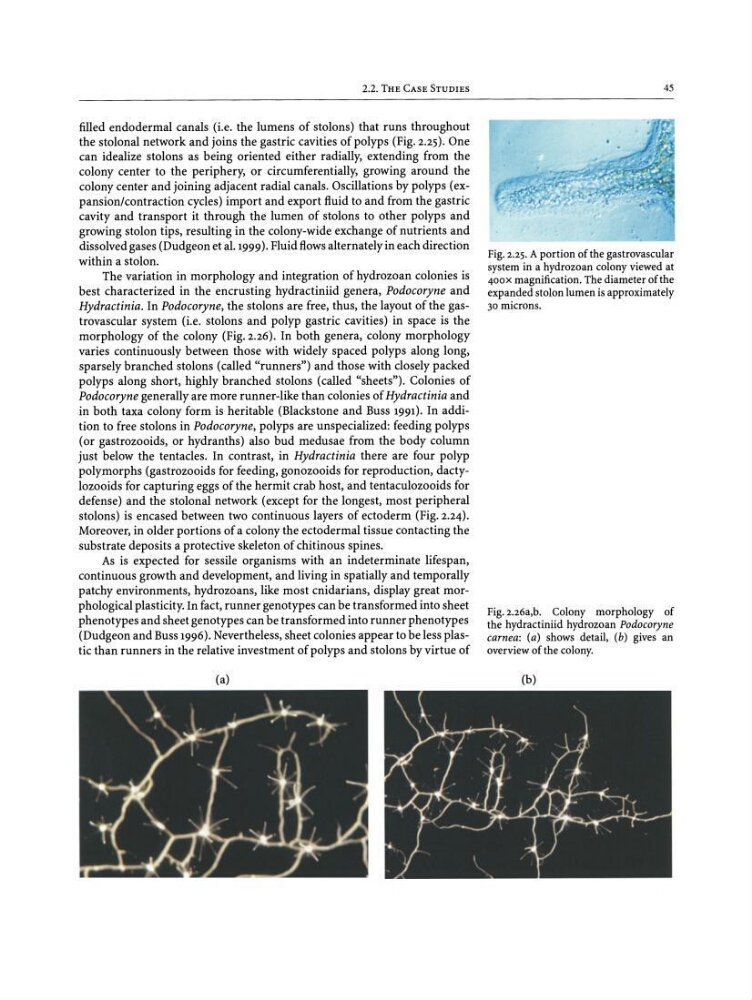
Hydractinia. In Podocoryne, the stolons are free, thus, the layout of the gastrovascular system (i.e. stolons and polyp gastric cavities) in space is the
morphology of the colony (Fig. 2.26). In both genera, colony morphology
varies continuously between those with widely spaced polyps along long,
sparsely branched stolons (called "runners") and those with closely packed
polyps along short, highly branched stolons (called "sheets") . Colonies of
Podocoryne generally are more runner-like than colonies of Hydractinia and
in both taxa colony form is heritable (Blackstone and Buss 1991). In addition to free stolons in Podocoryne, polyps are unspecialized: feeding polyps
(or gastrozooids, or hydranths) also bud medusae from the body column
just below the tentacles. In contrast, in Hydractinia there are four polyp
polymorphs (gastrozooids for feeding, gonozooids for reproduction, dactylozooids for capturing eggs of the hermit crab host, and tentaculozooids for
defense) and the stolonal network (except for the longest, most peripheral
stolons) is encased between two continuous layers of ectoderm (Fig. 2.24).
Moreover, in older portions of a colony the ectodermal tissue contacting the
substrate deposits a protective skeleton of chitinous spines.
As is expected for sessile organisms with an indeterminate lifespan,
continuous growth and development, and living in spatially and temporally
patchy environments, hydrozoans, like most cnidarians, display great morphological plasticity. In fact, runner genotypes can be transformed into sheet
phenotypes and sheet genotypes can be transformed into runner phenotypes
(Dudgeon and Buss 1996). Nevertheless, sheet colonies appear to be less plastic than runners in the relative investment of polyps and stolons by virtue of
(a)
45
Fig. 2.25. A portion of the gastrovascular
system in a hydrozoan colony viewed at
400X magnification. The diameter of the
expanded stolon lumen is approximately
30 microns.
Fig. 2.26a,b. Colony morphology of
the hydractiniid hydrozoan Podocoryne
carnea: (a) shows detail, (b) gives an
overview of the colony.
(b)
filled endodermal canals (i.e. the lumens of stolons) that runs throughout
the stolonal network and joins the gastric cavities of polyps (Fig. 2.25). One
can idealize stolons as being oriented either radially, extending from the
colony center to the periphery, or circumferentially, growing around the
colony center and joining adjacent radial canals. Oscillations by polyps (expansion/contraction cycles) import and export fluid to and from the gastric
cavity and transport it through the lumen of stolons to other polyps and
growing stolon tips, resulting in the colony-wide exchange of nutrients and
dissolved gases (Dudgeon et al. 1999). Fluid flowsalternately in each direction
within a stolon.
The variation in morphology and integration of hydrozoan colonies is
best characterized in the encrusting hydractiniid genera, Podocoryne and
Hydractinia. In Podocoryne, the stolons are free, thus, the layout of the gastrovascular system (i.e. stolons and polyp gastric cavities) in space is the
morphology of the colony (Fig. 2.26). In both genera, colony morphology
varies continuously between those with widely spaced polyps along long,
sparsely branched stolons (called "runners") and those with closely packed
polyps along short, highly branched stolons (called "sheets") . Colonies of
Podocoryne generally are more runner-like than colonies of Hydractinia and
in both taxa colony form is heritable (Blackstone and Buss 1991). In addition to free stolons in Podocoryne, polyps are unspecialized: feeding polyps
(or gastrozooids, or hydranths) also bud medusae from the body column
just below the tentacles. In contrast, in Hydractinia there are four polyp
polymorphs (gastrozooids for feeding, gonozooids for reproduction, dactylozooids for capturing eggs of the hermit crab host, and tentaculozooids for
defense) and the stolonal network (except for the longest, most peripheral
stolons) is encased between two continuous layers of ectoderm (Fig. 2.24).
Moreover, in older portions of a colony the ectodermal tissue contacting the
substrate deposits a protective skeleton of chitinous spines.
As is expected for sessile organisms with an indeterminate lifespan,
continuous growth and development, and living in spatially and temporally
patchy environments, hydrozoans, like most cnidarians, display great morphological plasticity. In fact, runner genotypes can be transformed into sheet
phenotypes and sheet genotypes can be transformed into runner phenotypes
(Dudgeon and Buss 1996). Nevertheless, sheet colonies appear to be less plastic than runners in the relative investment of polyps and stolons by virtue of
(a)
45
Fig. 2.25. A portion of the gastrovascular
system in a hydrozoan colony viewed at
400X magnification. The diameter of the
expanded stolon lumen is approximately
30 microns.
Fig. 2.26a,b. Colony morphology of
the hydractiniid hydrozoan Podocoryne
carnea: (a) shows detail, (b) gives an
overview of the colony.
(b)