

32
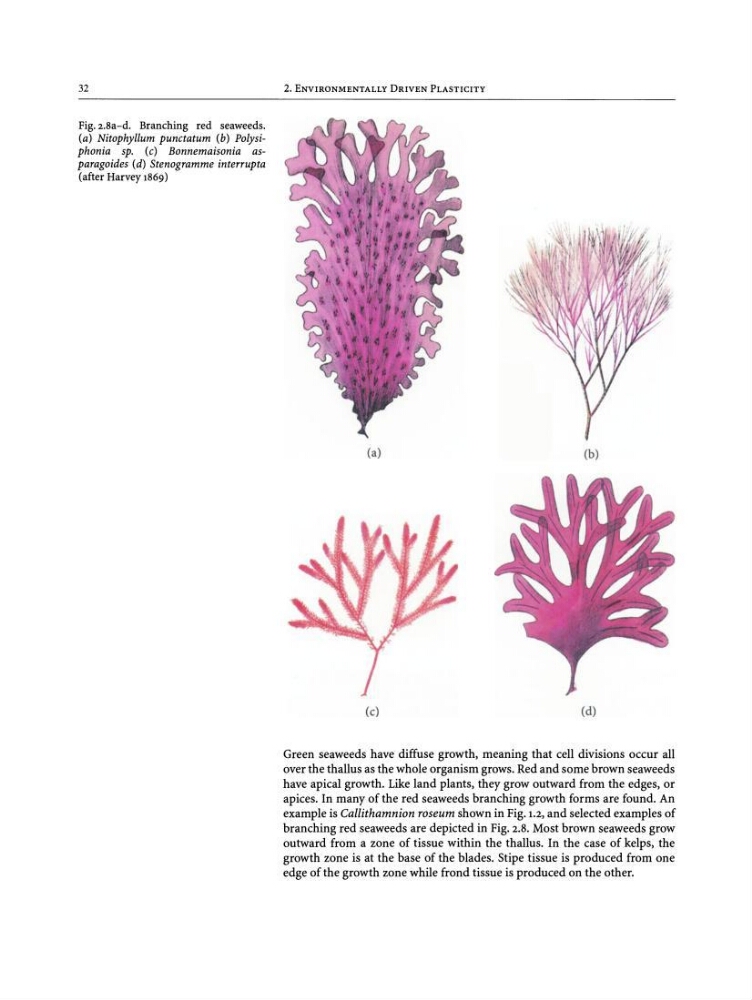
Pig.z.sa-d, Branching red seaweeds.
(a) Nitophyllum punctatum (b) Polysiphonia sp. (c) Bonnemaisonia asparagoides (d) Stenogramme interrupta
(after Harvey 1869)
2. ENVIRONMENTALLY DRIVEN PLASTICITY
(a)
(c)
(b)
(d)
Green seaweeds have diffuse growth, meaning that cell divisions occur all
over the thallus as the whole organism grows. Red and some brown seaweeds
have apical growth . Like land plants, they grow outward from the edges, or
apices. In many of the red seaweeds branching growth forms are found. An
example is Callithamnion roseum shown in Fig. 1.2, and selected examples of
branching red seaweeds are depicted in Fig. 2.8. Most brown seaweeds grow
outward from a zone of tissue within the thallus. In the case of kelps, the
growth zone is at the base of the blades. Stipe tissue is produced from one
edge of the growth zone while frond tissue is produced on the other.
Pig.z.sa-d, Branching red seaweeds.
(a) Nitophyllum punctatum (b) Polysiphonia sp. (c) Bonnemaisonia asparagoides (d) Stenogramme interrupta
(after Harvey 1869)
2. ENVIRONMENTALLY DRIVEN PLASTICITY
(a)
(c)
(b)
(d)
Green seaweeds have diffuse growth, meaning that cell divisions occur all
over the thallus as the whole organism grows. Red and some brown seaweeds
have apical growth . Like land plants, they grow outward from the edges, or
apices. In many of the red seaweeds branching growth forms are found. An
example is Callithamnion roseum shown in Fig. 1.2, and selected examples of
branching red seaweeds are depicted in Fig. 2.8. Most brown seaweeds grow
outward from a zone of tissue within the thallus. In the case of kelps, the
growth zone is at the base of the blades. Stipe tissue is produced from one
edge of the growth zone while frond tissue is produced on the other.