

2.2. THE CASE STUDIES
as diatoms which date to 900 million years ago, but the earliest putative
brown seaweed appeared only 490 million years ago in the ordovician epoch
(Graham and Wilcox 1999).
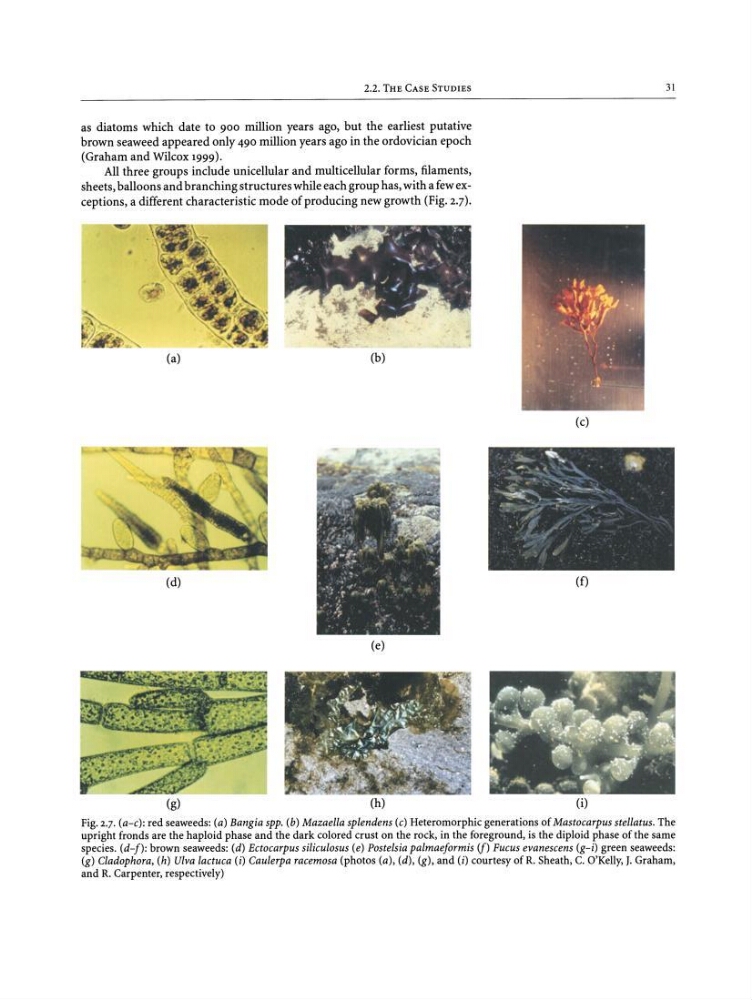
All three groups include unicellular and multicellular forms, filaments,
sheets, balloons and branching structures while each group has, with a few exceptions' a different characteristic mode of producing new growth (Fig. 2.7).
31
(a)
(d)
(g)
(b)
(e)
(h)
(c)
(0
(i)
Fig. 2.7. (a-c ): red seaweeds: (a) Bangia spp. (b) Mazaella splendens (c) Heteromorphic generations of Mastocarpus stellatus. The
upright fronds are the haploid pha se and the dark colored crust on the rock, in the foreground, is the diploid phase of the same
species. (d-/): brown seaweeds: (d) Ectocarpus siliculosus (e) Postelsia palmaefo rmis (f) Fucus evanescens (g- i) green seaweeds:
(g) Cladophora, (h) Ulva lactuca (i) Caulerpa racemosa (photos (a), (d), (g), and (i ) courtesy of R. Sheath, C. O'Kelly, J. Graham ,
and R. Carpenter, respecti vely)
as diatoms which date to 900 million years ago, but the earliest putative
brown seaweed appeared only 490 million years ago in the ordovician epoch
(Graham and Wilcox 1999).
All three groups include unicellular and multicellular forms, filaments,
sheets, balloons and branching structures while each group has, with a few exceptions' a different characteristic mode of producing new growth (Fig. 2.7).
31
(a)
(d)
(g)
(b)
(e)
(h)
(c)
(0
(i)
Fig. 2.7. (a-c ): red seaweeds: (a) Bangia spp. (b) Mazaella splendens (c) Heteromorphic generations of Mastocarpus stellatus. The
upright fronds are the haploid pha se and the dark colored crust on the rock, in the foreground, is the diploid phase of the same
species. (d-/): brown seaweeds: (d) Ectocarpus siliculosus (e) Postelsia palmaefo rmis (f) Fucus evanescens (g- i) green seaweeds:
(g) Cladophora, (h) Ulva lactuca (i) Caulerpa racemosa (photos (a), (d), (g), and (i ) courtesy of R. Sheath, C. O'Kelly, J. Graham ,
and R. Carpenter, respecti vely)