

1. INTRODUCTION
Another reason why marine sessile organisms are an important case study is
that growth and form is closely linked with the state of the physical environment . There exist potentially many applications in biomonitoring research,
where the growth form in combination with simulation models is analyzed to
assess the state of the physical environment. In the series of growth forms of
Pocillopora damicornis in Fig. 1.1 it is potentially possible to assess the state
of the environment, in this case the amount of water movement from the
growth forms . In, for example, a study by Bosence (1976) the morphology of
coralline algae was correlated to the amount of water movement. Coralline
algae represent an important part of the fossil record and Bosence in his
paper argues that these different morphologies enable palaeontologists to
make detailed interpretations of the palaeoenvironment. Because of their
enormous age (up to hundreds or thousands of years) and because of their
morphological plasticity due to the environmental influence, some of the marine sessile organisms, for example stromatolites, coralline algae, sponges,
and stony corals can be used as bioarchives, in which information on the
state of the environment is stored during the growth process. A very good
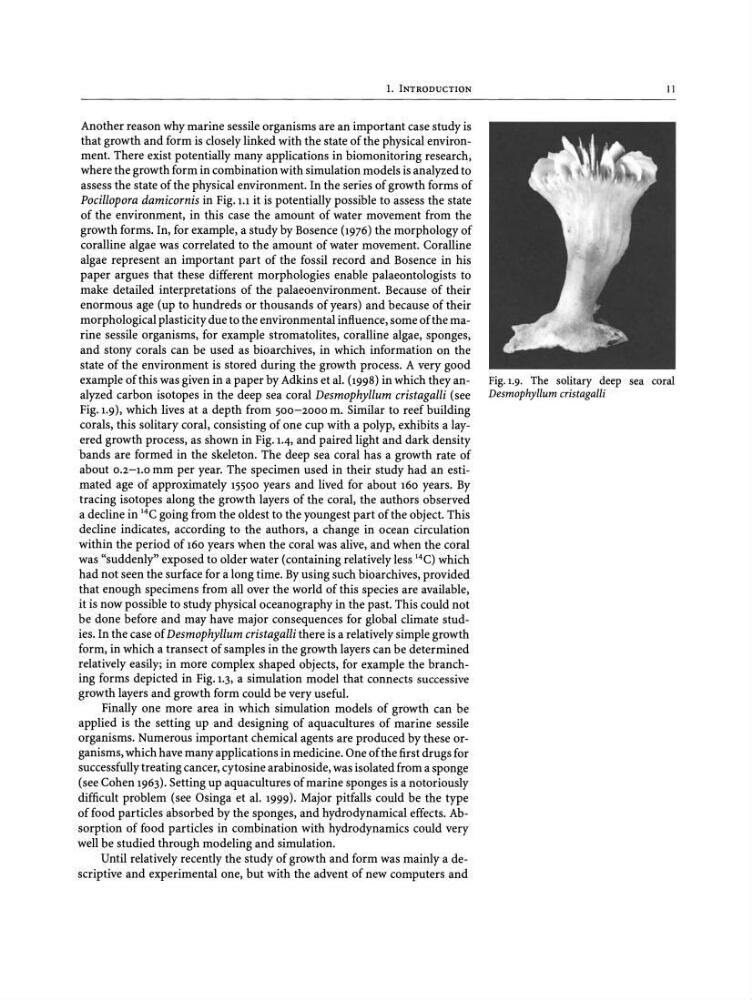
example of this was given in a paper by Adkins et al. (1998) in which they analyzed carbon isotopes in the deep sea coral Desmophyllum cristagalli (see
Fig. 1.9), which lives at a depth from 500-2000 m. Similar to reef building
corals, this solitary coral, consisting of one cup with a polyp, exhibits a layered growth process, as shown in Fig. 1.4, and paired light and dark density
bands are formed in the skeleton . The deep sea coral has a growth rate of
about 0.2-1.0 mm per year. The specimen used in their study had an estimated age of approximately 15500 years and lived for about 160 years. By
tracing isotopes along the growth layers of the coral, the authors observed
a decline in 1
4 C going from the oldest to the youngest part of the object. This
decline indicates, accord ing to the authors, a change in ocean circulation
within the period of 160 years when the coral was alive, and when the coral
was "suddenly" exposed to older water (containing relatively less 1 4 C) which
had not seen the surface for a long time . By using such bioarchives, provided
that enough specimens from all over the world of this species are available,
it is now possible to study physical oceanography in the past. This could not
be done before and may have major consequences for global climate studies. In the case of Desmophyllum cristagallithere is a relatively simple growth
form, in which a transect of samples in the growth layers can be determined
relatively easily; in more complex shaped objects, for example the branching forms depicted in Fig. 1.3, a simulation model that connects successive
growth layers and growth form could be very useful.
Finally one more area in which simulation models of growth can be
applied is the setting up and designing of aqua cultures of marine sessile
organisms. Numerous important chemical agents are produced by these organisms, which have many applications in medicine. One of the first drugs for
successfully treating cancer, cytosine arabinoside, was isolated from a sponge
(see Cohen 1963). Setting up aquacultures of marine sponges is a notoriously
difficult problem (see Osinga et al. 1999). Major pitfalls could be the type
of food particles absorbed by the sponges, and hydrodynamical effects. Absorption of food particles in combination with hydrodynamics could very
well be studied through modeling and simulation.
Until relatively recently the study of growth and form was mainly a descriptive and experimental one, but with the advent of new computers and
II
Fig. 1.9. The solitary deep sea coral
Desmophyllum cristagalli
Another reason why marine sessile organisms are an important case study is
that growth and form is closely linked with the state of the physical environment . There exist potentially many applications in biomonitoring research,
where the growth form in combination with simulation models is analyzed to
assess the state of the physical environment. In the series of growth forms of
Pocillopora damicornis in Fig. 1.1 it is potentially possible to assess the state
of the environment, in this case the amount of water movement from the
growth forms . In, for example, a study by Bosence (1976) the morphology of
coralline algae was correlated to the amount of water movement. Coralline
algae represent an important part of the fossil record and Bosence in his
paper argues that these different morphologies enable palaeontologists to
make detailed interpretations of the palaeoenvironment. Because of their
enormous age (up to hundreds or thousands of years) and because of their
morphological plasticity due to the environmental influence, some of the marine sessile organisms, for example stromatolites, coralline algae, sponges,
and stony corals can be used as bioarchives, in which information on the
state of the environment is stored during the growth process. A very good
example of this was given in a paper by Adkins et al. (1998) in which they analyzed carbon isotopes in the deep sea coral Desmophyllum cristagalli (see
Fig. 1.9), which lives at a depth from 500-2000 m. Similar to reef building
corals, this solitary coral, consisting of one cup with a polyp, exhibits a layered growth process, as shown in Fig. 1.4, and paired light and dark density
bands are formed in the skeleton . The deep sea coral has a growth rate of
about 0.2-1.0 mm per year. The specimen used in their study had an estimated age of approximately 15500 years and lived for about 160 years. By
tracing isotopes along the growth layers of the coral, the authors observed
a decline in 1
4 C going from the oldest to the youngest part of the object. This
decline indicates, accord ing to the authors, a change in ocean circulation
within the period of 160 years when the coral was alive, and when the coral
was "suddenly" exposed to older water (containing relatively less 1 4 C) which
had not seen the surface for a long time . By using such bioarchives, provided
that enough specimens from all over the world of this species are available,
it is now possible to study physical oceanography in the past. This could not
be done before and may have major consequences for global climate studies. In the case of Desmophyllum cristagallithere is a relatively simple growth
form, in which a transect of samples in the growth layers can be determined
relatively easily; in more complex shaped objects, for example the branching forms depicted in Fig. 1.3, a simulation model that connects successive
growth layers and growth form could be very useful.
Finally one more area in which simulation models of growth can be
applied is the setting up and designing of aqua cultures of marine sessile
organisms. Numerous important chemical agents are produced by these organisms, which have many applications in medicine. One of the first drugs for
successfully treating cancer, cytosine arabinoside, was isolated from a sponge
(see Cohen 1963). Setting up aquacultures of marine sponges is a notoriously
difficult problem (see Osinga et al. 1999). Major pitfalls could be the type
of food particles absorbed by the sponges, and hydrodynamical effects. Absorption of food particles in combination with hydrodynamics could very
well be studied through modeling and simulation.
Until relatively recently the study of growth and form was mainly a descriptive and experimental one, but with the advent of new computers and
II
Fig. 1.9. The solitary deep sea coral
Desmophyllum cristagalli