

6
(a)
1. INTRODUCTION
(b)
(c)
(d)
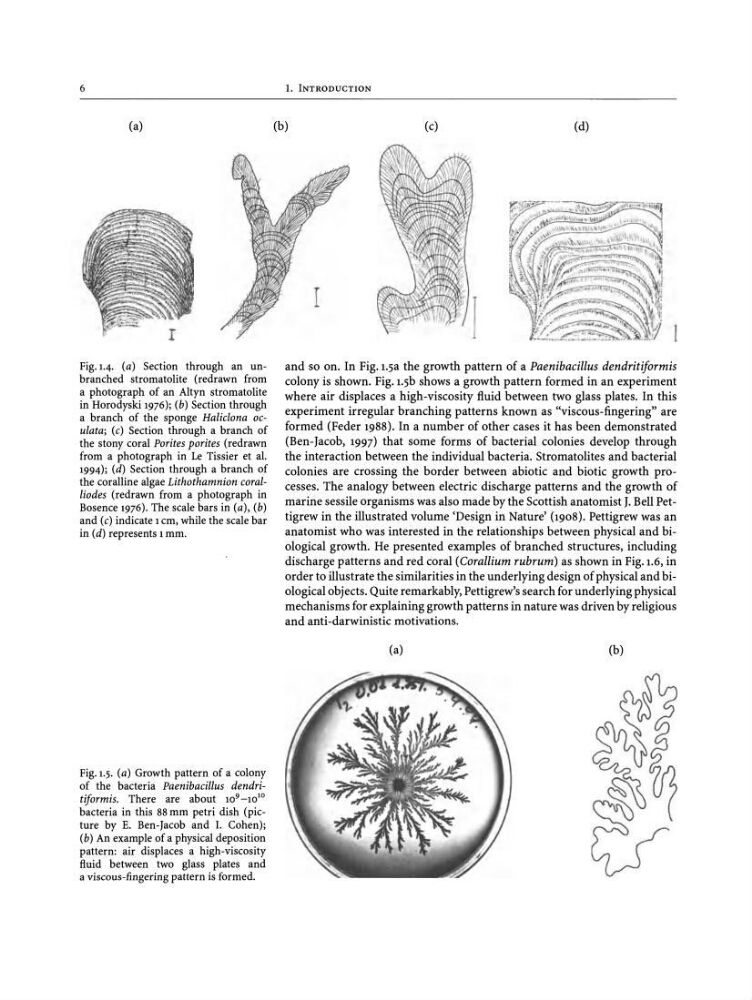
Fig. 1.4. (a) Section through an unbranched stromatolite (redrawn from
a photograph of an Altyn stromatolite
in Horodyski 1976); (b) Section through
a branch of the sponge Haliclona oculata; (c) Section through a branch of
the stony coral Porites porites (redrawn
from a photograph in Le Tissier et al.
1994); (d) Section through a branch of
the corallinealgae Lithothamnion coralliodes (redrawn from a photograph in
Bosence 1976). The scale bars in (a), (b)
and (c) indicate1 em, while the scalebar
in (d) represents 1 mm.
and so on. In Fig. l.sa the growth pattern of a Paenibacillus dendritiformis
colony is shown. Fig. i.sb shows a growth pattern formed in an experiment
where air displaces a high-viscosity fluid between two glass plates. In this
experiment irregular branching patterns known as "viscous-fingering" are
formed (Feder 1988). In a number of other cases it has been demonstrated
(Ben-Jacob, 1997) that some forms of bacterial colonies develop through
the interaction between the individual bacteria. Stromatolites and bacterial
colonies are crossing the border between abiotic and biotic growth processes. The analogy between electric discharge patterns and the growth of
marine sessile organisms was also made by the Scottish anatomist J. Bell Pettigrew in the illustrated volume 'Design in Nature' (1908). Pettigrew was an
anatomist who was interested in the relationships between physical and biological growth. He presented examples of branched structures, including
discharge patterns and red coral (Corallium rubrum) as shown in Fig. 1.6, in
order to illustrate the similarities in the underlying design of physical and biological objects. Quite remarkably, Pettigrew's search for underlying physical
mechanisms for explaining growth patterns in nature was driven by religious
and anti-darwinistic motivations.
Fig. 1.5. (a) Growth pattern of a colony
of the bacteria Paenibacillus dendritiformis. There are about 10 9 _10
10
bacteria in this 88 mm petri dish (picture by E. Ben-Jacob and 1. Cohen);
(b) An exampleof a physical deposition
pattern: air displaces a high-viscosity
fluid between two glass plates and
a viscous-fingering pattern is formed.
(a)
(b)
(a)
1. INTRODUCTION
(b)
(c)
(d)
Fig. 1.4. (a) Section through an unbranched stromatolite (redrawn from
a photograph of an Altyn stromatolite
in Horodyski 1976); (b) Section through
a branch of the sponge Haliclona oculata; (c) Section through a branch of
the stony coral Porites porites (redrawn
from a photograph in Le Tissier et al.
1994); (d) Section through a branch of
the corallinealgae Lithothamnion coralliodes (redrawn from a photograph in
Bosence 1976). The scale bars in (a), (b)
and (c) indicate1 em, while the scalebar
in (d) represents 1 mm.
and so on. In Fig. l.sa the growth pattern of a Paenibacillus dendritiformis
colony is shown. Fig. i.sb shows a growth pattern formed in an experiment
where air displaces a high-viscosity fluid between two glass plates. In this
experiment irregular branching patterns known as "viscous-fingering" are
formed (Feder 1988). In a number of other cases it has been demonstrated
(Ben-Jacob, 1997) that some forms of bacterial colonies develop through
the interaction between the individual bacteria. Stromatolites and bacterial
colonies are crossing the border between abiotic and biotic growth processes. The analogy between electric discharge patterns and the growth of
marine sessile organisms was also made by the Scottish anatomist J. Bell Pettigrew in the illustrated volume 'Design in Nature' (1908). Pettigrew was an
anatomist who was interested in the relationships between physical and biological growth. He presented examples of branched structures, including
discharge patterns and red coral (Corallium rubrum) as shown in Fig. 1.6, in
order to illustrate the similarities in the underlying design of physical and biological objects. Quite remarkably, Pettigrew's search for underlying physical
mechanisms for explaining growth patterns in nature was driven by religious
and anti-darwinistic motivations.
Fig. 1.5. (a) Growth pattern of a colony
of the bacteria Paenibacillus dendritiformis. There are about 10 9 _10
10
bacteria in this 88 mm petri dish (picture by E. Ben-Jacob and 1. Cohen);
(b) An exampleof a physical deposition
pattern: air displaces a high-viscosity
fluid between two glass plates and
a viscous-fingering pattern is formed.
(a)
(b)