

1. INTRODUCTION
the interplay between the genome and the physical environment controls
morphogenesis. Even now, knowledge about how the genetic information is
translated into a physical form is scarce, although major advances have been
made in the developmental biology of model organisms such as the fruit
fly Drosophila melanogaster and the plant Arabidopsis thaliana. Even less is
currently known about how the enormous diversity oflife forms has evolved.
One of the remarkable properties of a coral reef and many other marine
ecosystems is the high diversity of growth forms that coexist in virtually the
same (at least at a first superficial view) physical environment.
Indeterminate growth patterns are fundamental to the diversity of life
forms on earth. The sessile, colonial way oflife is represented in all kingdoms.
A glimpse of the overwhelming variety and beauty of marine sessile organisms is presented in Fig. 1.3 (after Margulis 1993) which shows only a few
representatives of the kinds of organisms which we discuss in this book.
The most primitive marine sessile growth forms are stromatolites,
organosedimentary structures principally formed by cyanobacteria. Red,
brown, and green algae all include species with flexible and with rigid , calcified sessile growth forms, the coralline algae. Sessile, modular growth occurs
in several animal phyla and in different classes within phyla. Sessile growth
forms are also found in plants and fungi but we focus our discuss ion on algae
and animals, the dominant macroscopic organ isms in the marine environ -
ment. We will briefly discuss stromatolites since these structures are, from
a modeling point of view, very interesting. In the animal kingdom we will
restrict ourselves to sessile growth forms in sponges and cnidarians, with
a relatively simple developmental biology. Sessile growth forms have also developed in many other phyla in the animal kingdom. Beautiful sessile growth
forms, for example, developed in the bryozoans, an animal phylum with an
enormous diversity in growth forms (see McKinney and Jackson 1991) and
a more complex developmental biology. It is also important to realize that
most of the growth forms depicted in Fig. 1.3 cannot be simply considered the
product of a single organism. Most of the growth forms are the result of a firm
symbiosis between several organisms, either colonies of a single species or
symbiosis of multiple species or both. Mixtures of microorganisms, mainly
cyanobacteria, form stromatolites by trapping sediment and chemical deposition. Many sponges live in symbiosis with bacteria or algae. Most stony
corals live in symbiosis with algae, the zooxanthellae. The symbionts often
playa crucial role in the energy supply of the organism and consequently in
the emergence of the growth form. A good introduction to the full diversity
of marine sessile organisms would require a full course in invertebrate zoology (Barnes 1974), phycology (Graham and Wilcox 2000) and stromatolites
(Walter 1976).
A remarkable property of the forms of the organisms displayed in Fig. 1.3
is that although they originate in tremendously distantly related organisms,
there are recurring themes, or resemblances, in overall shape. This phe -
nomenon of recurrent forms in different taxonomic groups was also observed
by Jackson (1979) . Even an experienced marine biologist might find it difficult
to decide which taxonomic group a certain specimen should be attributed
to, based only on their overall shape. This figure illustrates two of the basic
themes in this book. First, similar growth forms found in very different taxonomic groups seem to suggest that there is a deeper physical reason why
different organisms sometimes converge on just a few "styles". Second, there
3
/ /
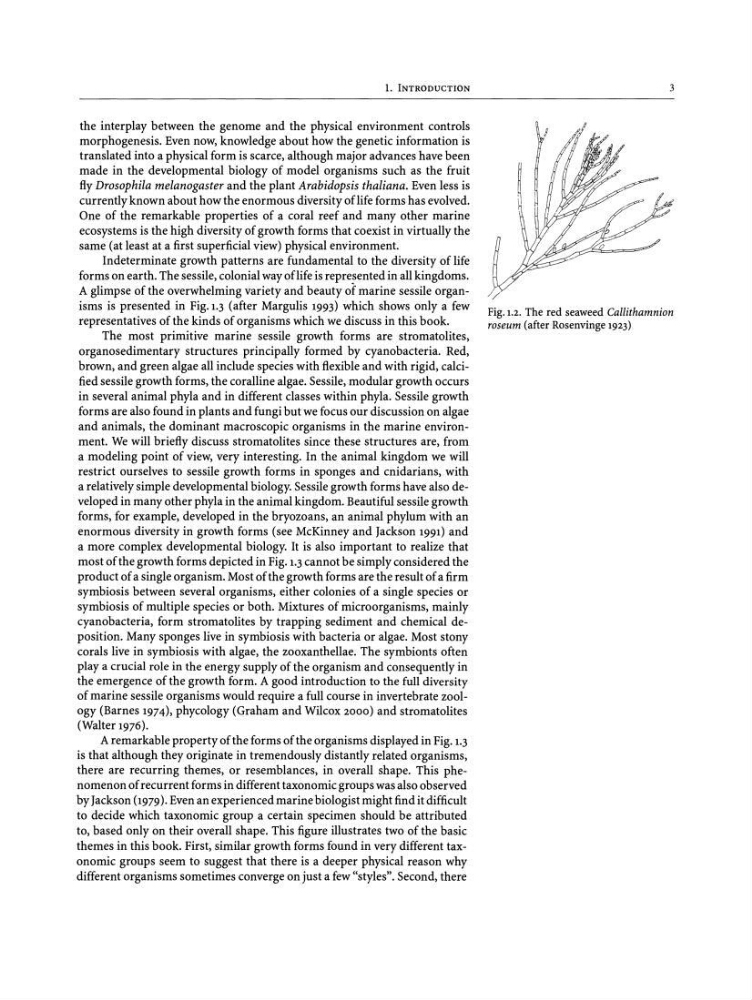
Fig.1.2. The red seaweed Callithamnion
roseum (after Rosenvinge 1923)
the interplay between the genome and the physical environment controls
morphogenesis. Even now, knowledge about how the genetic information is
translated into a physical form is scarce, although major advances have been
made in the developmental biology of model organisms such as the fruit
fly Drosophila melanogaster and the plant Arabidopsis thaliana. Even less is
currently known about how the enormous diversity oflife forms has evolved.
One of the remarkable properties of a coral reef and many other marine
ecosystems is the high diversity of growth forms that coexist in virtually the
same (at least at a first superficial view) physical environment.
Indeterminate growth patterns are fundamental to the diversity of life
forms on earth. The sessile, colonial way oflife is represented in all kingdoms.
A glimpse of the overwhelming variety and beauty of marine sessile organisms is presented in Fig. 1.3 (after Margulis 1993) which shows only a few
representatives of the kinds of organisms which we discuss in this book.
The most primitive marine sessile growth forms are stromatolites,
organosedimentary structures principally formed by cyanobacteria. Red,
brown, and green algae all include species with flexible and with rigid , calcified sessile growth forms, the coralline algae. Sessile, modular growth occurs
in several animal phyla and in different classes within phyla. Sessile growth
forms are also found in plants and fungi but we focus our discuss ion on algae
and animals, the dominant macroscopic organ isms in the marine environ -
ment. We will briefly discuss stromatolites since these structures are, from
a modeling point of view, very interesting. In the animal kingdom we will
restrict ourselves to sessile growth forms in sponges and cnidarians, with
a relatively simple developmental biology. Sessile growth forms have also developed in many other phyla in the animal kingdom. Beautiful sessile growth
forms, for example, developed in the bryozoans, an animal phylum with an
enormous diversity in growth forms (see McKinney and Jackson 1991) and
a more complex developmental biology. It is also important to realize that
most of the growth forms depicted in Fig. 1.3 cannot be simply considered the
product of a single organism. Most of the growth forms are the result of a firm
symbiosis between several organisms, either colonies of a single species or
symbiosis of multiple species or both. Mixtures of microorganisms, mainly
cyanobacteria, form stromatolites by trapping sediment and chemical deposition. Many sponges live in symbiosis with bacteria or algae. Most stony
corals live in symbiosis with algae, the zooxanthellae. The symbionts often
playa crucial role in the energy supply of the organism and consequently in
the emergence of the growth form. A good introduction to the full diversity
of marine sessile organisms would require a full course in invertebrate zoology (Barnes 1974), phycology (Graham and Wilcox 2000) and stromatolites
(Walter 1976).
A remarkable property of the forms of the organisms displayed in Fig. 1.3
is that although they originate in tremendously distantly related organisms,
there are recurring themes, or resemblances, in overall shape. This phe -
nomenon of recurrent forms in different taxonomic groups was also observed
by Jackson (1979) . Even an experienced marine biologist might find it difficult
to decide which taxonomic group a certain specimen should be attributed
to, based only on their overall shape. This figure illustrates two of the basic
themes in this book. First, similar growth forms found in very different taxonomic groups seem to suggest that there is a deeper physical reason why
different organisms sometimes converge on just a few "styles". Second, there
3
/ /
Fig.1.2. The red seaweed Callithamnion
roseum (after Rosenvinge 1923)