

2
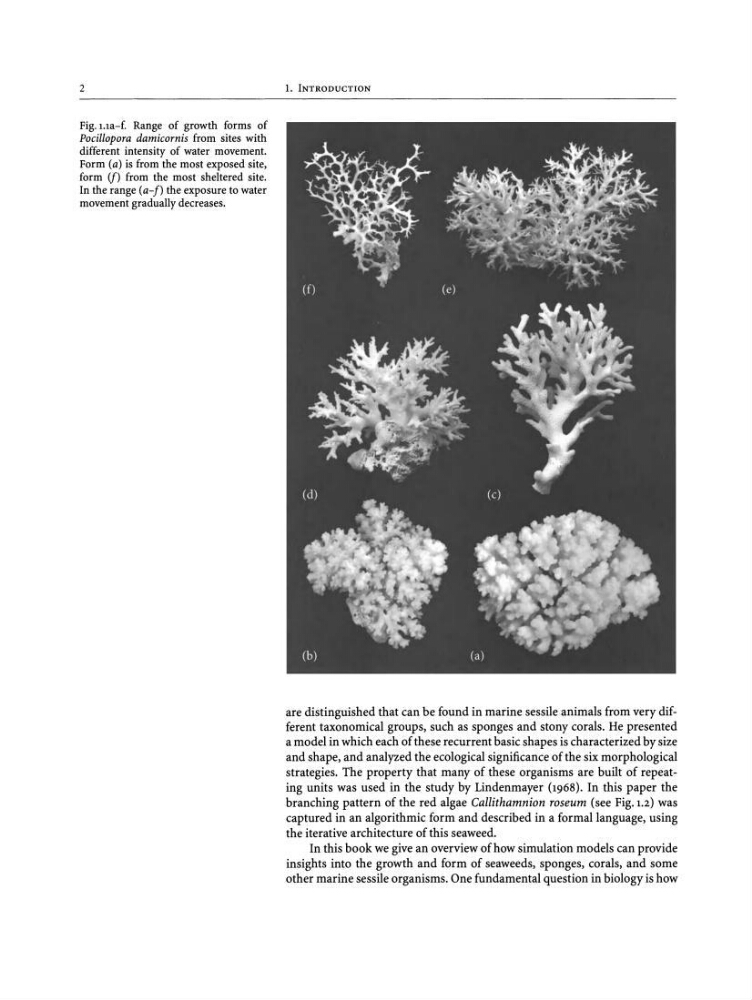
Fig.i.ia-f Range of growth forms of
Pocillopora damicornis from sites with
different intensity of water movement.
Form (a) is from the most exposed site,
form (j) from the most sheltered site.
In the range (a-j) the exposure to water
movement gradually decreases.
1. INTRODUCTION
are distinguished that can be found in marine sessile animals from very different taxonomical groups, such as sponges and stony corals. He presented
a model in which each of these recurrent basic shapes is characterized by size
and shape, and analyzed the ecological significance of the six morphological
strategies. The property that many of these organisms are built of repeating units was used in the study by Lindenmayer (1968). In this paper the
branching pattern of the red algae Callithamnion roseum (see Fig. 1.2) was
captured in an algorithmic form and described in a formal language, using
the iterative architecture of this seaweed.
In this book we give an overview of how simulation models can provide
insights into the growth and form of seaweeds, sponges, corals, and some
other marine sessile organisms. One fundamental question in biology is how
Fig.i.ia-f Range of growth forms of
Pocillopora damicornis from sites with
different intensity of water movement.
Form (a) is from the most exposed site,
form (j) from the most sheltered site.
In the range (a-j) the exposure to water
movement gradually decreases.
1. INTRODUCTION
are distinguished that can be found in marine sessile animals from very different taxonomical groups, such as sponges and stony corals. He presented
a model in which each of these recurrent basic shapes is characterized by size
and shape, and analyzed the ecological significance of the six morphological
strategies. The property that many of these organisms are built of repeating units was used in the study by Lindenmayer (1968). In this paper the
branching pattern of the red algae Callithamnion roseum (see Fig. 1.2) was
captured in an algorithmic form and described in a formal language, using
the iterative architecture of this seaweed.
In this book we give an overview of how simulation models can provide
insights into the growth and form of seaweeds, sponges, corals, and some
other marine sessile organisms. One fundamental question in biology is how