

5.3. PERTURBATION EXPERIMENTS OF GASTROVASCULAR PHYSIOLOGY
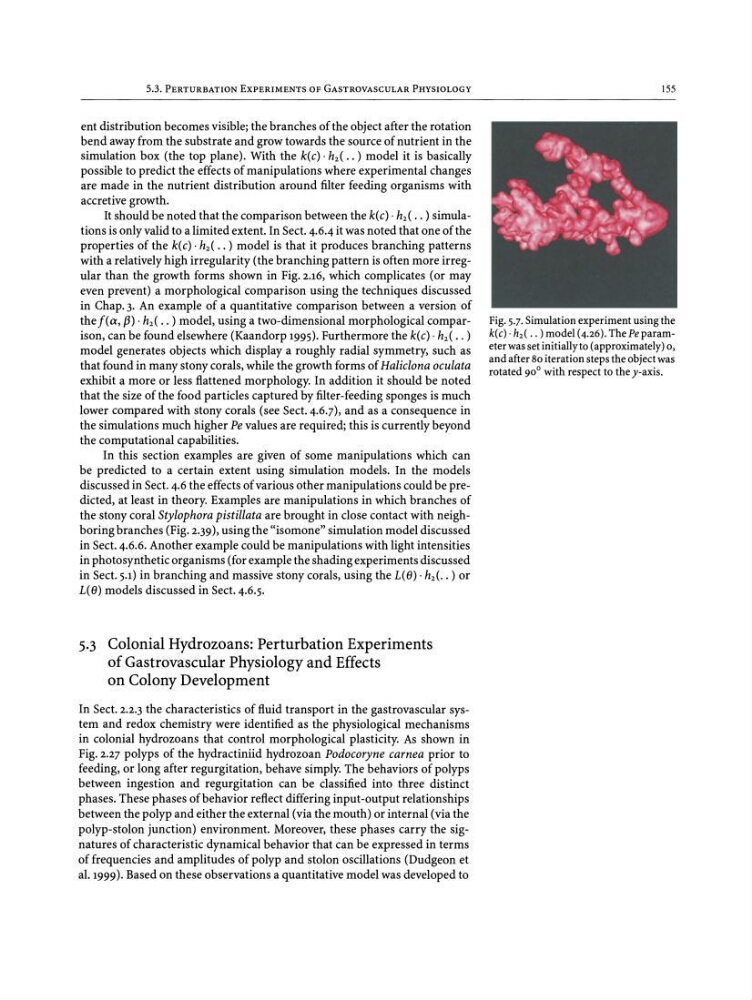
ent distribution becomes visible; the branches of the object after the rotation
bend away from the substrate and grow towards the source of nutrient in the
simulation box (the top plane). With the k(c) . h 2 ( •• ) model it is basically
possible to predict the effects of manipulations where experimental changes
are made in the nutrient distribution around filter feeding organisms with
accretive growth.
It should be noted that the comparison between the k(c) · h 2 ( • • ) simulations is only valid to a limited extent. In Sect. 4.6.4 it was noted that one of the
properties of the k(c) . h 2 ( •• ) model is that it produces branching patterns
with a relatively high irregularity (the branching pattern is often more irregular than the growth forms shown in Fig. 2 .16, which complicates (or may
even prevent) a morphological comparison using the techniques discussed
in Chap. 3. An example of a quantitative comparison between a version of
the [ta, f3) . h 2 ( • • ) model, using a two-dimensional morphological comparison, can be found elsewhere (Kaandorp 1995) . Furthermore the k(c) · h 2 ( • • )
model generates objects which display a roughly radial symmetry, such as
that found in many stony corals, while the growth forms of Haliclona oculata
exhibit a more or less flattened morphology. In addition it should be noted
that the size of the food particles captured by filter-feeding sponges is much
lower compared with stony corals (see Sect. 4.6.7), and as a consequence in
the simulations much higher Pevalues are required; this is currently beyond
the computational capabilities.
In this section examples are given of some manipulations which can
be predicted to a certain extent using simulation models. In the models
discussed in Sect. 4.6 the effects of various other manipulations could be pre -
dicted, at least in theory. Examples are manipulations in which branches of
the stony coral Stylophorapistillata are brought in close contact with neighboring branches (Fig. 2.39), using the "isomone" simulation model discussed
in Sect. 4.6.6. Another example could be manipulations with light intensities
in photosynthetic organisms (for example the shading experiments discussed
in Sect. 5.1) in branching and massive stony corals, using the L(8) · h 2 ( • • ) or
L(8) models discussed in Sect. 4.6.5.
5.3 Colonial Hydrozoans: Perturbation Experiments
of Gastrovascular Physiology and Effects
on Colony Development
In Sect. 2.2.3 the characteristics of fluid transport in the gastrovascular system and redox chemistry were identified as the physiological mechanisms
in colonial hydrozoans that control morphological plasticity. As shown in
Fig. 2 .27 polyps of the hydractiniid hydrozoan Podocoryne carnea prior to
feeding, or long after regurgitation, behave simply. The behav iors of polyps
between ingestion and regurgitation can be classified into three distinct
phases. These phases of behavior reflect differing input-output relationships
between the polyp and either the external (via the mouth) or internal (via the
polyp-stolon junction) environment. Moreover, these phases carry the signatures of characteristic dynamical behavior that can be expressed in terms
of frequencies and amplitudes of polyp and stolon oscillations (Dudgeon et
al. 1999). Based on these observations a quantitative model was developed to
155
Fig. 5.7. Simulation experiment using the
k(c) ' h2 ( • • ) model (4.26). The Peparameterwas set initially to (approximately) 0,
and after 80 iteration steps the object was
rotated 90° with respect to the y-axis .
ent distribution becomes visible; the branches of the object after the rotation
bend away from the substrate and grow towards the source of nutrient in the
simulation box (the top plane). With the k(c) . h 2 ( •• ) model it is basically
possible to predict the effects of manipulations where experimental changes
are made in the nutrient distribution around filter feeding organisms with
accretive growth.
It should be noted that the comparison between the k(c) · h 2 ( • • ) simulations is only valid to a limited extent. In Sect. 4.6.4 it was noted that one of the
properties of the k(c) . h 2 ( •• ) model is that it produces branching patterns
with a relatively high irregularity (the branching pattern is often more irregular than the growth forms shown in Fig. 2 .16, which complicates (or may
even prevent) a morphological comparison using the techniques discussed
in Chap. 3. An example of a quantitative comparison between a version of
the [ta, f3) . h 2 ( • • ) model, using a two-dimensional morphological comparison, can be found elsewhere (Kaandorp 1995) . Furthermore the k(c) · h 2 ( • • )
model generates objects which display a roughly radial symmetry, such as
that found in many stony corals, while the growth forms of Haliclona oculata
exhibit a more or less flattened morphology. In addition it should be noted
that the size of the food particles captured by filter-feeding sponges is much
lower compared with stony corals (see Sect. 4.6.7), and as a consequence in
the simulations much higher Pevalues are required; this is currently beyond
the computational capabilities.
In this section examples are given of some manipulations which can
be predicted to a certain extent using simulation models. In the models
discussed in Sect. 4.6 the effects of various other manipulations could be pre -
dicted, at least in theory. Examples are manipulations in which branches of
the stony coral Stylophorapistillata are brought in close contact with neighboring branches (Fig. 2.39), using the "isomone" simulation model discussed
in Sect. 4.6.6. Another example could be manipulations with light intensities
in photosynthetic organisms (for example the shading experiments discussed
in Sect. 5.1) in branching and massive stony corals, using the L(8) · h 2 ( • • ) or
L(8) models discussed in Sect. 4.6.5.
5.3 Colonial Hydrozoans: Perturbation Experiments
of Gastrovascular Physiology and Effects
on Colony Development
In Sect. 2.2.3 the characteristics of fluid transport in the gastrovascular system and redox chemistry were identified as the physiological mechanisms
in colonial hydrozoans that control morphological plasticity. As shown in
Fig. 2 .27 polyps of the hydractiniid hydrozoan Podocoryne carnea prior to
feeding, or long after regurgitation, behave simply. The behav iors of polyps
between ingestion and regurgitation can be classified into three distinct
phases. These phases of behavior reflect differing input-output relationships
between the polyp and either the external (via the mouth) or internal (via the
polyp-stolon junction) environment. Moreover, these phases carry the signatures of characteristic dynamical behavior that can be expressed in terms
of frequencies and amplitudes of polyp and stolon oscillations (Dudgeon et
al. 1999). Based on these observations a quantitative model was developed to
155
Fig. 5.7. Simulation experiment using the
k(c) ' h2 ( • • ) model (4.26). The Peparameterwas set initially to (approximately) 0,
and after 80 iteration steps the object was
rotated 90° with respect to the y-axis .