

112
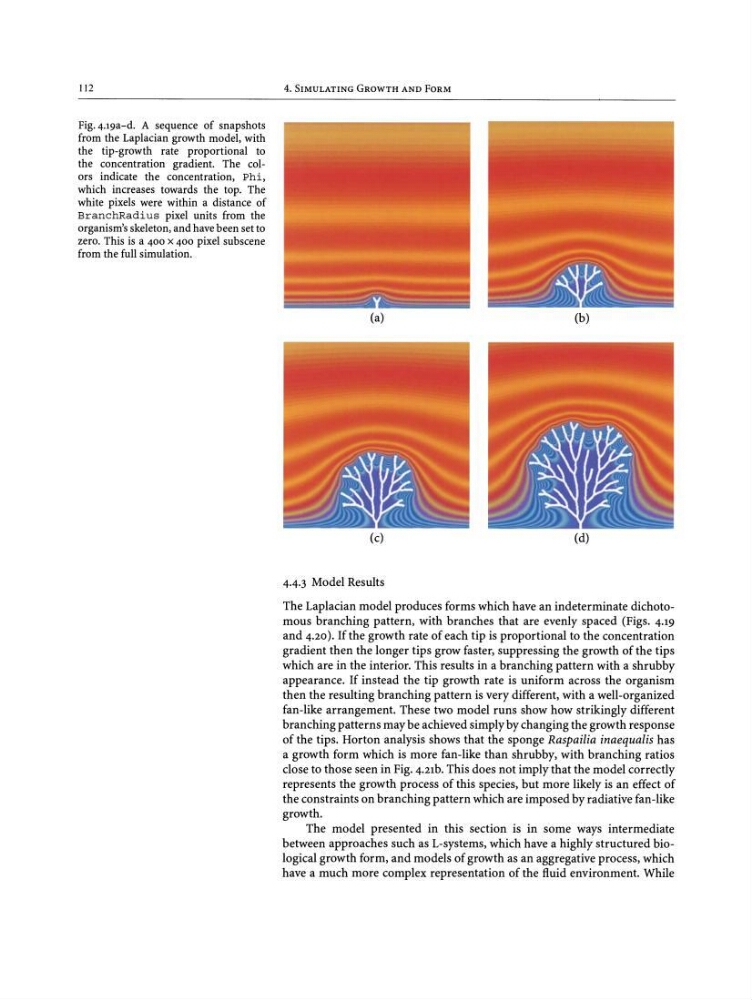
Pig.a.ioa-d. A sequence of snapshots
from the Laplacian growth model, with
the tip-growth rate proportional to
the concentration gradient. The colors indicate the concentration, Phi,
which increases towards the top. The
white pixels were within a distance of
BranchRadi us pixel units from the
organism's skeleton, and have been set to
zero. This is a 400 x 400 pixel subscene
from the full simulation .
4. SIMULATING GROWTH AND FORM
(a)
(c)
(b)
(d)
4.4.3 Model Results
The Laplacian model produces forms which have an indeterminate dichotomous branching pattern, with branches that are evenly spaced (Figs. 4.19
and 4.20). If the growth rate of each tip is proportional to the concentration
gradient then the longer tips grow faster, suppressing the growth of the tips
which are in the interior. This results in a branching pattern with a shrubby
appearance. If instead the tip growth rate is uniform across the organism
then the resulting branching pattern is very different, with a well-organized
fan-like arrangement. These two model runs show how strikingly different
branching patterns may be achieved simply by changing the growth response
of the tips. Horton analysis shows that the sponge Raspailia inaequalis has
a growth form which is more fan-like than shrubby, with branching ratios
close to those seen in Fig. 4.2Ib. This does not imply that the model correctly
represents the growth process of this species, but more likely is an effect of
the constraints on branching pattern which are imposed by radiative fan-like
growth.
The model presented in this section is in some ways intermediate
between approaches such as L-systems, which have a highly structured biological growth form, and models of growth as an aggregative process, which
have a much more complex representation of the fluid environment. While
Pig.a.ioa-d. A sequence of snapshots
from the Laplacian growth model, with
the tip-growth rate proportional to
the concentration gradient. The colors indicate the concentration, Phi,
which increases towards the top. The
white pixels were within a distance of
BranchRadi us pixel units from the
organism's skeleton, and have been set to
zero. This is a 400 x 400 pixel subscene
from the full simulation .
4. SIMULATING GROWTH AND FORM
(a)
(c)
(b)
(d)
4.4.3 Model Results
The Laplacian model produces forms which have an indeterminate dichotomous branching pattern, with branches that are evenly spaced (Figs. 4.19
and 4.20). If the growth rate of each tip is proportional to the concentration
gradient then the longer tips grow faster, suppressing the growth of the tips
which are in the interior. This results in a branching pattern with a shrubby
appearance. If instead the tip growth rate is uniform across the organism
then the resulting branching pattern is very different, with a well-organized
fan-like arrangement. These two model runs show how strikingly different
branching patterns may be achieved simply by changing the growth response
of the tips. Horton analysis shows that the sponge Raspailia inaequalis has
a growth form which is more fan-like than shrubby, with branching ratios
close to those seen in Fig. 4.2Ib. This does not imply that the model correctly
represents the growth process of this species, but more likely is an effect of
the constraints on branching pattern which are imposed by radiative fan-like
growth.
The model presented in this section is in some ways intermediate
between approaches such as L-systems, which have a highly structured biological growth form, and models of growth as an aggregative process, which
have a much more complex representation of the fluid environment. While