

5 Insecta (Lepidoptera)
67
3. Transfer the embryos into culture medium.
4. Cut the embryos into several pieces.
5. Transfer the fragments, with the culture medium, into culture vessels.
6. Culture at 25°C.
• • Troubleshooting
If the cut made on the chorion is too small, the embryos will disintegrate
when they are squeezed out through the opening. To avoid this, make a
large enough incision to start with .
• • Results
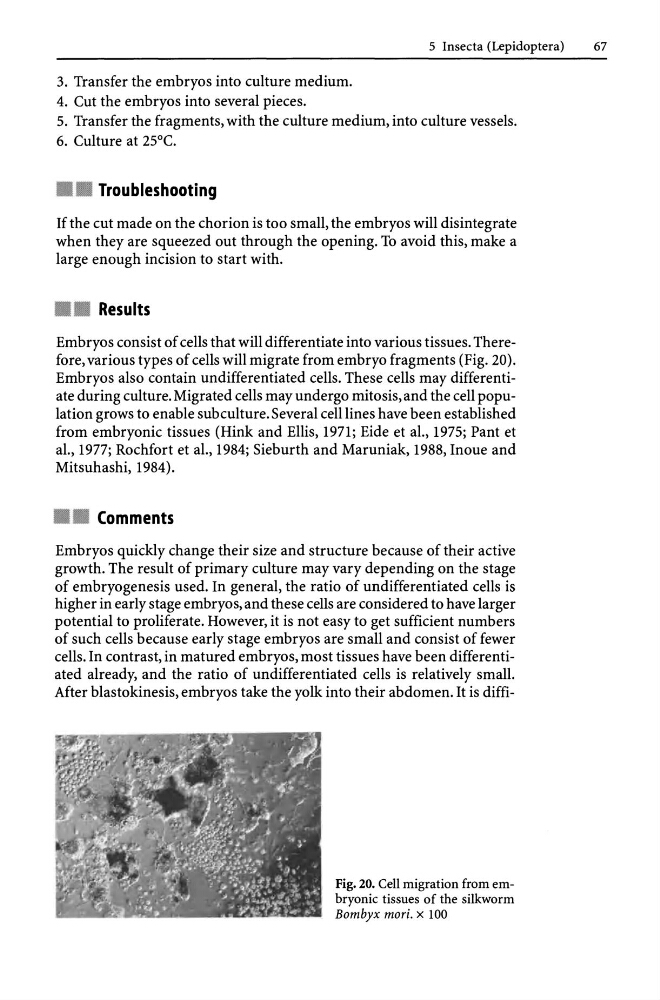
Embryos consist of cells that will differentiate into various tissues. Therefore, various types of cells will migrate from embryo fragments (Fig. 20).
Embryos also contain undifferentiated cells. These cells may differentiate during culture. Migrated cells may undergo mitosis, and the cell population grows to enable subculture. Several cell lines have been established
from embryonic tissues (Hink and Ellis, 1971; Eide et aI., 1975; Pant et
aI., 1977; Rochfort et aI., 1984; Sieburth and Maruniak, 1988, Inoue and
Mitsuhashi, 1984) .
• • Comments
Embryos quickly change their size and structure because of their active
growth. The result of primary culture may vary depending on the stage
of embryogenesis used. In general, the ratio of undifferentiated cells is
higher in early stage embryos, and these cells are considered to have larger
potential to proliferate. However, it is not easy to get sufficient numbers
of such cells because early stage embryos are small and consist of fewer
cells. In contrast, in matured embryos, most tissues have been differentiated already, and the ratio of undifferentiated cells is relatively small.
After blastokinesis, embryos take the yolk into their abdomen. It is diffiFig. 20. Cell migration from embryonic tissues of the silkworm
Bombyx mori. x 100
67
3. Transfer the embryos into culture medium.
4. Cut the embryos into several pieces.
5. Transfer the fragments, with the culture medium, into culture vessels.
6. Culture at 25°C.
• • Troubleshooting
If the cut made on the chorion is too small, the embryos will disintegrate
when they are squeezed out through the opening. To avoid this, make a
large enough incision to start with .
• • Results
Embryos consist of cells that will differentiate into various tissues. Therefore, various types of cells will migrate from embryo fragments (Fig. 20).
Embryos also contain undifferentiated cells. These cells may differentiate during culture. Migrated cells may undergo mitosis, and the cell population grows to enable subculture. Several cell lines have been established
from embryonic tissues (Hink and Ellis, 1971; Eide et aI., 1975; Pant et
aI., 1977; Rochfort et aI., 1984; Sieburth and Maruniak, 1988, Inoue and
Mitsuhashi, 1984) .
• • Comments
Embryos quickly change their size and structure because of their active
growth. The result of primary culture may vary depending on the stage
of embryogenesis used. In general, the ratio of undifferentiated cells is
higher in early stage embryos, and these cells are considered to have larger
potential to proliferate. However, it is not easy to get sufficient numbers
of such cells because early stage embryos are small and consist of fewer
cells. In contrast, in matured embryos, most tissues have been differentiated already, and the ratio of undifferentiated cells is relatively small.
After blastokinesis, embryos take the yolk into their abdomen. It is diffiFig. 20. Cell migration from embryonic tissues of the silkworm
Bombyx mori. x 100