

5 Insecta (Lepidoptera)
57
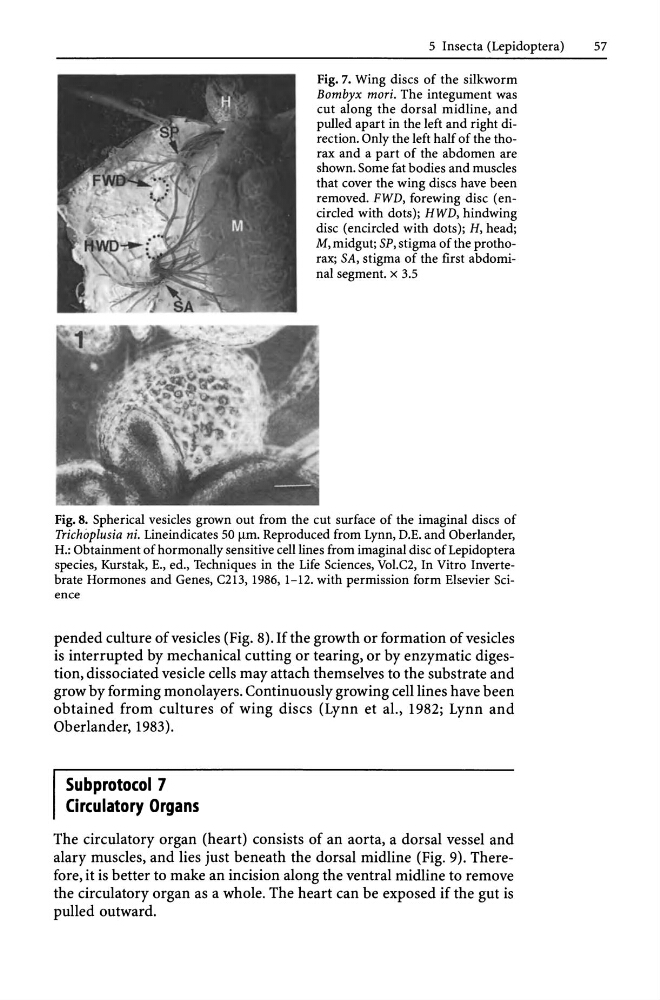
Fig. 7. Wing discs of the silkworm
Bambyx mario The integument was
cut along the dorsal midline, and
pulled apart in the left and right direction. Only the left half of the thorax and a part of the abdomen are
shown. Some fat bodies and muscles
that cover the wing discs have been
removed. FWD, forewing disc (encircled with dots); HWD, hindwing
disc (encircled with dots); H, head;
M, midgut; SP, stigma of the prothorax; SA, stigma of the first abdominal segment. x 3.5
Fig. 8. Spherical vesicles grown out from the cut surface of the imaginal discs of
Trichoplusia ni. Lineindicates 50 J..lm. Reproduced from Lynn, D.E. and Oberlander,
H.: Obtainment of hormonally sensitive cell lines from imaginal disc of Lepidoptera
species, Kurstak, E., ed., Techniques in the Life Sciences, Vol.C2, In Vitro Invertebrate Hormones and Genes, C2l3, 1986, 1-12. with permission form Elsevier Science
pended culture of vesicles (Fig. 8). If the growth or formation of vesicles
is interrupted by mechanical cutting or tearing, or by enzymatic digestion, dissociated vesicle cells may attach themselves to the substrate and
grow by forming monolayers. Continuously growing cell lines have been
obtained from cultures of wing discs (Lynn et aI., 1982; Lynn and
Oberlander, 1983).
Subprotocol 7
Circulatory Organs
The circulatory organ (heart) consists of an aorta, a dorsal vessel and
alary muscles, and lies just beneath the dorsal midline (Fig. 9). Therefore, it is better to make an incision along the ventral midline to remove
the circulatory organ as a whole. The heart can be exposed if the gut is
pulled outward.
57
Fig. 7. Wing discs of the silkworm
Bambyx mario The integument was
cut along the dorsal midline, and
pulled apart in the left and right direction. Only the left half of the thorax and a part of the abdomen are
shown. Some fat bodies and muscles
that cover the wing discs have been
removed. FWD, forewing disc (encircled with dots); HWD, hindwing
disc (encircled with dots); H, head;
M, midgut; SP, stigma of the prothorax; SA, stigma of the first abdominal segment. x 3.5
Fig. 8. Spherical vesicles grown out from the cut surface of the imaginal discs of
Trichoplusia ni. Lineindicates 50 J..lm. Reproduced from Lynn, D.E. and Oberlander,
H.: Obtainment of hormonally sensitive cell lines from imaginal disc of Lepidoptera
species, Kurstak, E., ed., Techniques in the Life Sciences, Vol.C2, In Vitro Invertebrate Hormones and Genes, C2l3, 1986, 1-12. with permission form Elsevier Science
pended culture of vesicles (Fig. 8). If the growth or formation of vesicles
is interrupted by mechanical cutting or tearing, or by enzymatic digestion, dissociated vesicle cells may attach themselves to the substrate and
grow by forming monolayers. Continuously growing cell lines have been
obtained from cultures of wing discs (Lynn et aI., 1982; Lynn and
Oberlander, 1983).
Subprotocol 7
Circulatory Organs
The circulatory organ (heart) consists of an aorta, a dorsal vessel and
alary muscles, and lies just beneath the dorsal midline (Fig. 9). Therefore, it is better to make an incision along the ventral midline to remove
the circulatory organ as a whole. The heart can be exposed if the gut is
pulled outward.