

22 Arthropoda Other than Insecta
273
2. Before dissection, chill the animals on ice.
1. Swab the animals with ethanol.
Sterilization
1. Cut the epidermal fracture lines, and remove the carapaces.
Dissection
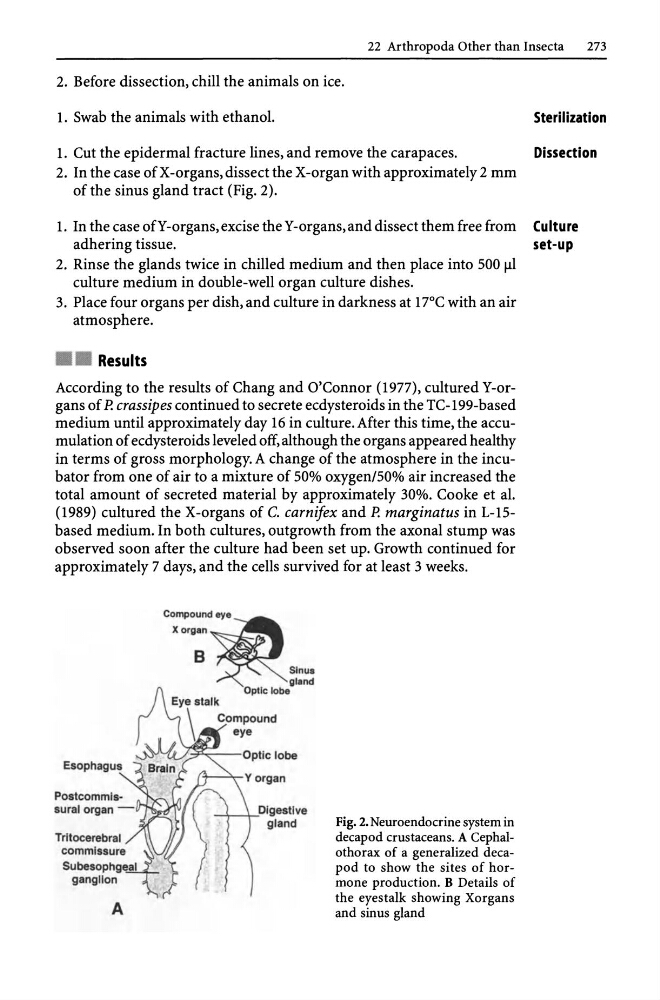
2. In the case of X-organs, dissect the X-organ with approximately 2 mm
of the sinus gland tract (Fig. 2).
1. In the case ofY-organs, excise the Y-organs, and dissect them free from Culture
adhering tissue.
set-up
2. Rinse the glands twice in chilled medium and then place into 500 fil
culture medium in double-well organ culture dishes.
3. Place four organs per dish, and culture in darkness at 17°C with an air
atmosphere .
• • Results
According to the results of Chang and O'Connor (1977), cultured Y-organs of P. crassipes continued to secrete ecdysteroids in the TC-I99-based
medium until approximately day 16 in culture. After this time, the accumulation of ecdysteroids leveled off, although the organs appeared healthy
in terms of gross morphology. A change of the atmosphere in the incubator from one of air to a mixture of 50% oxygen/SO% air increased the
total amount of secreted material by approximately 30%. Cooke et al.
(1989) cultured the X-organs of C. carnifex and P. marginatus in L-ISbased medium. In both cultures, outgrowth from the axonal stump was
observed soon after the culture had been set up. Growth continued for
approximately 7 days, and the cells survived for at least 3 weeks.
Esophagus
Postcommlssural organ -
Tritocerebral
A
compOUnd~eye
X organ
B
Sinus
gland
Opllc lobe
Ey\stalk
--+--Ir-!Digestlve
gland
Fig. 2. Neuroendocrine system in
decapod crustaceans. A Cephalothorax of a generalized decapod to show the sites of hormone production. B Details of
the eyestalk showing Xorgans
and sinus gland
273
2. Before dissection, chill the animals on ice.
1. Swab the animals with ethanol.
Sterilization
1. Cut the epidermal fracture lines, and remove the carapaces.
Dissection
2. In the case of X-organs, dissect the X-organ with approximately 2 mm
of the sinus gland tract (Fig. 2).
1. In the case ofY-organs, excise the Y-organs, and dissect them free from Culture
adhering tissue.
set-up
2. Rinse the glands twice in chilled medium and then place into 500 fil
culture medium in double-well organ culture dishes.
3. Place four organs per dish, and culture in darkness at 17°C with an air
atmosphere .
• • Results
According to the results of Chang and O'Connor (1977), cultured Y-organs of P. crassipes continued to secrete ecdysteroids in the TC-I99-based
medium until approximately day 16 in culture. After this time, the accumulation of ecdysteroids leveled off, although the organs appeared healthy
in terms of gross morphology. A change of the atmosphere in the incubator from one of air to a mixture of 50% oxygen/SO% air increased the
total amount of secreted material by approximately 30%. Cooke et al.
(1989) cultured the X-organs of C. carnifex and P. marginatus in L-ISbased medium. In both cultures, outgrowth from the axonal stump was
observed soon after the culture had been set up. Growth continued for
approximately 7 days, and the cells survived for at least 3 weeks.
Esophagus
Postcommlssural organ -
Tritocerebral
A
compOUnd~eye
X organ
B
Sinus
gland
Opllc lobe
Ey\stalk
--+--Ir-!Digestlve
gland
Fig. 2. Neuroendocrine system in
decapod crustaceans. A Cephalothorax of a generalized decapod to show the sites of hormone production. B Details of
the eyestalk showing Xorgans
and sinus gland