

1 Facilities and Equipment
7
An ultra low-temperature freezer is used to freeze living cells, or some
microorganisms, at temperatures lower than -80°e. Living cells are usually frozen with a cryoprotectant. Frozen cells and microorganisms can
be preserved at between -80° and -150°C for long periods of time.
A liquid nitrogen freezer is also used for the semipermanent storage
of living cells. To use a liquid nitrogen freezer, a liquid nitrogen storage
flask is also necessary (Fig. 10).
An autoclave (Fig. 11) is used to sterilize glassware, stainless steel tools, Sterilizer
heat-resistant plastic, rubber, etc. It is usually operated at 202,65 kPa,
121°C for 30 min. Some physiological salt solutions and culture media
are also autoclavable at 121°C for 15 min. For the sterilization of small
materials, a domestic pressure cooker may be used. There is a risk with
autoclaving that condensed water in the apparatus may get into the material to be sterilized. To minimize contamination with unfavorable substances, such as heavy metals from condensed water, purified water should
always be supplied to the autoclave.
A dry oven (Fig. 12) is used to sterilize glassware and stainless steel
tools at 180°C for 2 h. A smaller oven (about 80 1) will be more conve10
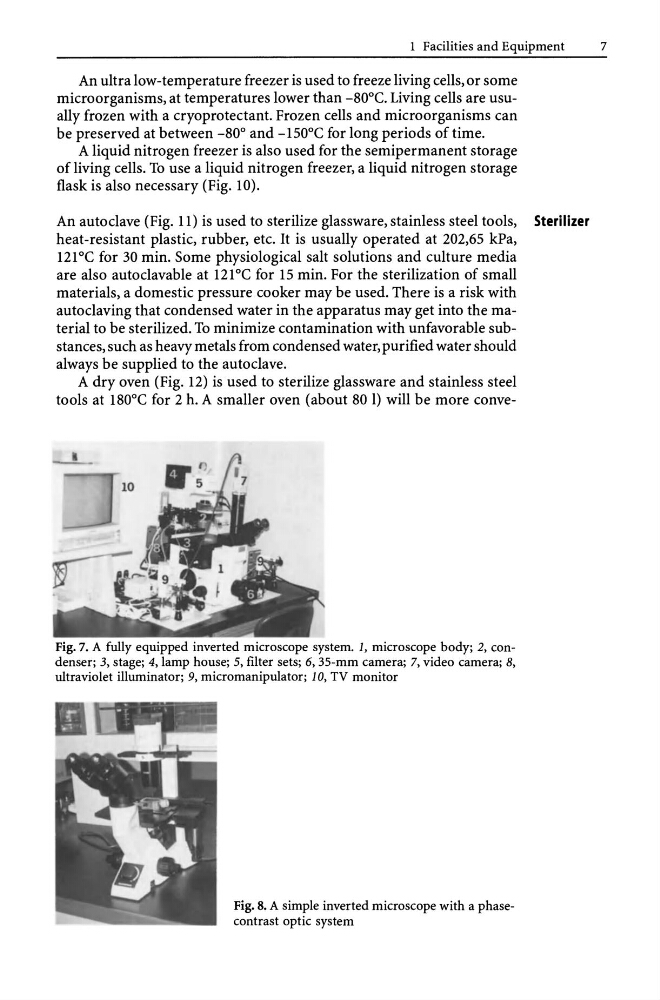
=Fig. 7. A fully equipped inverted microscope system. 1, microscope body; 2, condenser; 3, stage; 4, lamp house; 5, filter sets; 6, 35-mm camera; 7, video camera; 8,
ultraviolet illuminator; 9, micromanipulator; 10, TV monitor
Fig. 8. A simple inverted microscope with a phasecontrast optic system
7
An ultra low-temperature freezer is used to freeze living cells, or some
microorganisms, at temperatures lower than -80°e. Living cells are usually frozen with a cryoprotectant. Frozen cells and microorganisms can
be preserved at between -80° and -150°C for long periods of time.
A liquid nitrogen freezer is also used for the semipermanent storage
of living cells. To use a liquid nitrogen freezer, a liquid nitrogen storage
flask is also necessary (Fig. 10).
An autoclave (Fig. 11) is used to sterilize glassware, stainless steel tools, Sterilizer
heat-resistant plastic, rubber, etc. It is usually operated at 202,65 kPa,
121°C for 30 min. Some physiological salt solutions and culture media
are also autoclavable at 121°C for 15 min. For the sterilization of small
materials, a domestic pressure cooker may be used. There is a risk with
autoclaving that condensed water in the apparatus may get into the material to be sterilized. To minimize contamination with unfavorable substances, such as heavy metals from condensed water, purified water should
always be supplied to the autoclave.
A dry oven (Fig. 12) is used to sterilize glassware and stainless steel
tools at 180°C for 2 h. A smaller oven (about 80 1) will be more conve10
=Fig. 7. A fully equipped inverted microscope system. 1, microscope body; 2, condenser; 3, stage; 4, lamp house; 5, filter sets; 6, 35-mm camera; 7, video camera; 8,
ultraviolet illuminator; 9, micromanipulator; 10, TV monitor
Fig. 8. A simple inverted microscope with a phasecontrast optic system