

204
Methods for Setting Up Primary Cultures Specific to Animal Groups
Dissociation 1. Add 5 ml culture medium (Leibovitz's L-lS medium or Schneider's
Drosophila medium) to the nematodes and transfer the nematodes,
with the culture medium, into a sterile petri dish.
2. Crush the nematodes using forceps.
Culture 1. Transfer the resulting suspension into a plastic lS-cm 2 culture bottle.
set-up 2. Keep the culture at 27°C.
3. Add 5 ml culture medium to the culture each week for 4 weeks.
4. At the end of this period, spin the cells down at 170 g for 10 min.
S. Suspend the cell pellet in fresh medium, and return this suspension to
the original culture vessel.
• • Results
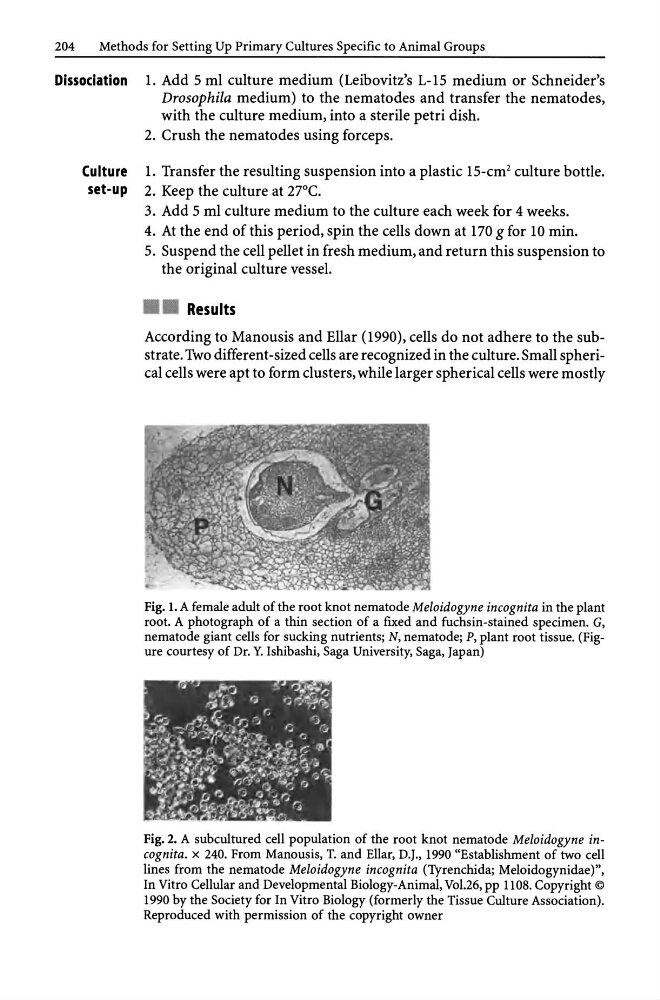
According to Manousis and Ellar (1990), cells do not adhere to the substrate. Two different-sized cells are recognized in the culture. Small spherical cells were apt to form clusters, while larger spherical cells were mostly
Fig. 1. A female adult of the root knot nematode Meloidogyne incognita in the plant
root. A photograph of a thin section of a fixed and fuchsin-stained specimen. G,
nematode giant cells for sucking nutrients; N, nematode; P, plant root tissue. (Figure courtesy of Dr. Y. Ishibashi, Saga University, Saga, Japan)
Fig. 2. A subcultured cell population of the root knot nematode Meloidogyne incognita. x 240. From Manousis, T. and Ellar, D.J., 1990 "Establishment of two cell
lines from the nematode Meloidogyne incognita (Tyrenchida; Meloidogynidae)",
In Vitro Cellular and Developmental Biology-Animal, Vo1.26, pp 1108. Copyright ©
1990 by the Society for In Vitro Biology (formerly the Tissue Culture Association).
Reproduced with permission of the copyright owner
Methods for Setting Up Primary Cultures Specific to Animal Groups
Dissociation 1. Add 5 ml culture medium (Leibovitz's L-lS medium or Schneider's
Drosophila medium) to the nematodes and transfer the nematodes,
with the culture medium, into a sterile petri dish.
2. Crush the nematodes using forceps.
Culture 1. Transfer the resulting suspension into a plastic lS-cm 2 culture bottle.
set-up 2. Keep the culture at 27°C.
3. Add 5 ml culture medium to the culture each week for 4 weeks.
4. At the end of this period, spin the cells down at 170 g for 10 min.
S. Suspend the cell pellet in fresh medium, and return this suspension to
the original culture vessel.
• • Results
According to Manousis and Ellar (1990), cells do not adhere to the substrate. Two different-sized cells are recognized in the culture. Small spherical cells were apt to form clusters, while larger spherical cells were mostly
Fig. 1. A female adult of the root knot nematode Meloidogyne incognita in the plant
root. A photograph of a thin section of a fixed and fuchsin-stained specimen. G,
nematode giant cells for sucking nutrients; N, nematode; P, plant root tissue. (Figure courtesy of Dr. Y. Ishibashi, Saga University, Saga, Japan)
Fig. 2. A subcultured cell population of the root knot nematode Meloidogyne incognita. x 240. From Manousis, T. and Ellar, D.J., 1990 "Establishment of two cell
lines from the nematode Meloidogyne incognita (Tyrenchida; Meloidogynidae)",
In Vitro Cellular and Developmental Biology-Animal, Vo1.26, pp 1108. Copyright ©
1990 by the Society for In Vitro Biology (formerly the Tissue Culture Association).
Reproduced with permission of the copyright owner