

239
eggs produced in the ovary of these bryozoans may be generally higher than in those that brood a single larva at a time.
Nevertheless, additional research is needed to test this
suggestion.
The reduction in the number of offspring is most pronounced in representatives of the family Epistomiidae. In
Synnotum sp. (as aegyptiacum ) and Epistomia bursaria the
female zooid forms a single larva, although the total number
of germinal cells formed in the ovary is presumably greater
(Marcus 1941b ; Dyrynda and King 1982 ). So, taking into
account the limited reproductive season (from 2–3 to several
months for most species), the duration of brooding (10–14
days on the average) and the fact that, with rare exceptions,
only one embryo is incubated in the brood chamber, we may
conclude that in the lifetime of a single ovary one fertile
zooid in Cheilostomata can potentially produce from four to
Brooders
Species
Number of oocytes
(ovarian + ovulated) and
incubated embryos
Size of mature ovarian
oocyte or embryo
(μm)
References
Alcyonidium eightsi
?
290.0 × 340.0
Porter and Hayward ( 2004 )
6–12 embryos
Alcyonidium hirsutum
>10
Hayward ( 1983 )
4–12
150.0–200.0
Owrid and Ryland ( 1991 )
4–11 embryos
Bulbella abscondita
10–11 (+3 embryos)
90.0–100.0
Braem ( 1951 )
4–6 embryos
100.0
Jebram and Everitt ( 1982 )
Alcyonidium diaphanum
6–10
130.0
Chrétien ( 1958 )
4–5 embryos
3*
71.0 × 43.0 (early)
Porter ( 2004 )
Alcyonidium polyoum
?
50.0 (early?)
Matricon ( 1963 )
4–6 embryos
Panolicella nutans
5 + 1 (+2 embryos)
70.0
Jebram ( 1985 )
2–5 embryos
Flustrellidra hispida
4–5
Prouho ( 1892 )
4–5
120.0 × 75.0
Pace ( 1906 )
4–5 embryos (matrotrophy)
Up to 8 embryos
Hayward ( 1985 )
Bowerbankia gracilis
2–5 (0–1 ripe) *
80.0
Braem ( 1951 )
3 (+1 embryo)*
1–2 (+several young oocytes)
160.0
Reed ( 1987 , 1988 , 1991 )
1 embryo
200.0 × 150.0 (larva)
1–4
200.0–352.0
Temkin ( 1996 )
Bowerbankia imbricata
2
Joliet ( 1877 )
1 embryo
Bowerbankia pustulosa
2*
Calvet ( 1900 )
1 embryo
Spathipora comma
3 (+1 embryo)
108.0 × 80.0
Bobin and Prenant ( 1954 )
1 embryo
69.0
Soule ( 1950a )
Walkeria uwa
2–3
Joliet ( 1877 )
1 embryo (matrotrophy)
Zoobotryon verticillatum
2
Zirpolo ( 1933 )
1 embryo (matrotrophy)
Bantariella cookae
?
Banta ( 1968 )
1 embryo (matrotrophy)
20.0 (young)
230.0 × 115.0 (mature)
Alcyonidium disciforme
?
Kuklinski and Porter
( 2004 )
1 embryo
330.0–370.0
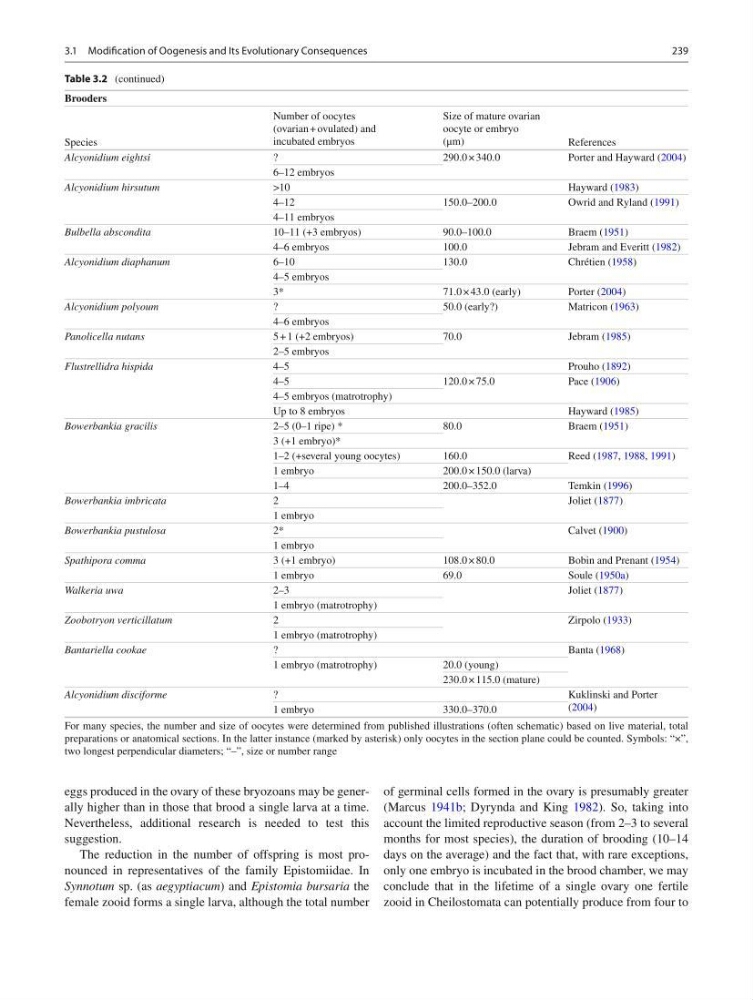
For many species, the number and size of oocytes were determined from published illustrations (often schematic) based on live material, total
preparations or anatomical sections. In the latter instance (marked by asterisk) only oocytes in the section plane could be counted. Symbols: “×”,
two longest perpendicular diameters; “–”, size or number range
Table 3.2 (continued)
3.1 Modifi cation of Oogenesis and Its Evolutionary Consequences
eggs produced in the ovary of these bryozoans may be generally higher than in those that brood a single larva at a time.
Nevertheless, additional research is needed to test this
suggestion.
The reduction in the number of offspring is most pronounced in representatives of the family Epistomiidae. In
Synnotum sp. (as aegyptiacum ) and Epistomia bursaria the
female zooid forms a single larva, although the total number
of germinal cells formed in the ovary is presumably greater
(Marcus 1941b ; Dyrynda and King 1982 ). So, taking into
account the limited reproductive season (from 2–3 to several
months for most species), the duration of brooding (10–14
days on the average) and the fact that, with rare exceptions,
only one embryo is incubated in the brood chamber, we may
conclude that in the lifetime of a single ovary one fertile
zooid in Cheilostomata can potentially produce from four to
Brooders
Species
Number of oocytes
(ovarian + ovulated) and
incubated embryos
Size of mature ovarian
oocyte or embryo
(μm)
References
Alcyonidium eightsi
?
290.0 × 340.0
Porter and Hayward ( 2004 )
6–12 embryos
Alcyonidium hirsutum
>10
Hayward ( 1983 )
4–12
150.0–200.0
Owrid and Ryland ( 1991 )
4–11 embryos
Bulbella abscondita
10–11 (+3 embryos)
90.0–100.0
Braem ( 1951 )
4–6 embryos
100.0
Jebram and Everitt ( 1982 )
Alcyonidium diaphanum
6–10
130.0
Chrétien ( 1958 )
4–5 embryos
3*
71.0 × 43.0 (early)
Porter ( 2004 )
Alcyonidium polyoum
?
50.0 (early?)
Matricon ( 1963 )
4–6 embryos
Panolicella nutans
5 + 1 (+2 embryos)
70.0
Jebram ( 1985 )
2–5 embryos
Flustrellidra hispida
4–5
Prouho ( 1892 )
4–5
120.0 × 75.0
Pace ( 1906 )
4–5 embryos (matrotrophy)
Up to 8 embryos
Hayward ( 1985 )
Bowerbankia gracilis
2–5 (0–1 ripe) *
80.0
Braem ( 1951 )
3 (+1 embryo)*
1–2 (+several young oocytes)
160.0
Reed ( 1987 , 1988 , 1991 )
1 embryo
200.0 × 150.0 (larva)
1–4
200.0–352.0
Temkin ( 1996 )
Bowerbankia imbricata
2
Joliet ( 1877 )
1 embryo
Bowerbankia pustulosa
2*
Calvet ( 1900 )
1 embryo
Spathipora comma
3 (+1 embryo)
108.0 × 80.0
Bobin and Prenant ( 1954 )
1 embryo
69.0
Soule ( 1950a )
Walkeria uwa
2–3
Joliet ( 1877 )
1 embryo (matrotrophy)
Zoobotryon verticillatum
2
Zirpolo ( 1933 )
1 embryo (matrotrophy)
Bantariella cookae
?
Banta ( 1968 )
1 embryo (matrotrophy)
20.0 (young)
230.0 × 115.0 (mature)
Alcyonidium disciforme
?
Kuklinski and Porter
( 2004 )
1 embryo
330.0–370.0
For many species, the number and size of oocytes were determined from published illustrations (often schematic) based on live material, total
preparations or anatomical sections. In the latter instance (marked by asterisk) only oocytes in the section plane could be counted. Symbols: “×”,
two longest perpendicular diameters; “–”, size or number range
Table 3.2 (continued)
3.1 Modifi cation of Oogenesis and Its Evolutionary Consequences