

71
been observed in some broadcasters (Marcus 1926a ; Cook
1962 ; Mawatari 1975 ; Mawatari and Mawatari 1975 ).
Interestingly, Marcus ( 1926a ) and Mawatari ( 1975 ) wrote
that swallowed eggs were not digested and were subsequently released via the anus, with faecal pellets, in E . pilosa
and Membranipora serrilamella without undergoing any
external changes. It is doubtful, however, that normal
embryogenesis could occur after an excursion through the
digestive tract. A swallowed egg would undergo both physical
and chemical infl uences that make further development
highly improbable.
During spawning, the tentacles of the polypide sometimes
adopt a special position. Cook ( 1960 , p. 261) described
spawning through the ITO in Einhornia crustulenta .
According to her observations the polypide is fully extended
but the tentacles are closely opposed and defl ected to a
position parallel to the frontal wall of the zooid. In such a
position the intertentacular organ is protruded as far as
possible above the surface of the colony. It should be noted
that, when adopting this horizontal position, the tentacle
ciliature creates an ascending (rising) water current (see
Shunatova and Ostrovsky 2001 ), thus allowing the movement
of spawning eggs away from the colony surface.
In contrast, the problem of egg swallowing is absent in
uniserial colonies owing to their comparatively distant
lophophores. Therefore Ostrovsky and Porter ( 2011 ) suggested
that the acquisition of the intertentacular organ might be
connected with the evolution of large colonies with closely
packed zooids in Gymnolaemata. The terminal opening
of the ITO is higher than its base (where the supraneural
coelomopore is positioned), so released eggs can be placed
in a zone with a relatively higher level of water exchange.
This mechanism could provide a more effective process
for transport of released eggs away from the parent colony.
The fossil record suggests that both the earliest Ctenostomata
and Cheilostomata were uniserial (Banta 1975 ; Pohowsky
1973 ; Boardman et al. 1983 ; Taylor 1990 , 1994 ; Todd 2000 ),
and multiseriality evolved independently (Silén 1944 ;
Boardman et al. 1983 ; see also McKinney and Jackson
1989 ). It is possible, therefore, that the ITO could also have
evolved independently in both gymnolaemate orders.
The ctenostomes Farrella repens and Hypophorella
expansa possibly show an ancestral variant. These broadcasters, with their loose zooidal arrangement, have a supraneural coelomopore rather than ITO. It is possible that the
ITO might also be absent in primitive uniserial malacostegans such as Pyroporopsis and Pyripora , which presumably
evolved from uniserial broadcasting ctenostomes (Banta
1975 ; Taylor 1994 ) with SNP. The evolution of colonies of
closely packed zooids (multiserial and others) could have
been a trigger for the evolution of the ITO. From a different
perspective, the broadcaster Bifl ustra arborescens forms
multiserial colonies with polypides that Corrêa ( 1948 )
reported as possessing a coelomopore. This is one of only
two known exceptions, and there is some doubt as to whether
it is really the case as Corrêa only mentioned that this species
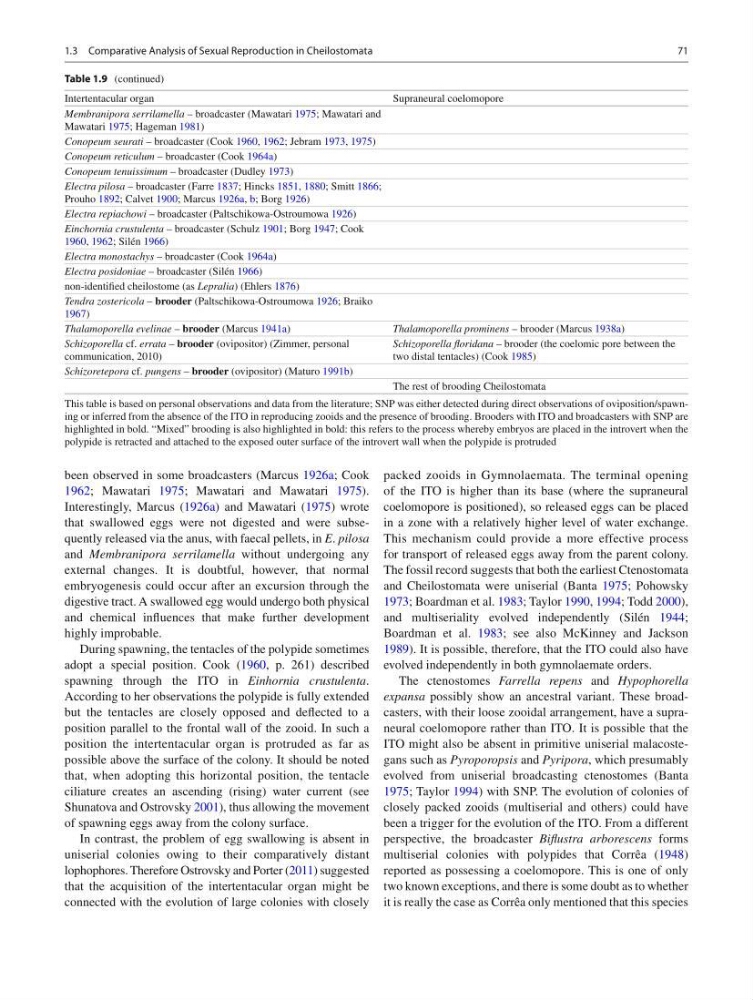
Intertentacular organ
Supraneural coelomopore
Membranipora serrilamella – broadcaster (Mawatari 1975 ; Mawatari and
Mawatari 1975 ; Hageman 1981 )
Conopeum seurati – broadcaster (Cook 1960 , 1962 ; Jebram 1973 , 1975 )
Conopeum reticulum – broadcaster (Cook 1964a )
Conopeum tenuissimum – broadcaster (Dudley 1973 )
Electra pilosa – broadcaster (Farre 1837 ; Hincks 1851 , 1880 ; Smitt 1866 ;
Prouho 1892 ; Calvet 1900 ; Marcus 1926a , b ; Borg 1926 )
Electra repiachowi – broadcaster (Paltschikowa-Ostroumowa 1926 )
Einchornia crustulenta – broadcaster (Schulz 1901 ; Borg 1947 ; Cook
1960 , 1962 ; Silén 1966 )
Electra monostachys – broadcaster (Cook 1964a )
Electra posidoniae – broadcaster (Silén 1966 )
non-identifi ed cheilostome (as Lepralia ) (Ehlers 1876 )
Tendra zostericola – brooder (Paltschikowa-Ostroumowa 1926 ; Braiko
1967 )
Thalamoporella evelinae – brooder (Marcus 1941a )
Thalamoporella prominens – brooder (Marcus 1938a )
Schizoporella cf. errata – brooder (ovipositor) (Zimmer, personal
communication, 2010)
Schizoporella fl oridana – brooder (the coelomic pore between the
two distal tentacles) (Cook 1985 )
Schizoretepora cf. pungens – brooder (ovipositor) (Maturo 1991b )
The rest of brooding Cheilostomata
This table is based on personal observations and data from the literature; SNP was either detected during direct observations of oviposition/spawning or inferred from the absence of the ITO in reproducing zooids and the presence of brooding. Brooders with ITO and broadcasters with SNP are
highlighted in bold. “Mixed” brooding is also highlighted in bold: this refers to the process whereby embryos are placed in the introvert when the
polypide is retracted and attached to the exposed outer surface of the introvert wall when the polypide is protruded
Table 1.9 (continued)
1.3 Comparative Analysis of Sexual Reproduction in Cheilostomata
been observed in some broadcasters (Marcus 1926a ; Cook
1962 ; Mawatari 1975 ; Mawatari and Mawatari 1975 ).
Interestingly, Marcus ( 1926a ) and Mawatari ( 1975 ) wrote
that swallowed eggs were not digested and were subsequently released via the anus, with faecal pellets, in E . pilosa
and Membranipora serrilamella without undergoing any
external changes. It is doubtful, however, that normal
embryogenesis could occur after an excursion through the
digestive tract. A swallowed egg would undergo both physical
and chemical infl uences that make further development
highly improbable.
During spawning, the tentacles of the polypide sometimes
adopt a special position. Cook ( 1960 , p. 261) described
spawning through the ITO in Einhornia crustulenta .
According to her observations the polypide is fully extended
but the tentacles are closely opposed and defl ected to a
position parallel to the frontal wall of the zooid. In such a
position the intertentacular organ is protruded as far as
possible above the surface of the colony. It should be noted
that, when adopting this horizontal position, the tentacle
ciliature creates an ascending (rising) water current (see
Shunatova and Ostrovsky 2001 ), thus allowing the movement
of spawning eggs away from the colony surface.
In contrast, the problem of egg swallowing is absent in
uniserial colonies owing to their comparatively distant
lophophores. Therefore Ostrovsky and Porter ( 2011 ) suggested
that the acquisition of the intertentacular organ might be
connected with the evolution of large colonies with closely
packed zooids in Gymnolaemata. The terminal opening
of the ITO is higher than its base (where the supraneural
coelomopore is positioned), so released eggs can be placed
in a zone with a relatively higher level of water exchange.
This mechanism could provide a more effective process
for transport of released eggs away from the parent colony.
The fossil record suggests that both the earliest Ctenostomata
and Cheilostomata were uniserial (Banta 1975 ; Pohowsky
1973 ; Boardman et al. 1983 ; Taylor 1990 , 1994 ; Todd 2000 ),
and multiseriality evolved independently (Silén 1944 ;
Boardman et al. 1983 ; see also McKinney and Jackson
1989 ). It is possible, therefore, that the ITO could also have
evolved independently in both gymnolaemate orders.
The ctenostomes Farrella repens and Hypophorella
expansa possibly show an ancestral variant. These broadcasters, with their loose zooidal arrangement, have a supraneural coelomopore rather than ITO. It is possible that the
ITO might also be absent in primitive uniserial malacostegans such as Pyroporopsis and Pyripora , which presumably
evolved from uniserial broadcasting ctenostomes (Banta
1975 ; Taylor 1994 ) with SNP. The evolution of colonies of
closely packed zooids (multiserial and others) could have
been a trigger for the evolution of the ITO. From a different
perspective, the broadcaster Bifl ustra arborescens forms
multiserial colonies with polypides that Corrêa ( 1948 )
reported as possessing a coelomopore. This is one of only
two known exceptions, and there is some doubt as to whether
it is really the case as Corrêa only mentioned that this species
Intertentacular organ
Supraneural coelomopore
Membranipora serrilamella – broadcaster (Mawatari 1975 ; Mawatari and
Mawatari 1975 ; Hageman 1981 )
Conopeum seurati – broadcaster (Cook 1960 , 1962 ; Jebram 1973 , 1975 )
Conopeum reticulum – broadcaster (Cook 1964a )
Conopeum tenuissimum – broadcaster (Dudley 1973 )
Electra pilosa – broadcaster (Farre 1837 ; Hincks 1851 , 1880 ; Smitt 1866 ;
Prouho 1892 ; Calvet 1900 ; Marcus 1926a , b ; Borg 1926 )
Electra repiachowi – broadcaster (Paltschikowa-Ostroumowa 1926 )
Einchornia crustulenta – broadcaster (Schulz 1901 ; Borg 1947 ; Cook
1960 , 1962 ; Silén 1966 )
Electra monostachys – broadcaster (Cook 1964a )
Electra posidoniae – broadcaster (Silén 1966 )
non-identifi ed cheilostome (as Lepralia ) (Ehlers 1876 )
Tendra zostericola – brooder (Paltschikowa-Ostroumowa 1926 ; Braiko
1967 )
Thalamoporella evelinae – brooder (Marcus 1941a )
Thalamoporella prominens – brooder (Marcus 1938a )
Schizoporella cf. errata – brooder (ovipositor) (Zimmer, personal
communication, 2010)
Schizoporella fl oridana – brooder (the coelomic pore between the
two distal tentacles) (Cook 1985 )
Schizoretepora cf. pungens – brooder (ovipositor) (Maturo 1991b )
The rest of brooding Cheilostomata
This table is based on personal observations and data from the literature; SNP was either detected during direct observations of oviposition/spawning or inferred from the absence of the ITO in reproducing zooids and the presence of brooding. Brooders with ITO and broadcasters with SNP are
highlighted in bold. “Mixed” brooding is also highlighted in bold: this refers to the process whereby embryos are placed in the introvert when the
polypide is retracted and attached to the exposed outer surface of the introvert wall when the polypide is protruded
Table 1.9 (continued)
1.3 Comparative Analysis of Sexual Reproduction in Cheilostomata