

Blood
Filtrate
Nc"
K+
cr
H 2C0 31
W.HC0 3
Glucose
Water
~O+C~ _ _
CA ~2C0:l- rProximal
Tubule
HCO J
Collecting
Duct
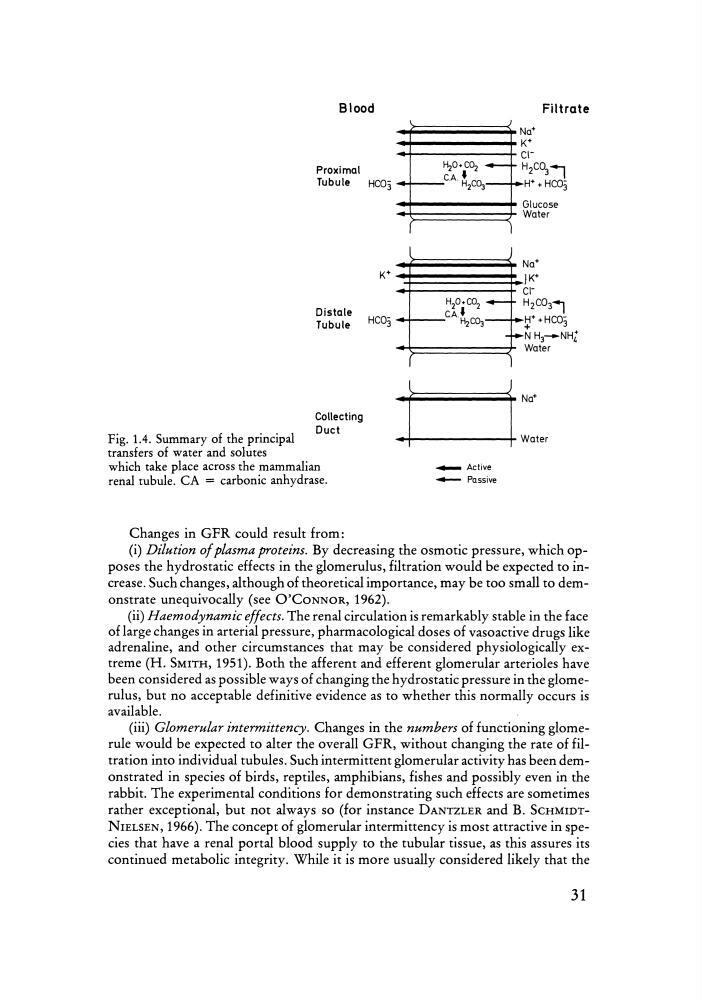
Fig. 1.4. Summary of the principal
transfers of water and solutes
which take place across the mammalian
renal tubule. CA = carbonic anhydrase.
~I-------+ Water
_
Active
- - Passive
Changes in GFR could result from:
(i) Dilution ofplasma proteins. By decreasing the osmotic pressure, which opposes the hydrostatic effects in the glomerulus, filtration would be expected to increase. Such changes, although of theoretical importance, may be too small to demonstrate unequivocally (see O'CONNOR, 1962).
(ii) H aemodynamic effects. The renal circulation is remarkably stable in the face
of large changes in arterial pressure, pharmacological doses of vasoactive drugs like
adrenaline, and other circumstances that may be considered physiologically extreme (H. SMITH, 1951). Both the afferent and efferent glomerular arterioles have
been considered as possible ways of changing the hydrostatic pressure in the glomerulus, but no acceptable definitive evidence as to whether this normally occurs is
available.
(iii) Glomerular intermittency. Changes in the numbers of functioning glomerule would be expected to alter the overall GFR, without changing the rate of filtration into individual tubules. Such intermittent glomerular activity has been demonstrated in species of birds, reptiles, amphibians, fishes and possibly even in the
rabbit. The experimental conditions for demonstrating such effects are sometimes
rather exceptional, but not always so (for instance DANTZLER and B. SCHMIDTNIELSEN, 1966). The concept of glomerular intermittency is most attractive in species that have a renal portal blood supply to the tubular tissue, as this assures its
continued metabolic integrity. While it is more usually considered likely that the
31
Filtrate
Nc"
K+
cr
H 2C0 31
W.HC0 3
Glucose
Water
~O+C~ _ _
CA ~2C0:l- rProximal
Tubule
HCO J
Collecting
Duct
Fig. 1.4. Summary of the principal
transfers of water and solutes
which take place across the mammalian
renal tubule. CA = carbonic anhydrase.
~I-------+ Water
_
Active
- - Passive
Changes in GFR could result from:
(i) Dilution ofplasma proteins. By decreasing the osmotic pressure, which opposes the hydrostatic effects in the glomerulus, filtration would be expected to increase. Such changes, although of theoretical importance, may be too small to demonstrate unequivocally (see O'CONNOR, 1962).
(ii) H aemodynamic effects. The renal circulation is remarkably stable in the face
of large changes in arterial pressure, pharmacological doses of vasoactive drugs like
adrenaline, and other circumstances that may be considered physiologically extreme (H. SMITH, 1951). Both the afferent and efferent glomerular arterioles have
been considered as possible ways of changing the hydrostatic pressure in the glomerulus, but no acceptable definitive evidence as to whether this normally occurs is
available.
(iii) Glomerular intermittency. Changes in the numbers of functioning glomerule would be expected to alter the overall GFR, without changing the rate of filtration into individual tubules. Such intermittent glomerular activity has been demonstrated in species of birds, reptiles, amphibians, fishes and possibly even in the
rabbit. The experimental conditions for demonstrating such effects are sometimes
rather exceptional, but not always so (for instance DANTZLER and B. SCHMIDTNIELSEN, 1966). The concept of glomerular intermittency is most attractive in species that have a renal portal blood supply to the tubular tissue, as this assures its
continued metabolic integrity. While it is more usually considered likely that the
31