

BOWMAN'S capsule, but this is reduced in size, or absent, in other groups of vertebrates (MARSHALL, 1934). The initial segment (proximal tubule) is lined with epithelial cells which have a brush border. In birds and mammals this is followed by
a thin section (thin loop of HENLE) which is lined with flattened epithelial cells.
In other vertebrates, a small 'intermediate' segment is often present (MARSHALL,
1934) but not invariably so, as shown among reptiles (BENTLEY, 1959b) and the
Amphibia (DAWSON, 1951). The posterior portion of the nephron (distal tubule)
runs into the urinary collecting ducts, which proceed to empty into the ureter. The
total length of the nephron varies considerably, both within a single kidney and,
characteristically, in different species (SPERBER, 1944).
In birds and mammals the loops of HENLE run vertically from the periphery
of the kidney (cortex), down through the medulla towards the renal papilla, where
Cortex
-------- JOO
Outer Zone
of Medulla '00
600
eoo
eoo
600
Inner Zone
of Medulla
Transport
Aclive Passive
_
Q Sodium
::: > Urea
Waler
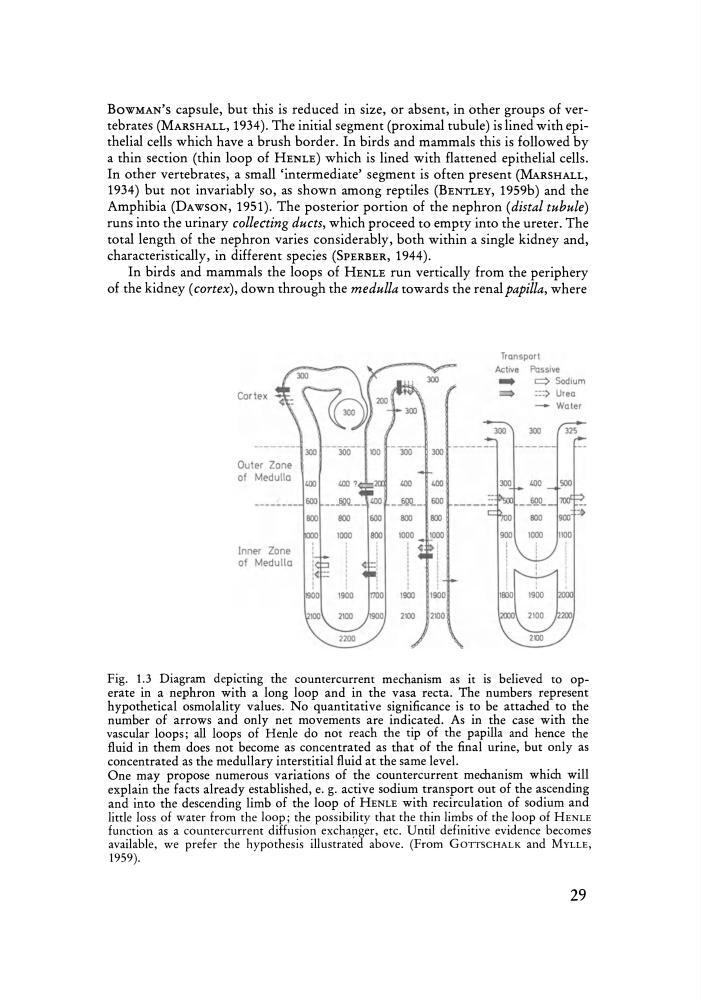
Fig. 1.3 Diagram depicting the countercurrent mechanism as it is believed to operate in a nephron with a long loop and in the vasa recta. The numbers represent
hypothetical osmolality values. No quantitative significance is to be attached to the
number of arrows and only net movements are indicated. As in the case with the
vascular loops; all loops of Henle do not reach the tip of the papilla and hence the
fluid in them does not become as concentrated as that of the final urine, but only as
concentrated as the medullary interstitial fluid at the same level.
One may propose numerous variations of the countercurrent mechanism which will
explain the facts already established, e. g. active sodium transport out of the ascending
and into the descending limb of the loop of HENLE with recirculation of sodium and
little loss of water from the loop ; the possibility that the thin limbs of the loop of HENLE
function as a countercurrent diffusion exchanger, etc. Until definitive evidence becomes
available, we prefer the hypothesis illustrated above. (From GOTTSCHALK and MYLLE,
1959).
29
a thin section (thin loop of HENLE) which is lined with flattened epithelial cells.
In other vertebrates, a small 'intermediate' segment is often present (MARSHALL,
1934) but not invariably so, as shown among reptiles (BENTLEY, 1959b) and the
Amphibia (DAWSON, 1951). The posterior portion of the nephron (distal tubule)
runs into the urinary collecting ducts, which proceed to empty into the ureter. The
total length of the nephron varies considerably, both within a single kidney and,
characteristically, in different species (SPERBER, 1944).
In birds and mammals the loops of HENLE run vertically from the periphery
of the kidney (cortex), down through the medulla towards the renal papilla, where
Cortex
-------- JOO
Outer Zone
of Medulla '00
600
eoo
eoo
600
Inner Zone
of Medulla
Transport
Aclive Passive
_
Q Sodium
::: > Urea
Waler
Fig. 1.3 Diagram depicting the countercurrent mechanism as it is believed to operate in a nephron with a long loop and in the vasa recta. The numbers represent
hypothetical osmolality values. No quantitative significance is to be attached to the
number of arrows and only net movements are indicated. As in the case with the
vascular loops; all loops of Henle do not reach the tip of the papilla and hence the
fluid in them does not become as concentrated as that of the final urine, but only as
concentrated as the medullary interstitial fluid at the same level.
One may propose numerous variations of the countercurrent mechanism which will
explain the facts already established, e. g. active sodium transport out of the ascending
and into the descending limb of the loop of HENLE with recirculation of sodium and
little loss of water from the loop ; the possibility that the thin limbs of the loop of HENLE
function as a countercurrent diffusion exchanger, etc. Until definitive evidence becomes
available, we prefer the hypothesis illustrated above. (From GOTTSCHALK and MYLLE,
1959).
29